Chain Section vs Flight Section in a Feeder Breaker Chain
Understand chain sections and flight sections in feeder breaker scraper chains, how each assembly is identified, inspected, photographed, and specified.
Engineering GuideUpdated 9月 16, 2026
Feeder breaker chain discussions often use “link,” “chain section,” “flight,” “scraper,” and “flight section” as if they were interchangeable. That shorthand may be harmless in a familiar maintenance crew, but it creates ambiguity as soon as the enquiry leaves the site. A supplier may interpret “one flight section” as the complete scraper assembly while a technician meant only the scraper plate. An RFQ may ask for a “chain section” without showing whether the attachment link and pins are included.
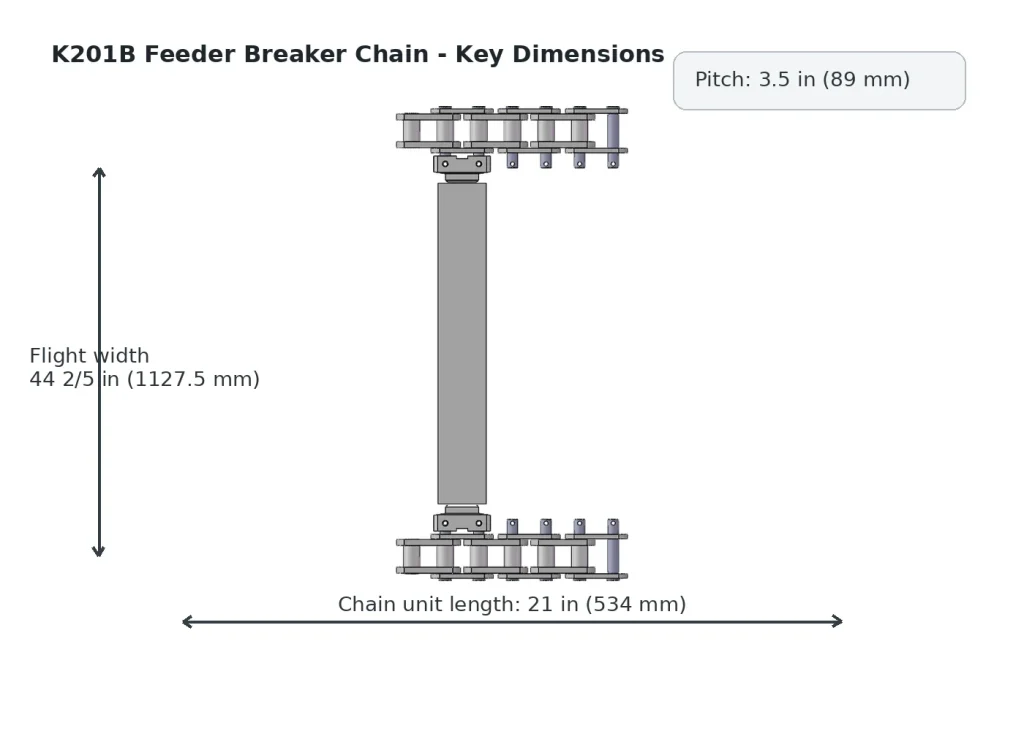
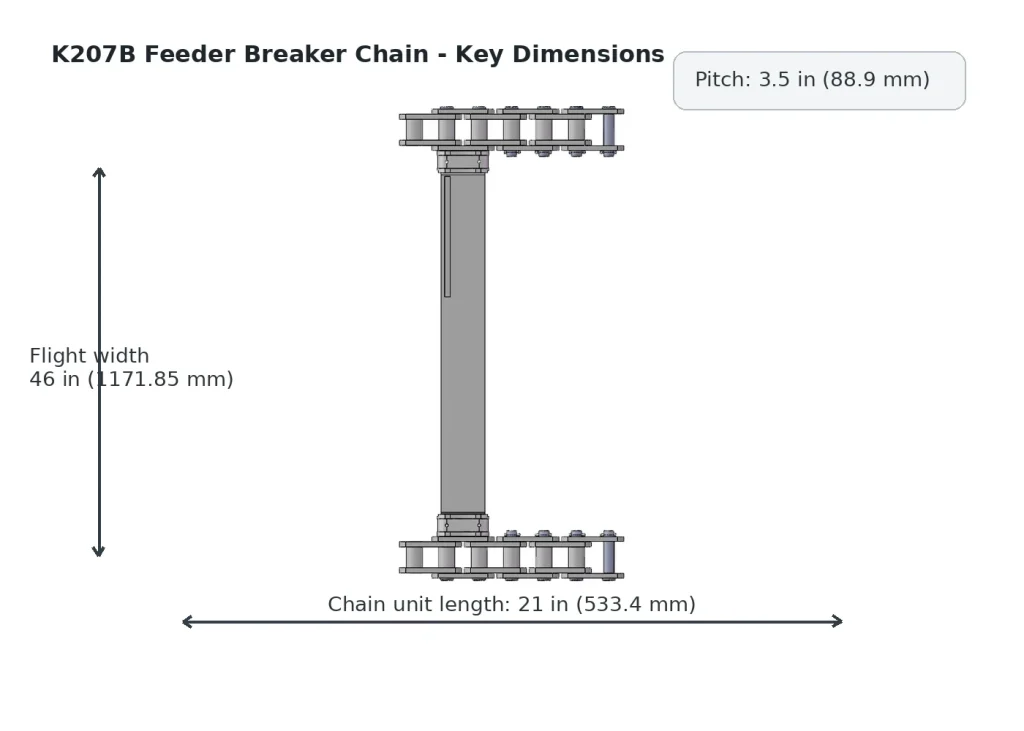
The listed K201B and K207B configurations provide a useful vocabulary. Both are described as repeating units made from one Flight Section and two Chain Sections. Their component trees then break those assemblies into named links, plates, bushes, pins, scraper heads, scraper plates, and model-specific attachment details. The hierarchy shows why an assembly term is not the same as a single component name.
This article uses those listed models as examples, not as proof that every feeder breaker chain in the market is built in exactly the same way. When the installed chain differs, preserve the actual geometry and use the terminology as a communication aid rather than forcing an unknown chain into a K201B or K207B structure.
Chain Section
The portion of the repeating assembly that carries the articulated chain structure between flight locations.
Flight Section
The assembly position where the conveying scraper or flight is integrated with the chain configuration.
Component Level
Plates, pins, bushes, scraper parts, retention parts, and special attachment links sit below those assembly-level terms.
1. Think in Assembly Levels Before Naming the Part
A practical way to remove ambiguity is to describe the chain in levels. At the top is the complete repeating chain unit. Inside that unit are assembly-level sections such as Chain Section and Flight Section. Inside those sections are individual links and components. A report becomes clearer when it states the level: “damage in the Flight Section,” followed by “cracked scraper plate,” is more precise than “flight broken.”
The distinction also helps purchasing. If the site needs a complete repeating unit, the RFQ should not be built from a list of tertiary part names copied from a drawing. Conversely, if engineering is investigating one damaged pin, asking for a full chain without showing the local component may hide the actual problem. Assembly hierarchy keeps the scope visible.
2. What the listed K201B Chain Section Contains
K201B identifies K201B01 as the Chain Section, with K201B02 as Outer Link and K201B03 as Inner Link at the secondary-component level. Its tertiary-component list includes Outer Plate, Inner Plate, Bush, Pin, Locating Bush, and Spring Pin. These names describe the articulated joint structure that forms the chain portion of the repeating unit.
During inspection, photograph the Chain Section with enough neighboring geometry to show how it sits between flights. Then add close-ups of the joint, pin/bush area, plates, and retention features. If an installed chain uses a different locking or retention arrangement, that difference is identification evidence and should remain visible in the RFQ.
Chain Section
An assembly-level portion of the articulated chain between or around flight locations.
Flight Section
The assembly-level position integrating the material-moving flight or scraper with the chain.
Secondary component
A named subassembly or link grouping below the complete chain unit in the listed product tree.
Tertiary component
An individual plate, pin, bush, scraper part, or retention element named within a documented subassembly.
K201B04 is documented as the Flight Section. At the tertiary level, K201B007 is Scraper Head and K201B008 is Scraper Plate. Those scraper components are the visible material-handling part of the unit, but the Flight Section should be understood as the assembly location and relationship, not merely the plate that contacts material.
That difference matters when damage is reported. “Scraper plate worn” identifies one visible component condition. “Flight Section distorted” suggests the reviewer should also examine the attachment, adjacent chain geometry, scraper head, pins, and alignment. The words therefore guide the inspection scope as well as the quotation scope.
4. K207B Uses the Same Assembly Concept with Different Structural Details
K207B also documents a Chain Section and Flight Section, but its secondary tree contains an additional Scraper Outer Link. The tertiary components include Outer Plate A, Outer Plate B, Inner Plate, Bush, Pin, Extended Pin, T-Pin, Scraper Head, and Scraper Plate. These details create a configuration fingerprint that is different from K201B even though the two models share nominal pitch and a 21 inch repeating unit.
For remote identification, the Scraper Outer Link and Extended Pin are therefore useful photographic targets on a suspected K207B chain. Their presence should not be assumed from pitch. Equally, an unfamiliar extended pin on another chain should not automatically be labelled K207B; the rest of the repeating unit must agree.
Assembly-level terminology for feeder breaker chain records
Scraper Outer Link / Extended Pin / T-Pin in component tree
Close-up and location within the repeating unit
Scraper components
Scraper Head + Scraper Plate
Scraper Head + Scraper Plate
Condition, dimensions if needed, interface photos
Record rule
Use the assembly level to define quotation scope, then use component names to describe the geometry or condition inside that scope.
5. Use Section Language to Describe Damage Location
A good maintenance note locates the condition at both assembly and component level. For example: “right strand, Flight Section at station mark F17, scraper plate edge loss and visible deformation near attachment; adjacent Chain Section joints photographed.” That sentence is more actionable than “chain worn” because it tells the next reviewer where to look and what supporting areas were checked.
For joint-related problems, the same structure works in reverse: “Chain Section at repeat 12, pin/bush articulation shows abnormal condition; neighboring Flight Sections visually intact.” The language keeps local damage from being generalized to the entire chain and helps engineering decide whether to request a sample, dimension, or wider inspection.
6. Photograph the Two Section Types Differently
For a Chain Section, prioritize the articulated path: link plates, pin/bush relationship, retention, and the section’s connection to the neighboring flight assembly. Shoot perpendicular views where plate shape matters and an oblique view where pin projection or bush depth needs to be understood. Include a ruler only when the photograph supports a named dimension.
For a Flight Section, capture the complete scraper width, the attachment to both strands, the scraper head/plate relationship, and any extended pin or special link that transfers the flight load. A wide view establishes orientation; detail views show the interface. Do not crop so tightly that a reviewer cannot tell whether the photographed part belongs to the flight or to an ordinary chain section.
7. Do Not Confuse Terminology with Supply Scope
A component tree can show that a Scraper Plate, Pin, Bush, or Outer Plate exists as a named design element. It does not automatically prove that the component is stocked, sold individually, or suitable for field replacement as a standalone item. Supply scope depends on the controlled product and quotation.
When an RFQ asks for one component, include the full chain model if known, the assembly level where the part belongs, photographs, dimensions, quantity, and the surrounding condition. Engineering can then determine whether component-level supply is appropriate or whether the replacement should be quoted as a larger section or complete chain assembly.
8. Connect Section Terminology to Dimensions
Assembly language becomes even more useful when tied to measured geometry. Pitch describes the repeated articulation. Unit length describes the repeating assembly. Scraper width describes the conveying element. Flight spacing describes where the Flight Sections recur along the chain. Together, those values explain both the chain path and the conveying pattern.
For the verified examples, K201B and K207B each use one Flight Section and two Chain Sections in a documented 21 inch unit. Their scraper widths differ, and their component trees differ. A dimensional record that uses the section terminology can therefore be compared directly with the model structure instead of relying on generic phrases such as “link spacing” or “bar distance.”
9. Build an RFQ That Identifies the Required Level
Start the line item with the highest confirmed level: complete feeder breaker chain, repeating unit, Chain Section, Flight Section, or named component. Add the model only if it is supported. Then give the quantity, drawing or photo reference, dimensions relevant to that level, and the reason for replacement. If the required scope is uncertain, write “engineering review requested” instead of choosing a part number from the component tree.
This method also makes quotations easier to compare. Two suppliers may otherwise quote different scopes against the same phrase “flight assembly.” A controlled RFQ states what the site believes it needs and shows the evidence, allowing each quotation to confirm or challenge that scope explicitly.
Use this handoff checklist to close the field record for Chain Section vs Flight Section in a Feeder Breaker Chain. The goal is not to create another generic maintenance form. It is to preserve the specific observations, reference points and machine context that the next reviewer needs in order to understand how the result was obtained. Keep machine-specific acceptance limits under the approved drawing, maintenance procedure or engineering instruction rather than inventing a universal web value.
Checkpoint
What to record
How the record is used
Think in Assembly Levels Before Naming the Part
Record the exact machine location, strand or side, current operating/shutdown state, and the observation that relates to think in assembly levels before naming the part. Include a photograph that lets another reviewer find the same area.
Establishes the context so later measurements are not detached from the machine and chain position.
What the listed K201B Chain Section Contains
Capture the physical reference used for what the listed k201b chain section contains. Keep the raw dimension, image or marking beside the interpretation, and note any wear, repair, build-up or access limitation that could affect the reading.
Makes the result repeatable and prevents a damaged or poorly defined reference from becoming the replacement requirement.
What the K201B Flight Section Adds
Cross-check what the k201b flight section adds against any controlled drawing, previous purchase reference or retained spare that is available. Keep current field data and historical information in separate fields when they differ.
Preserves traceability when field condition, historical records and nominal product information do not agree perfectly.
K207B Uses the Same Assembly Concept with Different Structural Details
For k207b uses the same assembly concept with different structural details, state what is confirmed, what is only observed, and what still needs engineering confirmation. Attach the image or measurement that supports the statement rather than relying on a product name alone.
Gives maintenance, purchasing and the supplier a clear list of what can be acted on now and what must be resolved before release.
Separate as-found condition from required replacement geometry. A worn, repaired, dirty or partially dismantled component may still be very useful for identification, but its current shape is not automatically the manufacturing requirement. Label field measurements as observed data, retain the original unit and measurement method, and identify any feature that may have been altered by service. For chain section vs flight section, photographs should show the measurement endpoints or component relationship clearly enough that a remote reviewer can reproduce the logic.
Resolve conflicting information instead of hiding it. If a drawing, old order, marking and current measurement point in different directions, keep each source visible and describe the conflict. Do not average values or silently choose the most convenient one. Use additional photographs, measurements from another intact repeating unit, machine interface information and the controlled document revision to determine which value governs. If build an rfq that identifies the required level cannot be confirmed during the shutdown, state that limitation explicitly so the open question survives the handoff.
Make the next action obvious for Chain Section vs Flight Section in a Feeder Breaker Chain. The completed record should tell maintenance what should be rechecked, tell purchasing what information belongs in the RFQ, and tell engineering which dimensions or interfaces still need approval. Before the machine returns to service, confirm that the file set includes an overall machine view, a complete repeating chain/flight view, close-ups of relevant components or markings, and the dimensions used in this guide. For chain section vs flight section, a traceable set of observations is more useful than a long narrative with no datum, and it reduces the risk that a replacement decision is made from pitch, appearance or an old part number alone.
Questions to Resolve Before the Next Decision
Is a Flight Section the same as a scraper plate?
No. In the listed K201B and K207B structures, the scraper plate is an individual component within the broader flight-related assembly. Use the assembly term and component term separately.
Does a named component mean it can be purchased separately?
Not necessarily. The component tree describes structure. Availability, field replaceability, and supply scope must be confirmed in the quotation.
Why do K201B and K207B need separate component records if the broad section names are the same?
Because their detailed structures differ. K207B, for example, documents a Scraper Outer Link and Extended Pin that are not presented in the same way in the K201B component tree.
How should an unknown chain be described if its structure does not match either model?
Describe what is physically present, use photographs and dimensions, and keep the model unconfirmed. The terminology can organize the evidence without forcing the unknown chain into a standard structure.
Next Step: Close the Technical Record
Chain Section and Flight Section are useful because they describe different functional parts of the repeating feeder breaker chain assembly. Once the assembly level is clear, individual component names can be used without confusing a scraper plate with a complete flight or a pin with a complete chain section.
Use that hierarchy in inspection logs, photographs, drawings, and RFQs. It makes model comparison easier, keeps damage descriptions local and specific, and gives engineering a clearer basis for deciding whether the correct supply scope is a component, section, repeating unit, or complete chain.