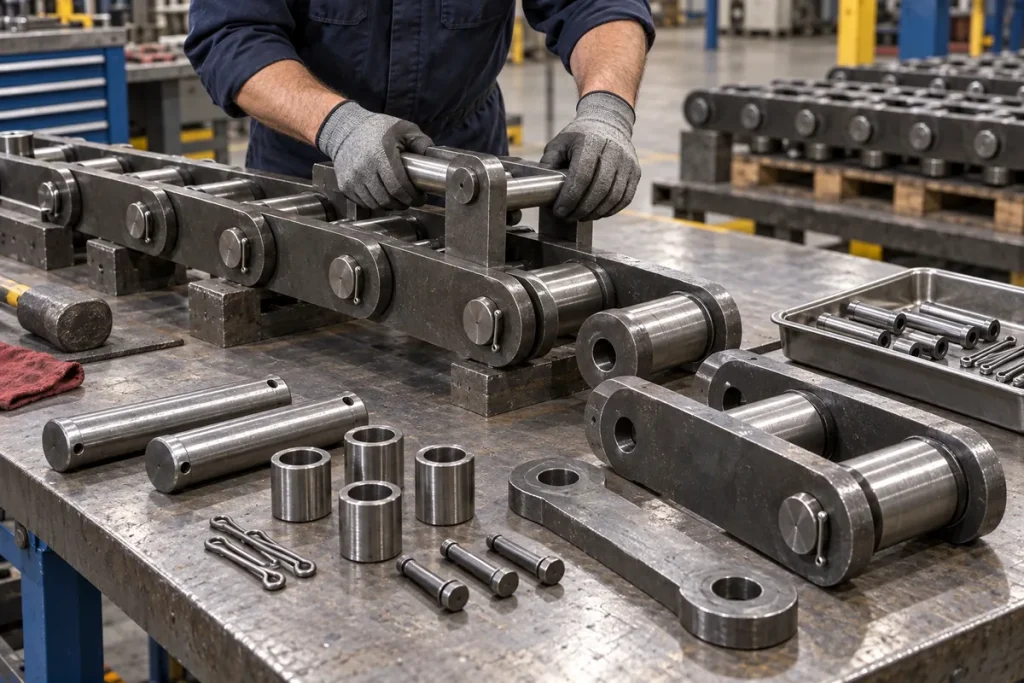
Как записывать историю регулировки цепи прерывателя подачи для более точной диагностики
Создайте историю корректировок цепи питания, которая связывает каждое изменение с измерениями, симптомами, условиями эксплуатации и проверкой после корректировки.
Engineering GuideUpdated Сентябрь 16, 2026
A maintenance note that says “chain tightened” is usually too weak for later diagnosis. It does not say which strand was adjusted, why the change was made, what the starting condition was, how much the mechanism moved, whether the adjustment was symmetrical, or whether the operating symptom improved. After several events, the team is left with activity history but little engineering evidence.
A feeder breaker chain adjustment history should be chronological and measurement-based. Each event needs the reason for adjustment, the safe machine state, observed chain condition, adjustment reference, amount or position change using the machine-defined method, and the verification completed afterward. The same record should also capture when no adjustment was made because another defect required attention first.
The history is not a substitute for the machine manual. This article does not prescribe a universal slack, take-up position, torque, or service interval. It shows how to document the approved adjustment process so repeated changes can be distinguished from normal planned maintenance and so diagnostic escalation has a reliable timeline.
Before
Record symptom, measured/observed chain condition, take-up references, side-to-side difference, and any visible damage before moving the adjustment.
Change
Record which mechanism was moved, the controlled reference used, direction and amount of change, and who authorized or performed it.
After
Record the same observation points after adjustment and again after the approved initial operating check.
1. Give Every Adjustment Event a Unique Record
Use a date/time plus work-order or inspection identifier so photographs and measurements can be attached to the correct event. Record machine identity and chain location exactly as the site system defines them.
If two shifts work on the same issue, keep the events linked but distinct. The handover should show what was changed on the first shift and what remained unresolved for the next team.
2. Record the Trigger Before Recording the Adjustment
State why the chain was inspected: planned check, visible slack change, tracking issue, abnormal noise, repeated trip, flight contact, new chain commissioning, or another observed condition. Describe the trigger without diagnosing the cause prematurely.
A trigger such as “drive-end noise increased during loaded operation” is more useful than “chain loose,” because the later review can test whether the adjustment actually affected the original symptom.
3. Capture the Pre-Adjustment Reference State
Record the chain position specified by the maintenance procedure, take-up or adjustment reference marks, visible side-to-side position, accessible engagement condition, and any approved chain measurement. Photograph the same reference points that will be used after the adjustment.
If material build-up, access, temperature state, or machine position affects the observation, record it. Trend data are meaningful only when future readers can understand how the starting state was established.
4. Describe the Adjustment in Machine Terms
Record the actual controlled action: which take-up or tensioning mechanism was moved, which side, direction, reference marks or measured displacement, and the procedure used. Do not translate an unfamiliar mechanism into a generic “turns of the bolt” rule unless the machine documentation defines that relationship.
If several small steps were used, preserve the sequence rather than reporting only the final position. A staged record can show when tracking or noise changed during the process.
For double-strand arrangements, record the references on both sides even when only one side is adjusted. A total take-up value without left/right context can hide a developing imbalance.
If the chain construction or machine arrangement requires coordinated movement, use the machine procedure for the target relationship. The log should preserve the measured relationship, not invent a universal symmetry tolerance.
6. Repeat the Same Observations After Adjustment
After the approved adjustment, repeat the pre-adjustment photos and measurements from the same reference points. Record flight clearance, chain tracking, seating, visible side contact, and other procedure-defined checks.
This before/after pairing is the core diagnostic value of the history. It shows whether the physical change produced the expected mechanical result before operating variables are introduced.
7. Add a Post-Run Verification Event
When the machine procedure calls for an initial run and recheck, create a separate post-run line rather than overwriting the after-adjustment result. Record load state if relevant, observations, and whether additional adjustment was required.
If the chain quickly returns to the original symptom, that recurrence becomes evidence for a broader inspection rather than an invitation to keep adjusting indefinitely.
Feeder breaker chain adjustment history fields
Field
Before adjustment
After / post-run
Trigger
Observed symptom or planned reason
Whether the trigger changed
Reference position
Take-up marks / controlled measurement
New position from same datum
Left/right or strand relation
Both sides recorded
Both sides re-recorded
Chain condition
Tracking, seating, flights, visible damage
Same observations repeated
Sprocket/guide context
Visible engagement and contact
Any change or persistent contact
Decision
Adjustment planned or held
Released, rechecked, adjusted again, escalated
Record rule
Use the machine procedure for the actual target setting and allowable adjustment range. The log records the event; it does not create the criterion.
8. Trend Adjustment Frequency Without Inventing an Interval
Sort the events chronologically and look at how often adjustment was required relative to operating hours, shifts, tonnage, or another site metric that is actually recorded. The purpose is to detect a change in behavior, not to compare the chain with an invented universal schedule.
A rising adjustment frequency should be reviewed together with chain wear measurements, sprocket condition, flight damage, guides, build-up, alignment, and loading history. The log provides the timing; inspection evidence determines the cause.
A useful log includes events where adjustment was considered but not performed. Record the reason: damaged component, uncertain chain identity, sprocket damage, unsafe access, missing criterion, adjustment already at a controlled limit, or engineering review required.
These entries protect the diagnostic history from a false impression that every inspection led to tension correction. They also show where maintenance correctly escalated a different problem.
Adjustment event
One controlled maintenance action with its own before, change, and after evidence.
Reference state
The machine position and measurement conditions used to compare one inspection with another.
Recurrence
Return of the same symptom or need for further adjustment after a prior correction.
No-adjustment decision
A documented choice not to adjust because another defect, limit, or missing criterion must be resolved first.
10. Turn the History into an Engineering Escalation Package
When repeated adjustment continues, attach the event table, representative before/after photographs, chain measurements, sprocket observations, relevant drawings, and the specific question requiring review. Highlight the first event where behavior changed rather than sending an unstructured folder of photos.
For replacement enquiries, include the adjustment trend as context but keep the replacement dimensions and product identification evidence separate. A history of frequent adjustment does not identify the correct chain model by itself.
Use this handoff checklist to close the field record for How to Record Feeder Breaker Chain Adjustment History for Better Diagnosis. The goal is not to create another generic maintenance form. It is to preserve the specific observations, reference points and machine context that the next reviewer needs in order to understand how the result was obtained. Keep machine-specific acceptance limits under the approved drawing, maintenance procedure or engineering instruction rather than inventing a universal web value.
Checkpoint
What to record
How the record is used
Give Every Adjustment Event a Unique Record
Record the exact machine location, strand or side, current operating/shutdown state, and the observation that relates to give every adjustment event a unique record. Include a photograph that lets another reviewer find the same area.
Establishes the context so later measurements are not detached from the machine and chain position.
Record the Trigger Before Recording the Adjustment
Capture the physical reference used for record the trigger before recording the adjustment. Keep the raw dimension, image or marking beside the interpretation, and note any wear, repair, build-up or access limitation that could affect the reading.
Makes the result repeatable and prevents a damaged or poorly defined reference from becoming the replacement requirement.
Capture the Pre-Adjustment Reference State
Cross-check capture the pre-adjustment reference state against any controlled drawing, previous purchase reference or retained spare that is available. Keep current field data and historical information in separate fields when they differ.
Preserves traceability when field condition, historical records and nominal product information do not agree perfectly.
Describe the Adjustment in Machine Terms
For describe the adjustment in machine terms, state what is confirmed, what is only observed, and what still needs engineering confirmation. Attach the image or measurement that supports the statement rather than relying on a product name alone.
Gives maintenance, purchasing and the supplier a clear list of what can be acted on now and what must be resolved before release.
Separate as-found condition from required replacement geometry. A worn, repaired, dirty or partially dismantled component may still be very useful for identification, but its current shape is not automatically the manufacturing requirement. Label field measurements as observed data, retain the original unit and measurement method, and identify any feature that may have been altered by service. For feeder breaker chain adjustment history, photographs should show the measurement endpoints or component relationship clearly enough that a remote reviewer can reproduce the logic.
Resolve conflicting information instead of hiding it. If a drawing, old order, marking and current measurement point in different directions, keep each source visible and describe the conflict. Do not average values or silently choose the most convenient one. Use additional photographs, measurements from another intact repeating unit, machine interface information and the controlled document revision to determine which value governs. If turn the history into an engineering escalation package cannot be confirmed during the shutdown, state that limitation explicitly so the open question survives the handoff.
Make the next action obvious for How to Record Feeder Breaker Chain Adjustment History for Better Diagnosis. The completed record should tell maintenance what should be rechecked, tell purchasing what information belongs in the RFQ, and tell engineering which dimensions or interfaces still need approval. Before the machine returns to service, confirm that the file set includes an overall machine view, a complete repeating chain/flight view, close-ups of relevant components or markings, and the dimensions used in this guide. For feeder breaker chain adjustment history, a traceable set of observations is more useful than a long narrative with no datum, and it reduces the risk that a replacement decision is made from pitch, appearance or an old part number alone.
Field Decision Notes for This Task
The inspection record for How to Record Feeder Breaker Chain Adjustment History for Better Diagnosis should be easy to use after the shutdown is over. The following three notes convert the article into a practical handoff without creating a machine-specific acceptance limit. They are especially useful when maintenance observations must be reviewed later by engineering or purchasing and the original chain is no longer accessible.
Confirm Give Every Adjustment Event a Unique Record
Start by identifying where and how the observation was made. Record the machine, chain side or strand, repeating unit or flight location, and the state of the chain when the check was performed. If the component was dirty, loaded, slack, removed, repaired or visibly deformed, keep that condition beside the reading. A photograph should include enough surrounding structure to let another person find the same location. For this article, the aim is to preserve the context behind give every adjustment event a unique record rather than to reduce it to an isolated number.
Cross-check Record the Trigger Before Recording the Adjustment
Use a second observation or controlled reference to challenge the first result. That may be a neighbouring intact repeating unit, another chain strand, a drawing revision, an earlier purchase record, or a retained spare part. Keep the original field value visible even when the comparison suggests a different nominal requirement. When the two do not agree, describe why the difference may exist and identify what must be confirmed next. This is particularly important for record the trigger before recording the adjustment, because service wear, measurement method and prior repair can affect the as-found condition.
Prepare Capture the Pre-Adjustment Reference State for review
Package the result so it can be checked remotely. Include the raw measurement or observation, its unit, reference faces or endpoints, at least one close photograph and one context photograph, and any drawing or marking used during identification. State whether the item is confirmed, candidate or unknown. If capture the pre-adjustment reference state depends on an assumption, write the open question in the RFQ instead of converting the assumption into a specification. The receiving reviewer should be able to understand the chain condition without reconstructing the method from memory.
Keep the decision boundary visible. Describe the Adjustment in Machine Terms may influence the next maintenance or sourcing step, but the website does not set a universal discard, tension or interchangeability limit. Use the equipment procedure, approved drawing and order-specific engineering requirements for acceptance decisions. The purpose of this record is to make the observation behind feeder breaker chain adjustment history traceable enough that the correct product or engineering route can be chosen without guessing.
Questions to Resolve Before the Next Decision
Should an adjustment history contain a universal target slack?
No. Record the target and method defined by the machine or approved maintenance procedure. Do not substitute a generic value from another conveyor.
Is the final take-up position enough?
No. The diagnostic value comes from the trigger, before state, change, after state, and post-run result.
What if adjustment marks are not readable?
Photograph the condition, establish another approved repeatable datum, and document the method change so later records remain interpretable.
When should repeated adjustment be escalated?
Escalate when the approved maintenance process indicates abnormal recurrence, when other defects appear, or when the reason for repeated change cannot be explained by the available product or field data.
Build a Timeline That Can Answer “What Changed?”
A feeder breaker chain adjustment history is most useful when every event can be reconstructed: what triggered the work, what the chain and mechanism looked like before, what moved, what the post-adjustment condition was, and whether the symptom returned. That chronology turns routine maintenance activity into evidence that supports troubleshooting and replacement planning.
Keep machine-specific settings under the control of the applicable manual, drawing, or engineering procedure. The history should make those criteria easier to apply, not replace them.