How to Photograph a Feeder Breaker Chain for Remote Identification
Photograph a feeder breaker chain for remote identification with context, repeating-unit views, joint details, dimensions, markings, and damage evidence.
Mühendislik KılavuzuGüncelleme tarihi: 16 Eylül 2026
Remote chain identification fails most often because the images are either too wide to show useful geometry or so close that the reviewer cannot tell what the part belongs to. A successful photo sequence solves both problems by moving from context to detail in a deliberate order. The machine view tells the application. The repeating-unit view shows the chain architecture. The joint and flight views show component details. Measurement and marking views add traceable evidence.
This is particularly important for K Series mining chains because feeder breaker, shuttle car, and bolter miner products can share broad visual characteristics while serving different equipment contexts. The site’s commercial scope is feeder breaker chain, so an enquiry must preserve enough application evidence to avoid routing a similar-looking chain into the wrong product family.
All photography must stay within the machine and site access rules. A clearer picture is never a reason to bypass guarding or stored-energy control. If the necessary angle cannot be obtained safely, use an approved drawing, removed sample, or previous controlled photograph to fill the evidence gap.
Wide first
Show the feeder breaker, chain path, strand/side, and direction or location reference before taking component close-ups.
Square for geometry
Use perpendicular views for plate shape, flight width, and repeating pattern; add oblique views for pin projection and attachment depth.
Pair every detail
A close-up of a marking, crack, pin, or scraper should be paired with a wider image proving where that detail is located.
1. Create an Orientation Image That Anchors the Entire Set
Take a wide photograph of the feeder breaker or accessible chain-conveyor section. Include fixed machine structure, both strands if visible, and a recognizable location such as inlet, discharge, take-up area, or a numbered maintenance marker. If the photograph does not show the whole machine, state the location in the filename and inspection sheet.
The orientation image is not expected to show pitch or component markings. Its purpose is traceability. Later, when a close-up shows an extended pin or unusual attachment, the reviewer can connect that detail to the correct side, chain path, and machine rather than treating it as an orphaned part photograph.
2. Capture One Complete Repeating Unit Nearly Perpendicular to the Chain
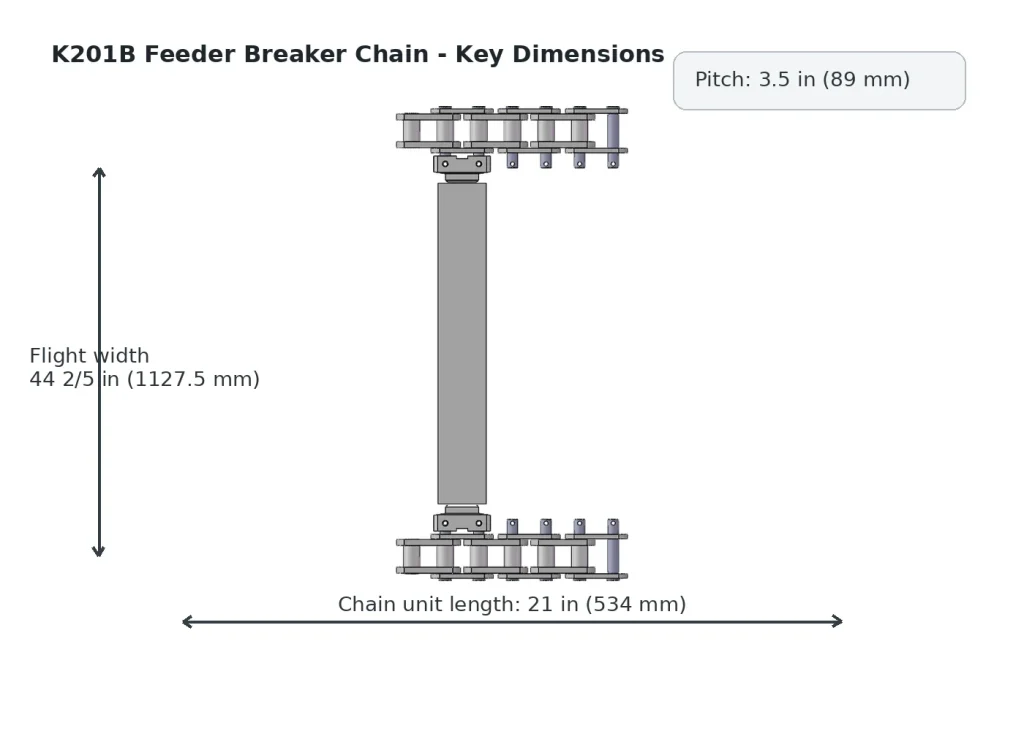
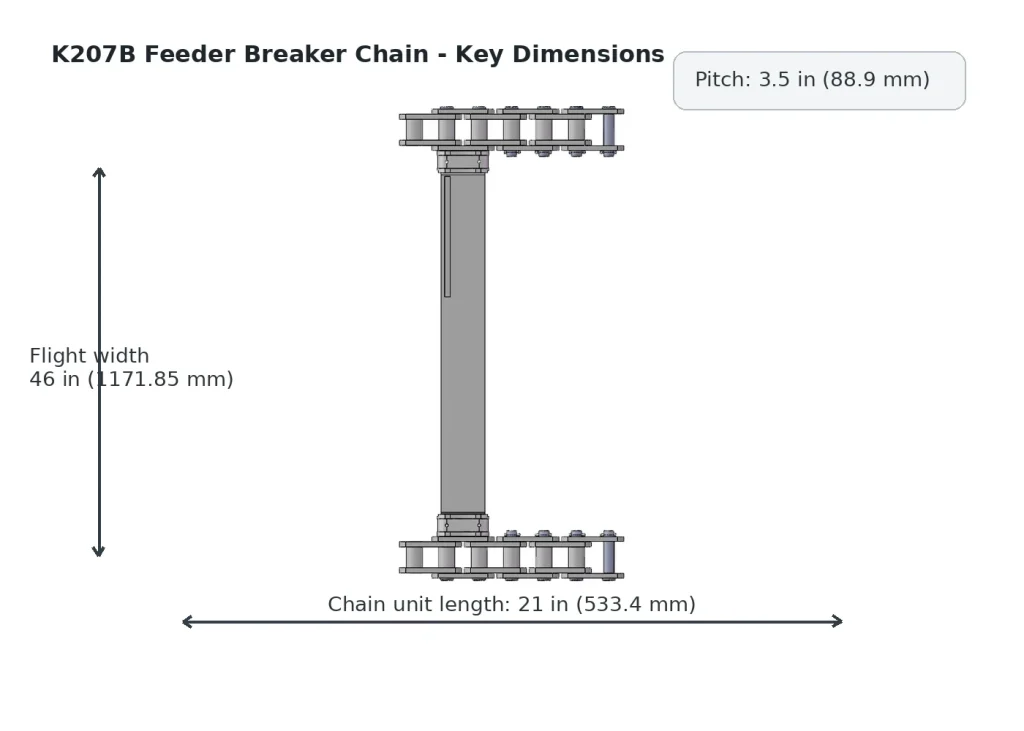
Move closer until the frame contains at least one complete structural repeat. For the listed K201B and K207B feeder breaker scraper chains, the unit is described as one Flight Section and two Chain Sections. The photograph should therefore show the flight and enough chain on both sides to understand that relationship.
Keep the camera as square to the chain plane as practical. Perspective makes one end of a flight appear wider and can distort apparent spacing. If the chain cannot be viewed squarely, take a second angle and note the limitation rather than using the perspective image as a dimensional reference.
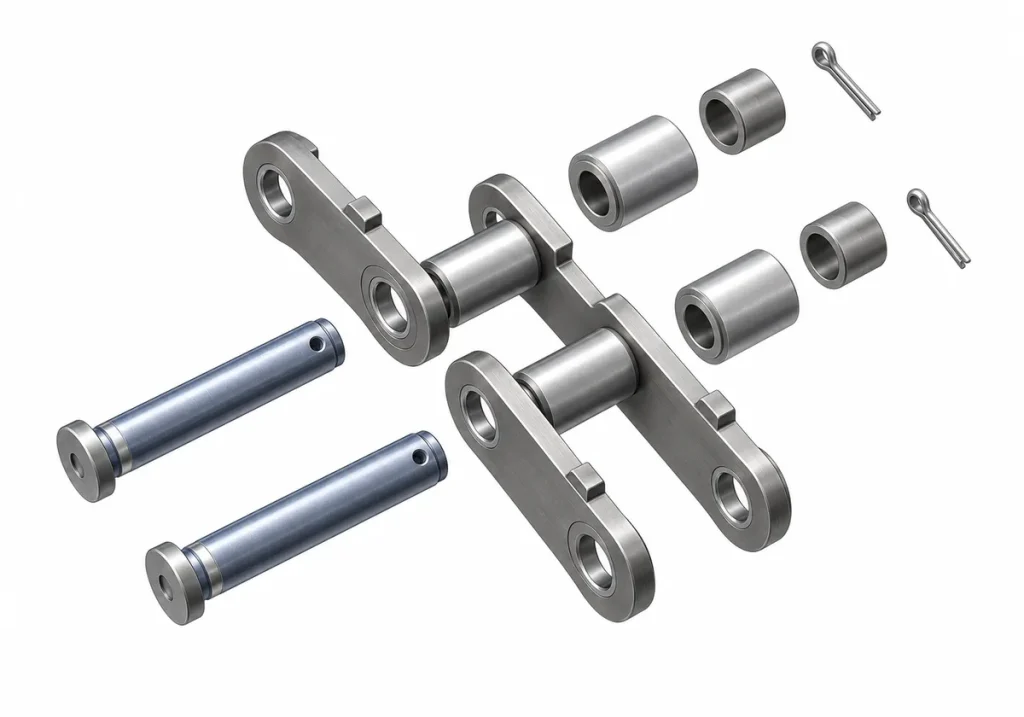
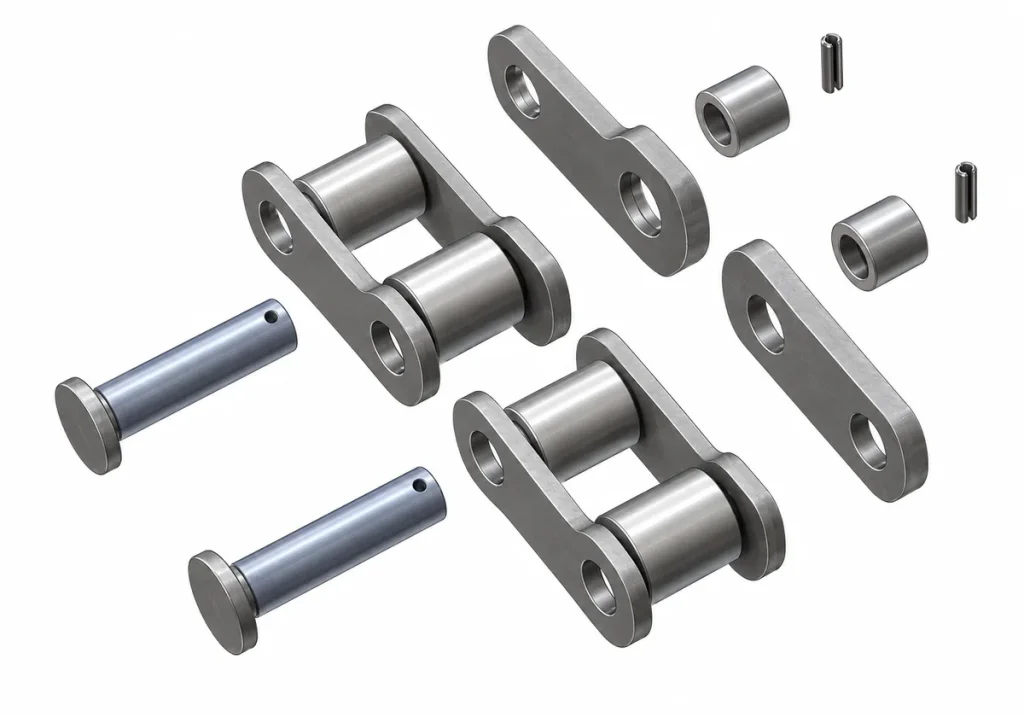
For the chain section, capture outer/inner link geometry, pin and bush areas, retention features, and any local plate shape that may distinguish the configuration. Use an oblique view to show pin projection or bush depth and a perpendicular view to show plate profile. Keep at least one neighboring link in frame.
On a suspected K207B, useful clues include the documented Scraper Outer Link, Extended Pin, and T-Pin. On a suspected K201B, the documented structure includes Locating Bush and Spring Pin details. These are supporting features, not standalone proof of model identity.
4. Photograph the Flight Section from Both Material and Chain Sides
The material-side view should show scraper width, edge shape, visible wear pattern, and the overall flight profile. The chain-side or oblique view should show how the flight attaches to both strands, including extended pins, attachment links, scraper head, scraper plate, or other visible connection geometry.
If the flight is damaged, photograph an intact flight as a comparison. The healthy reference can reveal whether a bent corner, missing plate, skewed head, or altered connection is a service condition rather than a normal design feature.
5. Add Measurement Photographs with Readable Reference Points
For pitch, unit length, scraper width, or flight spacing, place the measuring tool so the start and end features are visible. Photograph the tool and write the value separately in the measurement sheet. Do not depend on image pixels or perspective to derive a dimension later.
Where possible, include a second photo with no measuring tool obscuring the geometry. The measurement view proves endpoints; the clean geometry view helps the engineer see holes, pins, edges, and attachment relationships.
Take a close, sharply focused image of every readable model, component, machine, casting, or maintenance marking that may be relevant. Then step back and take another photograph showing exactly where the marking sits. A legible number without location context can be mistakenly attributed to the chain when it actually belongs to a nearby guard, spare, or machine component.
If several identifiers conflict, preserve all of them and state the physical location of each. Do not choose the one that best matches the desired replacement before geometry has been compared.
7. Photograph Damage as a Three-View Sequence
Use an overview of the repeating unit, a medium view of the affected component, and a close-up of the defect. Include a scale where it is safe and meaningful. This sequence lets the reviewer see both severity and structural context.
For wear, deformation, cracking, missing retention, or unusual polish, add a comparison view from a nearby healthy component if available. The comparison often clarifies whether the surface is abnormal without requiring a generic web-based reject limit.
Recommended remote-identification image sequence
Sequence
View
What the reviewer should learn
01
Machine/chain context
Equipment type, side/strand, chain path, general location
02
Complete repeating unit
Flight-to-chain pattern and overall architecture
03
Chain section perpendicular
Plate/link profile and articulation geometry
04
Joint oblique
Pin projection, bush and retention relationship
05
Flight material side
Scraper width, edge condition, flight profile
06
Flight chain side
Attachment link, pins and head/plate relationship
07
Measurement view
Defined endpoints and measuring tool position
08
Marking close + context
Readable identifier tied to a physical location
09
Damage overview/detail
Defect severity and relationship to surrounding assembly
Kayıt kuralı
Keep original photographs and a simple index so every detail image can be traced back to the machine and repeating-unit context.
8. Control Lighting, Focus, and Background Enough to Preserve Geometry
Use diffuse light or a work light at an angle to reveal stamped marks and surface detail without blowing out polished steel. Wipe the camera lens and stabilize the device against a safe fixed point when possible. Avoid digital zoom that turns pin edges into blocks and makes small cracks or markings impossible to assess.
Do not edit photographs in ways that change geometry or hide condition. Cropping and brightness correction can improve readability, but the engineering archive should retain the original files. If an annotated copy is used to show a measurement endpoint, store it beside the unannotated original.
9. Send the Images with an Index, Not as a Chat Stream
Rename the files or create an index that lists image ID, machine, chain side, component, and purpose. A remote engineer should be able to request “FB-L-07” and receive the exact scraper-attachment image rather than scrolling through a messaging thread.
Tie the index to the RFQ dimensions and open questions. For example, scraper width row W-02 can reference images FB-L-04 and FB-L-05. This creates a chain of evidence from number to photo to model decision and reduces repeated requests during a shutdown.
Orientation image
A wide view that identifies the machine and physical chain location.
Geometry image
A perpendicular or controlled-angle view used to compare shape and assembly relationships.
Evidence pair
A detail photograph plus a wider context photograph proving where the detail belongs.
Photo index
A list connecting image IDs with machine location, component, measurement, and RFQ question.
Bu devir teslim kontrol listesini kullanarak saha kaydını kapatın. How to Photograph a Feeder Breaker Chain for Remote IdentificationAmaç, başka bir genel bakım formu oluşturmak değil. Amaç, bir sonraki inceleyicinin sonucun nasıl elde edildiğini anlaması için ihtiyaç duyduğu özel gözlemleri, referans noktalarını ve makine bağlamını korumaktır. Evrensel bir değer icat etmek yerine, makineye özgü kabul limitlerini onaylanmış çizim, bakım prosedürü veya mühendislik talimatı altında tutmak gerekir.
Kontrol noktası
Ne kaydedilecek?
Kaydın nasıl kullanıldığı
Create an Orientation Image That Anchors the Entire Set
Record the exact machine location, strand or side, current operating/shutdown state, and the observation that relates to create an orientation image that anchors the entire set. Include a photograph that lets another reviewer find the same area.
Bu, daha sonraki ölçümlerin makine ve zincir konumundan bağımsız olmaması için bağlamı oluşturur.
Capture One Complete Repeating Unit Nearly Perpendicular to the Chain
Capture the physical reference used for capture one complete repeating unit nearly perpendicular to the chain. Keep the raw dimension, image or marking beside the interpretation, and note any wear, repair, build-up or access limitation that could affect the reading.
Sonucun tekrarlanabilir olmasını sağlar ve hasarlı veya kötü tanımlanmış bir referansın değiştirme gereksinimi haline gelmesini önler.
Photograph the Chain Section and Joint Details
Cross-check photograph the chain section and joint details against any controlled drawing, previous purchase reference or retained spare that is available. Keep current field data and historical information in separate fields when they differ.
Saha koşulları, geçmiş kayıtlar ve nominal ürün bilgileri tam olarak uyuşmadığında izlenebilirliği korur.
Photograph the Flight Section from Both Material and Chain Sides
For photograph the flight section from both material and chain sides, state what is confirmed, what is only observed, and what still needs engineering confirmation. Attach the image or measurement that supports the statement rather than relying on a product name alone.
Bakım, satın alma ve tedarikçiye, şu anda nelerin yapılabileceğini ve nelerin piyasaya sürülmeden önce çözülmesi gerektiğini açıkça gösteren bir liste sunar.
Mevcut durumu, gerekli değiştirme geometrisinden ayırın. A worn, repaired, dirty or partially dismantled component may still be very useful for identification, but its current shape is not automatically the manufacturing requirement. Label field measurements as observed data, retain the original unit and measurement method, and identify any feature that may have been altered by service. For photograph feeder breaker chain identification, photographs should show the measurement endpoints or component relationship clearly enough that a remote reviewer can reproduce the logic.
Çelişkili bilgileri gizlemek yerine çözüme kavuşturun. If a drawing, old order, marking and current measurement point in different directions, keep each source visible and describe the conflict. Do not average values or silently choose the most convenient one. Use additional photographs, measurements from another intact repeating unit, machine interface information and the controlled document revision to determine which value governs. If send the images with an index, not as a chat stream cannot be confirmed during the shutdown, state that limitation explicitly so the open question survives the handoff.
Make the next action obvious for How to Photograph a Feeder Breaker Chain for Remote Identification. Tamamlanan kayıt, bakım departmanına nelerin yeniden kontrol edilmesi gerektiğini, satın alma departmanına hangi bilgilerin teklif talebine (RFQ) dahil edilmesi gerektiğini ve mühendislik departmanına hangi boyutların veya arayüzlerin hala onaylanması gerektiğini bildirmelidir. Makine tekrar hizmete girmeden önce, dosya setinin genel bir makine görünümü, eksiksiz bir tekrarlayan zincir/kanat görünümü, ilgili bileşenlerin veya işaretlerin yakın çekimleri ve bu kılavuzda kullanılan boyutları içerdiğinden emin olun. photograph feeder breaker chain identificationİzlenebilir bir dizi gözlem, veri içermeyen uzun bir anlatıdan daha faydalıdır ve bir değiştirme kararının yalnızca ses perdesi, görünüm veya eski bir parça numarasına dayanarak verilmesi riskini azaltır.
Bu Görev İçin Saha Karar Notları
Denetim kaydı How to Photograph a Feeder Breaker Chain for Remote Identification Bakım durdurulduktan sonra kullanımı kolay olmalıdır. Aşağıdaki üç not, makineye özgü bir kabul sınırı oluşturmadan makaleyi pratik bir devir teslim haline getirir. Özellikle bakım gözlemlerinin daha sonra mühendislik veya satın alma tarafından incelenmesi gerektiğinde ve orijinal zincire artık erişilemediğinde faydalıdırlar.
Confirm Create an Orientation Image That Anchors the Entire Set
Öncelikle gözlemin nerede ve nasıl yapıldığını belirleyin. Makineyi, zincir tarafını veya telini, tekrarlayan üniteyi veya uçuş konumunu ve kontrol yapıldığı sırada zincirin durumunu kaydedin. Bileşen kirli, yüklü, gevşek, çıkarılmış, onarılmış veya gözle görülür şekilde deforme olmuşsa, bu durumu okumanın yanına ekleyin. Bir fotoğraf, başka bir kişinin aynı yeri bulmasını sağlayacak kadar çevredeki yapıyı içermelidir. Bu makale için amaç, bağlamı korumaktır. create an orientation image that anchors the entire set Onu tek bir sayıya indirgemek yerine.
Cross-check Capture One Complete Repeating Unit Nearly Perpendicular to the Chain
İlk sonucu doğrulamak için ikinci bir gözlem veya kontrollü referans kullanın. Bu, komşu, bozulmamış bir tekrarlayan birim, başka bir zincir teli, bir çizim revizyonu, daha önceki bir satın alma kaydı veya saklanmış bir yedek parça olabilir. Karşılaştırma farklı bir nominal gereksinim önerse bile, orijinal alan değerini görünür tutun. İki değer uyuşmadığında, farkın neden var olabileceğini açıklayın ve bir sonraki adımda neyin doğrulanması gerektiğini belirtin. Bu, özellikle şu durumlar için önemlidir: capture one complete repeating unit nearly perpendicular to the chainÇünkü kullanım kaynaklı aşınma, ölçüm yöntemi ve önceki onarımlar, bulunan durumun değişmesine neden olabilir.
Prepare Photograph the Chain Section and Joint Details for review
Sonucu uzaktan kontrol edilebilecek şekilde paketleyin. Ham ölçüm veya gözlemi, birimini, referans yüzeylerini veya uç noktalarını, en az bir yakın çekim fotoğrafını ve bir bağlam fotoğrafını ve tanımlama sırasında kullanılan herhangi bir çizimi veya işaretlemeyi ekleyin. Öğenin onaylanmış, aday veya bilinmeyen olup olmadığını belirtin. photograph the chain section and joint details Bir varsayıma bağlıysa, varsayımı bir spesifikasyona dönüştürmek yerine, açık soruyu teklif talebine (RFQ) yazın. Teklifi alan değerlendirici, yöntemi hafızasından yeniden oluşturmadan zincirleme koşulu anlayabilmelidir.
Karar sınırını görünür halde tutun. Photograph the Flight Section from Both Material and Chain Sides may influence the next maintenance or sourcing step, but the website does not set a universal discard, tension or interchangeability limit. Use the equipment procedure, approved drawing and order-specific engineering requirements for acceptance decisions. The purpose of this record is to make the observation behind photograph feeder breaker chain identification Yeterince izlenebilir olması, tahmin yürütmeye gerek kalmadan doğru ürün veya mühendislik yolunun seçilebilmesini sağlar.
Sonraki Karardan Önce Çözülmesi Gereken Sorular
Can one clear photo identify the chain?
Rarely. A single image may suggest a family, but remote identification is stronger when machine context, repeating unit, joints, flight, dimensions, and markings all support the same conclusion.
Should I include damaged parts only?
No. Include an intact repeating unit or healthy comparison part when possible. Damage can hide the original geometry.
Are phone photos acceptable?
Yes, if they are in focus, well lit, high enough resolution, and organized with location context. The evidence structure matters more than using a specialized camera.
Can I annotate photos?
Yes, but retain the originals. Use copies for arrows, endpoint labels, and measurement notes so the engineering archive preserves unmodified visual evidence.
Sonraki Adım: Teknik Kaydı Kapatın
A remote identification package should let the reviewer mentally walk from the feeder breaker into the chain, through one repeating unit, and down to the joints, flight, dimensions, markings, and defect. That is why the order and context of photographs matter as much as sharp focus.
If the images still leave a critical interface hidden, do not fill the gap with assumption. Add a drawing, measured sketch, controlled spare, or removed sample and keep the model status unconfirmed until the evidence converges.