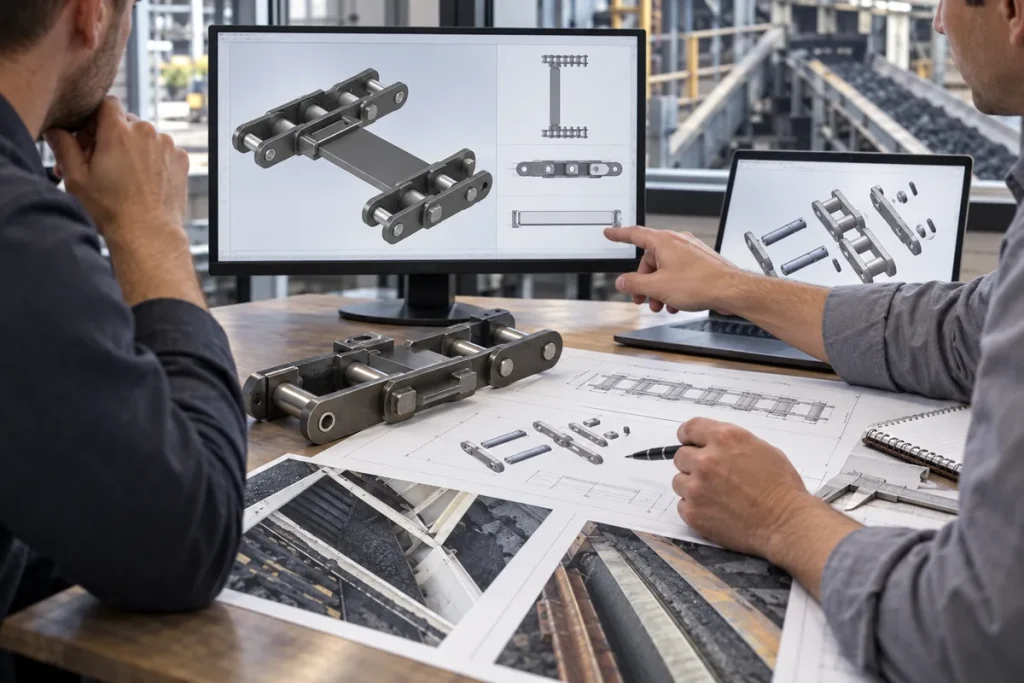
Як узгодити заміну ланцюга вимикача живильного механізму з перевіркою зірочки
Координуйте заміну ланцюга вимикача живильного механізму з перевіркою зірочки, фіксуючи стан зубців, ознаки зачеплення, вирівнювання та геометрію ланцюга.
Інженерний посібникОновлено 16 вересня 2026 р
When a feeder breaker chain is being considered for replacement, the sprockets should not disappear from the inspection record. The chain and sprockets interact at every engagement, yet they wear in different ways and may not reach a replacement decision at the same time. The practical task is therefore to preserve two evidence streams: what the chain shows and what each sprocket shows.
A useful shutdown record does not start with the conclusion that both items must be changed. It starts with controlled photographs, chain geometry, sprocket tooth observations, seating evidence, alignment clues, and the service history that led to the shutdown. Those inputs allow engineering or maintenance personnel to decide whether the sprocket condition could affect a new chain or whether another interface deserves attention.
This article gives a coordination workflow rather than a universal wear limit. Tooth thickness limits, chain elongation limits, backlash, alignment tolerances, and replacement criteria depend on the machine design and controlled technical documentation. The objective is to make sure those criteria can be applied to a complete field record rather than to a few isolated photographs.
Chain evidence
Record pitch condition, joint movement, flight condition, component damage, and any chain-specific measurement required by the machine procedure.
Докази зірочки
Record each sprocket separately: tooth profile, contact pattern, damaged teeth, packed material, retention, and visible alignment clues.
Interface decision
Review how the chain seats and tracks on the sprockets before deciding whether the replacement scope is chain-only, sprocket-only, or combined.
1. Freeze the Replacement Question Before Parts Are Removed
Write down why the shutdown was opened: chain wear trend, repeated adjustment, damaged flight, abnormal noise, visible sprocket damage, scheduled renewal, or another reason. This establishes the problem statement before disassembly changes the evidence.
Also record which strand, drive end, return end, and sprocket location are involved. If the machine has more than one sprocket, assign a clear location name or tag so tooth photographs cannot be mixed later.
2. Photograph Chain Seating on the Sprocket Before Disassembly
With the machine safely isolated and positioned under the approved procedure, photograph the chain as it approaches, seats on, and leaves the sprocket where access permits. Use a straight-on view for tooth engagement and an offset view for side contact or tracking evidence.
These photographs are often more useful than a loose sprocket photograph because they preserve the working relationship. Record material build-up or obstruction rather than cleaning first and losing the as-found context.
3. Build a Separate Tooth-Condition Record for Each Sprocket
Inspect multiple teeth around the circumference rather than selecting one convenient tooth. Look for visibly changed tooth profiles, hooked or uneven contact surfaces, impact damage, cracking, unusual polishing, packed material, and differences from adjacent teeth.
Do not convert visual appearance directly into a percent-wear claim unless the controlled drawing or procedure defines the measurement. Mark tooth positions and take repeatable photographs so engineering can compare the visual evidence with the applicable criterion.
4. Preserve Chain Measurements as Their Own Data Set
Measure the chain using the approved method for pitch or multi-pitch length, unit geometry, scraper width, flight spacing, and other required variables. Keep the chain measurement sheet separate from the sprocket sheet, but use the same location tags and inspection date.
For K201B and K207B identification, the verified catalogue dimensions can support product identification, but the condition of an installed chain still requires the machine-specific inspection method. A catalogue dimension is not a service wear limit.
Photograph side faces of sprocket teeth, chain plates, guides, and adjacent structure for asymmetric polishing or contact marks. A one-sided pattern can be important because it may indicate that the new chain will enter the same contact path unless alignment or guide condition is reviewed.
The record should distinguish observation from diagnosis. “Heavy polished contact on drive-side tooth faces” is an observation; “misalignment caused the wear” is a conclusion that requires confirmation from geometry and machine checks.
6. Compare Chain and Sprocket History on One Timeline
Create a short timeline showing the last known chain installation, sprocket change or reversal if documented, major adjustment events, abnormal events, and the current inspection. Unknown dates should remain unknown rather than being estimated from appearance.
This timeline helps distinguish a matched set with known history from a new chain running on older sprockets, or new sprockets installed while the chain remained in service. That history changes the questions engineering should ask during replacement planning.
Explains whether chain and sprockets share the same service history
Release baseline
Post-install seating, tracking, photos, inspection status
Creates the starting point for future trend review
Правило запису
Use the machine drawing and approved maintenance criteria for actual dimensional limits and replacement decisions.
7. Inspect the Sprocket After the Chain Is Removed
Once removal is authorized, repeat the sprocket photographs without the chain blocking the tooth roots, side faces, hubs, fasteners, or segments. Preserve the pre-removal images so the post-removal view does not replace evidence of actual seating.
Check accessible retention and mounting features, visible damage, looseness evidence, and material trapped around segmented or mounted components. Any dimensional measurement should follow the controlled drawing or maintenance procedure for that sprocket.
8. Decide What Must Be Escalated Before Installing the New Chain
Escalate the record when tooth geometry is visibly inconsistent, cracking or damage is present, chain seating is abnormal, side contact is severe, the sprocket identity is uncertain, or controlled wear criteria are unavailable. Installation should not become the point where unresolved interface questions are hidden.
An engineering review is especially useful when the replacement chain is being sourced from field dimensions rather than a confirmed machine part number. Chain identity and sprocket compatibility must be demonstrated through evidence, not assumed from nominal pitch.
Engagement evidence
Photographs or observations showing how the chain enters, seats on, and leaves a sprocket.
Contact pattern
Visible polishing, impact, or wear marks that show where components have touched during operation.
Matched history
A documented service history showing when the chain and relevant sprockets entered service or were changed.
Release baseline
The documented condition of the installed set after approved installation and initial verification.
9. Use a Combined Release Checklist After Installation
After the approved installation and adjustment procedure is complete, record chain tracking, sprocket seating, visible side contact, flight clearance, unusual noise, and the first inspection condition required by the machine procedure. Keep the as-installed photographs as the new baseline.
The goal is to create a traceable transition from old-set evidence to new-set baseline evidence. Future maintenance teams can then compare changes to a known starting condition instead of reconstructing the replacement event from memory.
10. Hand Procurement a Scope, Not Just a Part Name
If procurement needs quotations, state whether the request covers chain only, sprocket inspection pending, sprocket replacement, or a combined engineered set. Include the verified chain identity or field measurement package, sprocket identification, machine context, quantity, and drawing references.
Avoid wording such as “same as old chain” or “standard feeder breaker sprocket.” Those phrases remove the interface evidence that suppliers need to confirm geometry and may encourage unsupported assumptions.
Використайте цей контрольний список передачі, щоб закрити польовий запис для How to Coordinate Feeder Breaker Chain Replacement with Sprocket InspectionМета полягає не в тому, щоб створити ще одну загальну форму технічного обслуговування. Мета полягає в тому, щоб зберегти конкретні спостереження, опорні точки та контекст машини, які знадобляться наступному рецензенту, щоб зрозуміти, як було отримано результат. Дотримуйтесь специфічних для машини меж приймання згідно із затвердженим кресленням, процедурою технічного обслуговування або інженерною інструкцією, а не винаходьте універсальне веб-значення.
Контрольно-пропускний пункт
Що записувати
Як використовується запис
Freeze the Replacement Question Before Parts Are Removed
Record the exact machine location, strand or side, current operating/shutdown state, and the observation that relates to freeze the replacement question before parts are removed. Include a photograph that lets another reviewer find the same area.
Встановлює контекст, щоб подальші вимірювання не були відірвані від положення машини та ланцюга.
Photograph Chain Seating on the Sprocket Before Disassembly
Capture the physical reference used for photograph chain seating on the sprocket before disassembly. Keep the raw dimension, image or marking beside the interpretation, and note any wear, repair, build-up or access limitation that could affect the reading.
Робить результат повторюваним і запобігає тому, щоб пошкоджена або погано визначена опорна точка стала вимогою для заміни.
Build a Separate Tooth-Condition Record for Each Sprocket
Cross-check build a separate tooth-condition record for each sprocket against any controlled drawing, previous purchase reference or retained spare that is available. Keep current field data and historical information in separate fields when they differ.
Зберігає простежуваність, коли польові умови, історичні записи та номінальна інформація про продукт не повністю узгоджуються.
Preserve Chain Measurements as Their Own Data Set
For preserve chain measurements as their own data set, state what is confirmed, what is only observed, and what still needs engineering confirmation. Attach the image or measurement that supports the statement rather than relying on a product name alone.
Надає відділу технічного обслуговування, закупівель та постачальнику чіткий перелік того, що можна зробити зараз, а що потрібно вирішити до випуску.
Відокремте знайдений стан від необхідної геометрії заміни. A worn, repaired, dirty or partially dismantled component may still be very useful for identification, but its current shape is not automatically the manufacturing requirement. Label field measurements as observed data, retain the original unit and measurement method, and identify any feature that may have been altered by service. For feeder breaker chain replacement sprocket inspection, photographs should show the measurement endpoints or component relationship clearly enough that a remote reviewer can reproduce the logic.
Вирішуйте суперечливу інформацію замість того, щоб приховувати її. If a drawing, old order, marking and current measurement point in different directions, keep each source visible and describe the conflict. Do not average values or silently choose the most convenient one. Use additional photographs, measurements from another intact repeating unit, machine interface information and the controlled document revision to determine which value governs. If hand procurement a scope, not just a part name cannot be confirmed during the shutdown, state that limitation explicitly so the open question survives the handoff.
Make the next action obvious for How to Coordinate Feeder Breaker Chain Replacement with Sprocket Inspection. Заповнений запис має повідомляти відділу технічного обслуговування, що слід перевірити повторно, відділу закупівель, яку інформацію слід вказати в запиті цінових пропозицій (RFQ), а також інженерам, які розміри або інтерфейси все ще потребують затвердження. Перш ніж машина повернеться в експлуатацію, переконайтеся, що комплект файлів містить загальний вигляд машини, повний повторюваний вигляд ланцюга/маршруту, крупні плани відповідних компонентів або маркувань, а також розміри, що використовуються в цьому посібнику. Для feeder breaker chain replacement sprocket inspection, простежуваний набір спостережень є кориснішим, ніж довгий опис без даних, і він зменшує ризик того, що рішення про заміну буде прийнято лише на основі кроку, зовнішнього вигляду або старого номера деталі.
Примітки щодо польових рішень для цього завдання
Протокол перевірки для How to Coordinate Feeder Breaker Chain Replacement with Sprocket Inspection має бути простим у використанні після завершення зупинки. Наступні три примітки перетворюють статтю на практичний спосіб передачі даних без створення межі прийнятності для конкретної машини. Вони особливо корисні, коли зауваження щодо технічного обслуговування повинні бути переглянуті пізніше інженерами або закупівельниками, а оригінальний ланцюг більше не доступний.
Confirm Freeze the Replacement Question Before Parts Are Removed
Почніть з визначення місця та способу спостереження. Запишіть стан машини, сторони ланцюга або гілки, повторюваного блоку або місця розташування лотка, а також стан ланцюга під час проведення перевірки. Якщо компонент був брудним, навантаженим, провислим, знятим, відремонтованим або помітно деформованим, зафіксуйте цей стан поруч із показниками. Фотографія повинна містити достатньо навколишньої структури, щоб інша людина могла знайти те саме місце. Метою цієї статті є збереження контексту. freeze the replacement question before parts are removed а не зводити його до окремого числа.
Cross-check Photograph Chain Seating on the Sprocket Before Disassembly
Використайте друге спостереження або контрольоване посилання, щоб оскаржити перший результат. Це може бути сусідня неушкоджена повторювана одиниця, інша нитка ланцюга, перегляд креслення, попередній запис про закупівлю або збережена запасна деталь. Зберігайте видимим початкове значення поля, навіть якщо порівняння вказує на іншу номінальну вимогу. Якщо ці два значення не узгоджуються, опишіть, чому може існувати різниця, і визначте, що потрібно підтвердити далі. Це особливо важливо для photograph chain seating on the sprocket before disassembly, оскільки знос під час експлуатації, метод вимірювання та попередній ремонт можуть вплинути на зафіксований стан.
Prepare Build a Separate Tooth-Condition Record for Each Sprocket for review
Упакуйте результат, щоб його можна було перевірити дистанційно. Включіть необроблене вимірювання або спостереження, його одиницю вимірювання, опорні поверхні або кінцеві точки, принаймні одну фотографію крупним планом та одну фотографію контексту, а також будь-який малюнок або позначку, що використовувалися під час ідентифікації. Вкажіть, чи є об'єкт підтвердженим, кандидатом чи невідомим. Якщо build a separate tooth-condition record for each sprocket залежить від припущення, запишіть відкрите питання в RFQ замість того, щоб перетворювати припущення на специфікацію. Рецензент, який отримує запит, повинен мати змогу зрозуміти умову ланцюга, не відтворюючи метод по пам'яті.
Тримайте межі прийняття рішень видимими. Preserve Chain Measurements as Their Own Data Set may influence the next maintenance or sourcing step, but the website does not set a universal discard, tension or interchangeability limit. Use the equipment procedure, approved drawing and order-specific engineering requirements for acceptance decisions. The purpose of this record is to make the observation behind feeder breaker chain replacement sprocket inspection достатньо простежуваним, щоб можна було обрати правильний продукт або інженерний маршрут без здогадок.
Питання, які потрібно вирішити перед наступним рішенням
Should sprockets always be replaced with a feeder breaker chain?
Not automatically. Record sprocket condition and apply the machine-specific criteria. The inspection should support the decision rather than assume a universal combined replacement rule.
Can nominal chain pitch prove sprocket compatibility?
No. Pitch is only one interface variable. Chain construction, width, seating geometry, tooth form, and machine-specific interfaces still need verification.
What if only one sprocket shows unusual contact?
Tag and document each sprocket separately, then review alignment, mounting, guide, tracking, and load-path evidence before assigning a cause.
Should the old chain be discarded immediately after replacement?
Keep representative evidence or samples when the maintenance, quality, or engineering process requires them, especially when identity or failure cause is still under review.
Make the Replacement Event a Usable Engineering Baseline
A new feeder breaker chain should not erase the evidence that explains the old set. Coordinate chain and sprocket inspection, keep location-specific records, document pre- and post-removal condition, and close the job with an as-installed baseline. That workflow supports both immediate replacement decisions and better diagnosis during the next maintenance cycle.
When controlled wear limits or sprocket dimensions are missing, request the applicable machine drawing or engineering criteria instead of substituting a generic value from another chain system.