How to Identify an Unknown Feeder Breaker Chain Without a Part Number
Identify an unknown feeder breaker chain without a part number by combining machine context, pitch, unit length, scraper width, flight pattern.
Інженерний посібникОновлено 16 вересня 2026 р
An unreadable or missing part number is common on long-serving mining equipment. Paint, wear, repairs, supplier changes, and undocumented replacement cycles can leave a maintenance team with an installed feeder breaker chain that has no trustworthy identity. The wrong response is to choose the nearest listed model from one visible dimension. The stronger response is to build an identification record from independent pieces of evidence.
The process starts with the machine and application, then moves through pitch, repeating unit length, flight spacing, scraper width, chain-section structure, flight attachment, pins and retention, markings, and controlled historical documents. Each item either narrows the candidate set or reveals a discrepancy that must remain open. A model name is the conclusion of that process, not the starting assumption.
K201B and K207B are useful examples because they share nominal 3 1/2 inch pitch and a 21 inch repeating unit yet differ in scraper width and detailed component structure. If an unknown chain were identified from pitch alone, those two listed models could not be separated.
Identify the machine
Confirm feeder breaker application, chain location, strand count, travel direction, and any machine/drawing identifiers.
Build the geometry fingerprint
Record pitch, repeating unit, flight spacing, scraper width, chain and attachment structure, and visible markings.
Preserve uncertainty
If evidence conflicts, keep the model candidate status open and request drawing or sample review rather than forcing a match.
1. Prove the Application Before Comparing Chain Models
Start with the machine. Photograph the feeder breaker or chain-conveyor context, identify inlet/discharge orientation where known, and record which strand or side is being inspected. If the plant also operates shuttle cars or bolter miners, this step is essential because K Series chains exist for more than one underground mining application.
Machine context does not prove the exact chain model, but it eliminates an important class of routing errors. A chain removed from a feeder breaker should not be catalogued as a shuttle-car chain because one link looks similar, and a photograph of a loose spare should not be assumed to belong to the nearest machine without traceability.
2. Measure Pitch as the First Geometric Filter
Use equivalent joint references and span multiple pitch intervals where safe access permits. Record the raw span, pitch count, location, tool, unit, and photographs. Keep the field result separate from nominal pitch values in candidate drawings.
Pitch is a family filter, not a unique identifier. If the chain appears close to 3 1/2 inches, both K201B and K207B remain possible examples on this site, and other configurations may also exist. Continue the identification sequence.
Trace the chain until the structural pattern repeats. Count Chain Sections, Flight Sections, special attachments, and the number of pitch intervals between equivalent flights. Mark one reference flight and photograph a complete repeat. Measure unit length between equivalent datums.
For K201B and K207B, the documented repeat is one Flight Section and two Chain Sections with a 21 inch unit length. If an unknown chain presents a different sequence, that difference is more important than a close pitch reading.
4. Measure Scraper Width from Defined Faces
Choose an intact flight if possible and define exactly which faces or edges form the width dimension. Record several flights when wear is uneven. Separate observed remaining width from nominal drawing width.
The K201B width is 44 2/5 inches (1127.5 mm) and K207B is 46 inches (1171.85 mm). Those values help separate candidate models only when the field measurement uses comparable reference geometry.
5. Build a Component and Attachment Fingerprint
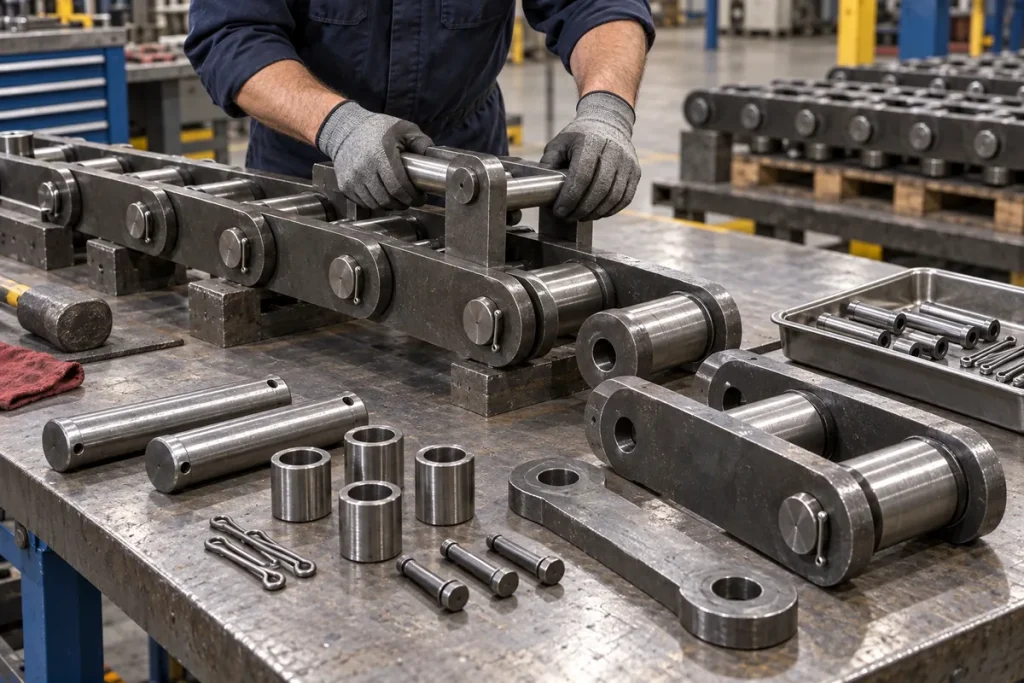
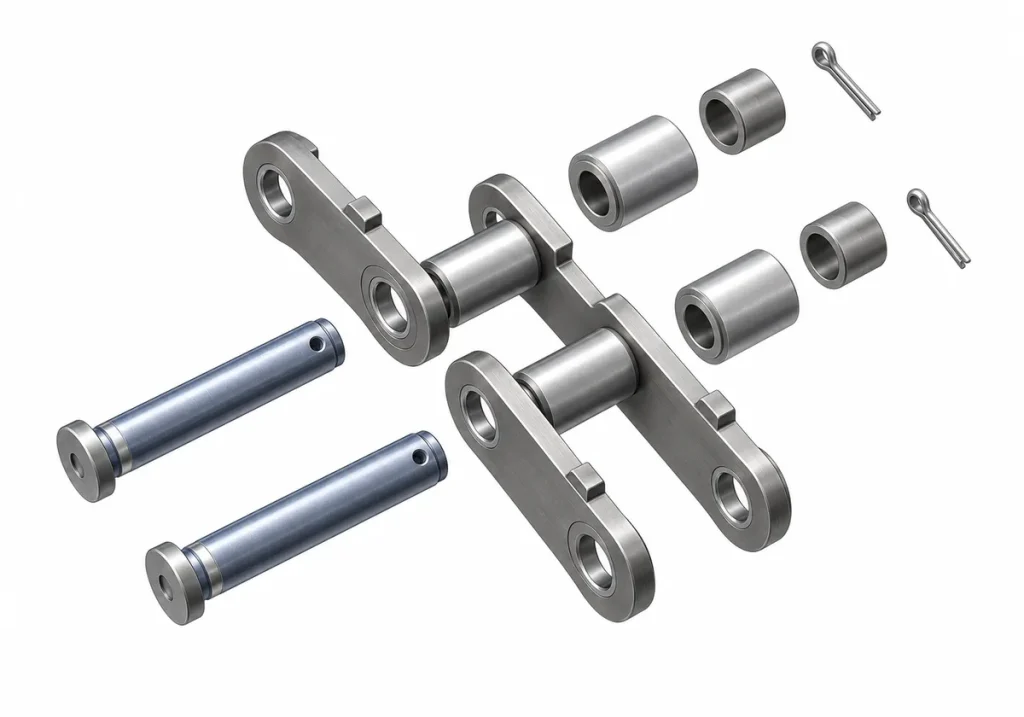
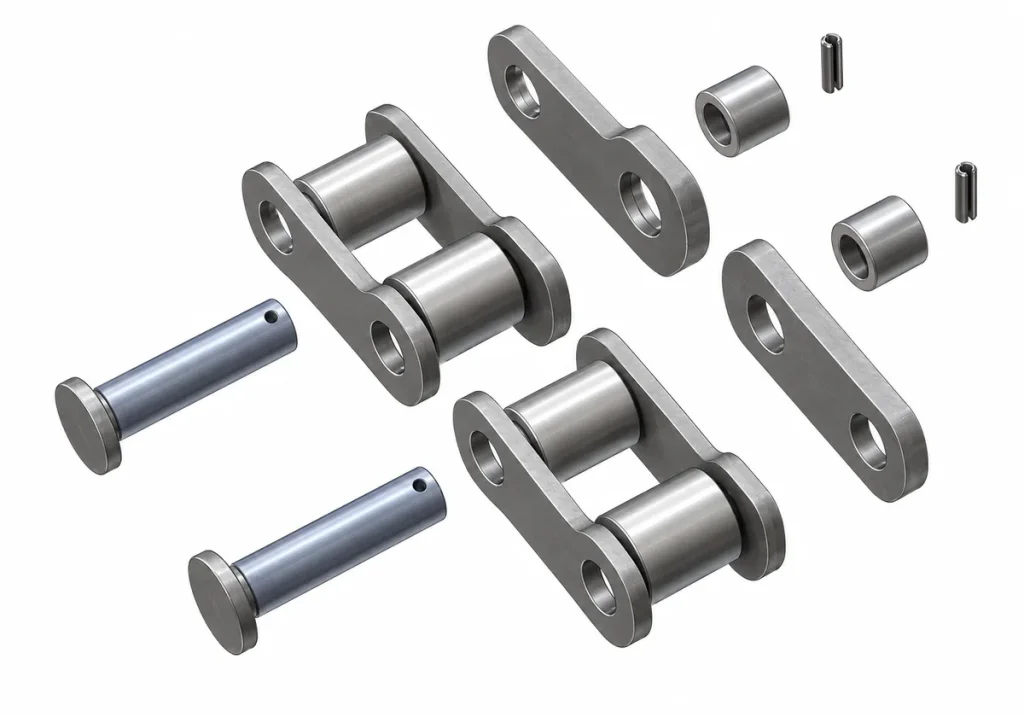
Photograph outer and inner links, plates, pin/bush joints, attachment links, extended pins, T-pins or spring pins, scraper head/plate relationships, and retention features. Include a wide view tying each detail to the repeating unit.
Component evidence can resolve candidates that share broad dimensions. K207B documents a Scraper Outer Link and Extended Pin, while K201B documents its own Locating Bush and Spring Pin arrangement. Treat those as supporting clues, not as permission to assign a model from one part.
6. Search for Markings but Verify What They Belong To
Inspect chain plates, scraper components, tags, old spares, machine records, and removed sections for readable identifiers. Photograph the marking close-up and then photograph its location. A number becomes trustworthy only when its relationship to the installed chain is clear.
If two markings conflict, retain both. One may be a component code, old maintenance mark, machine identifier, or a part from a repair. The geometry and document trail must decide which marking controls.
7. Compare with Old Drawings and Purchase Records
Collect drawings, previous purchase orders, inspection sheets, supplier confirmations, and maintenance notes that can be tied to the same machine. Check revision, date, and whether the record describes the complete chain or one component. Do not assume the newest file on a shared drive is the installed configuration.
Create a field-by-field comparison: pitch, unit length, width, flight arrangement, component clues, and markings. Mark each as agreement, conflict, or not verified. That matrix turns scattered historical documents into controlled identification evidence.
Prevents routing to another mining-chain application.
Крок
Raw multi-pitch span and observed/nominal comparison
Narrows candidate families.
Repeating unit
Unit length plus chain/flight sequence
Separates chains with the same pitch.
Ширина скребка
Defined endpoints on intact/best flight
Distinguishes listed configurations.
Інтервал польотів
Datum, interval count, pattern map
Confirms conveyor arrangement.
Component fingerprint
Links, pins/bushes, attachment and retention details
Adds model-specific structural evidence.
Markings
Readable code plus location context
Supports identity when traceable.
Documents
Drawing/order revision and machine relationship
Controls historical evidence.
Правило запису
Do not promote a candidate to confirmed status until the key dimensions, structure, and machine/document evidence are consistent.
8. Use Damage and Repair History as Context, Not Original Geometry
A repaired flight, replacement link, welded plate, or mixed chain section can make the installed chain differ from its original design. Record repairs and measure intact areas separately. Do not copy a field repair into a replacement specification unless engineering has approved it as the required configuration.
If every available unit is damaged, a removed sample and old drawing may be needed to reconstruct the original geometry. State what is measured and what is inferred; do not blend the two.
9. Assign an Evidence Status Instead of a Premature Model Name
Use status labels such as unidentified, candidate K201B, candidate K207B, custom configuration, or confirmed model. Define what evidence would move the status forward. This is more useful than repeatedly writing a model name with a question mark.
For example, a chain may match 3.5 inch pitch and 21 inch unit length but lack verified scraper width. The next action is a width and flight-interface measurement, not a purchase order. A different chain may match dimensions but show a conflicting attachment structure, triggering drawing review.
Unknown chain
A chain whose model or approved configuration cannot yet be supported by controlled evidence.
Candidate model
A listed model consistent with some, but not all, required identification evidence.
Configuration fingerprint
The combined pattern of dimensions, assemblies, components, and application context used to distinguish chains.
Confirmed model
A model identity supported by the required physical and documentary evidence for the procurement decision.
10. Package the Unknown Chain as an Engineering RFQ
When the model cannot be confirmed, the RFQ can still be strong. Send machine/application context, chain location, pitch record, repeating-unit sketch, scraper width, flight spacing, component photos, markings, repair history, drawing comparisons, and quantity. List open dimensions explicitly.
A supplier can then quote against an approved drawing review or request the one missing piece of evidence. That is a controlled custom/unknown-chain workflow, not a failed identification.
Використайте цей контрольний список передачі, щоб закрити польовий запис для How to Identify an Unknown Feeder Breaker Chain Without a Part NumberМета полягає не в тому, щоб створити ще одну загальну форму технічного обслуговування. Мета полягає в тому, щоб зберегти конкретні спостереження, опорні точки та контекст машини, які знадобляться наступному рецензенту, щоб зрозуміти, як було отримано результат. Дотримуйтесь специфічних для машини меж приймання згідно із затвердженим кресленням, процедурою технічного обслуговування або інженерною інструкцією, а не винаходьте універсальне веб-значення.
Контрольно-пропускний пункт
Що записувати
Як використовується запис
Prove the Application Before Comparing Chain Models
Record the exact machine location, strand or side, current operating/shutdown state, and the observation that relates to prove the application before comparing chain models. Include a photograph that lets another reviewer find the same area.
Встановлює контекст, щоб подальші вимірювання не були відірвані від положення машини та ланцюга.
Measure Pitch as the First Geometric Filter
Capture the physical reference used for measure pitch as the first geometric filter. Keep the raw dimension, image or marking beside the interpretation, and note any wear, repair, build-up or access limitation that could affect the reading.
Робить результат повторюваним і запобігає тому, щоб пошкоджена або погано визначена опорна точка стала вимогою для заміни.
Document the Repeating Unit and Flight Pattern
Cross-check document the repeating unit and flight pattern against any controlled drawing, previous purchase reference or retained spare that is available. Keep current field data and historical information in separate fields when they differ.
Зберігає простежуваність, коли польові умови, історичні записи та номінальна інформація про продукт не повністю узгоджуються.
Measure Scraper Width from Defined Faces
For measure scraper width from defined faces, state what is confirmed, what is only observed, and what still needs engineering confirmation. Attach the image or measurement that supports the statement rather than relying on a product name alone.
Надає відділу технічного обслуговування, закупівель та постачальнику чіткий перелік того, що можна зробити зараз, а що потрібно вирішити до випуску.
Відокремте знайдений стан від необхідної геометрії заміни. A worn, repaired, dirty or partially dismantled component may still be very useful for identification, but its current shape is not automatically the manufacturing requirement. Label field measurements as observed data, retain the original unit and measurement method, and identify any feature that may have been altered by service. For identify unknown feeder breaker chain, photographs should show the measurement endpoints or component relationship clearly enough that a remote reviewer can reproduce the logic.
Вирішуйте суперечливу інформацію замість того, щоб приховувати її. If a drawing, old order, marking and current measurement point in different directions, keep each source visible and describe the conflict. Do not average values or silently choose the most convenient one. Use additional photographs, measurements from another intact repeating unit, machine interface information and the controlled document revision to determine which value governs. If package the unknown chain as an engineering rfq cannot be confirmed during the shutdown, state that limitation explicitly so the open question survives the handoff.
Make the next action obvious for How to Identify an Unknown Feeder Breaker Chain Without a Part Number. Заповнений запис має повідомляти відділу технічного обслуговування, що слід перевірити повторно, відділу закупівель, яку інформацію слід вказати в запиті цінових пропозицій (RFQ), а також інженерам, які розміри або інтерфейси все ще потребують затвердження. Перш ніж машина повернеться в експлуатацію, переконайтеся, що комплект файлів містить загальний вигляд машини, повний повторюваний вигляд ланцюга/маршруту, крупні плани відповідних компонентів або маркувань, а також розміри, що використовуються в цьому посібнику. Для identify unknown feeder breaker chain, простежуваний набір спостережень є кориснішим, ніж довгий опис без даних, і він зменшує ризик того, що рішення про заміну буде прийнято лише на основі кроку, зовнішнього вигляду або старого номера деталі.
Примітки щодо польових рішень для цього завдання
Протокол перевірки для How to Identify an Unknown Feeder Breaker Chain Without a Part Number має бути простим у використанні після завершення зупинки. Наступні три примітки перетворюють статтю на практичний спосіб передачі даних без створення межі прийнятності для конкретної машини. Вони особливо корисні, коли зауваження щодо технічного обслуговування повинні бути переглянуті пізніше інженерами або закупівельниками, а оригінальний ланцюг більше не доступний.
Confirm Prove the Application Before Comparing Chain Models
Почніть з визначення місця та способу спостереження. Запишіть стан машини, сторони ланцюга або гілки, повторюваного блоку або місця розташування лотка, а також стан ланцюга під час проведення перевірки. Якщо компонент був брудним, навантаженим, провислим, знятим, відремонтованим або помітно деформованим, зафіксуйте цей стан поруч із показниками. Фотографія повинна містити достатньо навколишньої структури, щоб інша людина могла знайти те саме місце. Метою цієї статті є збереження контексту. prove the application before comparing chain models а не зводити його до окремого числа.
Cross-check Measure Pitch as the First Geometric Filter
Використайте друге спостереження або контрольоване посилання, щоб оскаржити перший результат. Це може бути сусідня неушкоджена повторювана одиниця, інша нитка ланцюга, перегляд креслення, попередній запис про закупівлю або збережена запасна деталь. Зберігайте видимим початкове значення поля, навіть якщо порівняння вказує на іншу номінальну вимогу. Якщо ці два значення не узгоджуються, опишіть, чому може існувати різниця, і визначте, що потрібно підтвердити далі. Це особливо важливо для measure pitch as the first geometric filter, оскільки знос під час експлуатації, метод вимірювання та попередній ремонт можуть вплинути на зафіксований стан.
Prepare Document the Repeating Unit and Flight Pattern for review
Упакуйте результат, щоб його можна було перевірити дистанційно. Включіть необроблене вимірювання або спостереження, його одиницю вимірювання, опорні поверхні або кінцеві точки, принаймні одну фотографію крупним планом та одну фотографію контексту, а також будь-який малюнок або позначку, що використовувалися під час ідентифікації. Вкажіть, чи є об'єкт підтвердженим, кандидатом чи невідомим. Якщо document the repeating unit and flight pattern залежить від припущення, запишіть відкрите питання в RFQ замість того, щоб перетворювати припущення на специфікацію. Рецензент, який отримує запит, повинен мати змогу зрозуміти умову ланцюга, не відтворюючи метод по пам'яті.
Тримайте межі прийняття рішень видимими. Measure Scraper Width from Defined Faces may influence the next maintenance or sourcing step, but the website does not set a universal discard, tension or interchangeability limit. Use the equipment procedure, approved drawing and order-specific engineering requirements for acceptance decisions. The purpose of this record is to make the observation behind identify unknown feeder breaker chain достатньо простежуваним, щоб можна було обрати правильний продукт або інженерний маршрут без здогадок.
Питання, які потрібно вирішити перед наступним рішенням
What is the minimum information for an unknown-chain enquiry?
Provide machine/application context, clear overall and detail photos, measured pitch, repeating-unit evidence, scraper width, flight spacing if accessible, component/attachment views, and any drawings or markings.
Can the closest listed model be used as a temporary identification?
Use it only as a candidate and state what has not been verified. Do not turn proximity into a compatibility claim or purchase specification.
What if the chain has mixed repair sections?
Map the repairs and collect measurements from intact areas as well. A replacement section may not represent the original chain configuration.
When is a physical sample useful?
A safely removed, traceably labelled sample is useful when photographs cannot show hidden geometry, dimensions are uncertain, or the installed chain is too damaged for reliable identification.
Наступний крок: Закриття технічного запису
An unknown feeder breaker chain becomes manageable when identification is treated as evidence accumulation. Application, pitch, repeating unit, width, spacing, components, markings, and records each answer a different question.
If the evidence converges, the model can be confirmed. If it does not, the honest output is a controlled custom or engineering-review RFQ that preserves uncertainty instead of hiding it behind the nearest part number.