فیڈر بریکر یا شٹل کار چین؟ غیر واضح انکوائری کو کیسے روٹ کریں۔
ایک غیر واضح فیڈر بریکر بمقابلہ شٹل کار چین انکوائری کو آلات کے سیاق و سباق، فل چین جیومیٹری، فلائٹ شواہد، نشانات اور ڈرائنگ کا استعمال کرتے ہوئے روٹ کریں۔
Engineering GuideUpdated ستمبر 16, 2026
A message that says “need K Series chain, 3.5 inch” is not enough to decide whether the request belongs to a feeder breaker or a shuttle car. The same broad K Series catalogue contains chains for shuttle cars and underground feeder breaker chain conveyors, and application names can be lost when a chain is removed from a machine or passed through several purchasing teams.
The safest routing method starts with the equipment and then moves toward the chain: machine type and function, where the chain runs, photographs of the installed path, chain configuration, flight or scraper geometry, repeating unit, pitch, width, markings, and any controlled drawing or previous purchase reference. A nominal pitch can support the record but should not be treated as the family identity.
This article is about enquiry routing, not cross-model interchangeability. A feeder breaker chain should not be replaced with a shuttle-car chain, or vice versa, merely because dimensions appear similar. Final compatibility needs the complete interfaces and controlled technical confirmation.
Start with equipment
Ask whether the chain is installed in a feeder breaker, shuttle car, or unidentified machine and request full-machine/location photographs.
Then map geometry
Record pitch, unit pattern, flight width/spacing, strand layout, components, attachment details, and visible markings.
Hold uncertain cases
If application and geometry conflict, route the enquiry to engineering review rather than forcing it into a familiar product model.
1. Ask What the Machine Does, Not Only What the Chain Is Called
A feeder breaker receives and meters bulk material while breaking or feeding it into the downstream system. A shuttle car serves a different mobile haulage role. Maintenance teams may still use local names that do not match catalogue terminology, so request a photograph of the complete machine and the chain location.
Record the customer wording exactly, then add a normalized internal description only after the equipment context is understood. Do not delete the original wording because it may contain useful site-specific identification clues.
2. Request Installed-Path Photographs Before Close-Ups
Begin with a wide image showing where the chain runs relative to the machine. Add drive-end, return-end, scraper/flight, and side views. A close-up of one chain joint can be mechanically detailed but still fail to identify the application.
If the chain is already removed, ask for machine photos, the removed chain laid out in sequence, and any tagged relationship between the sample and machine location.
3. Record the Repeating Chain Pattern
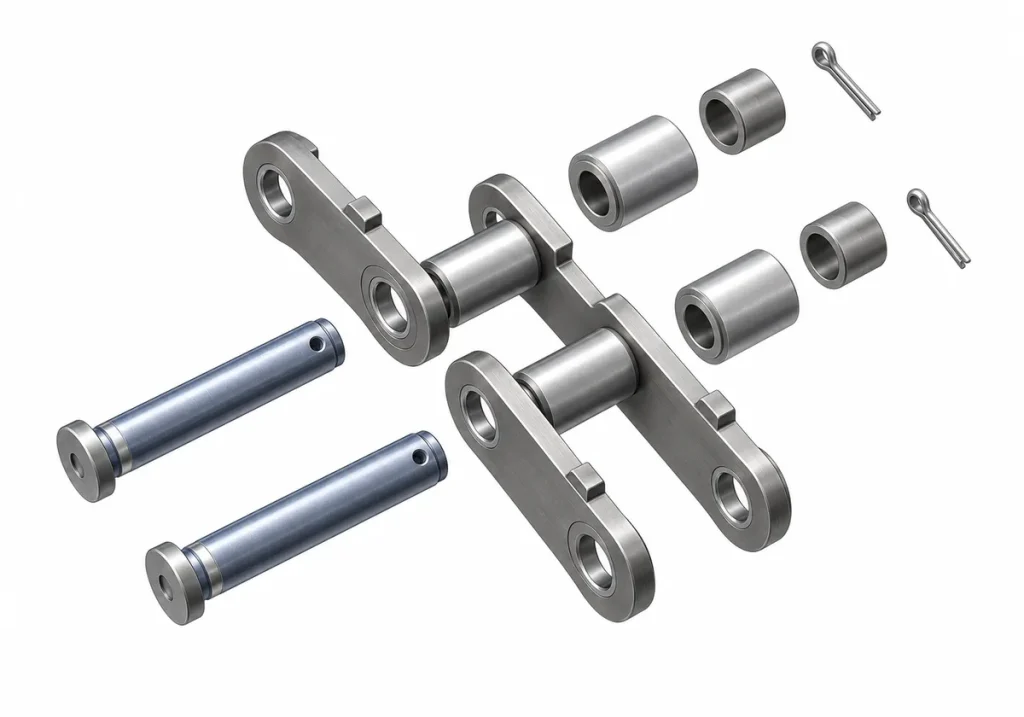
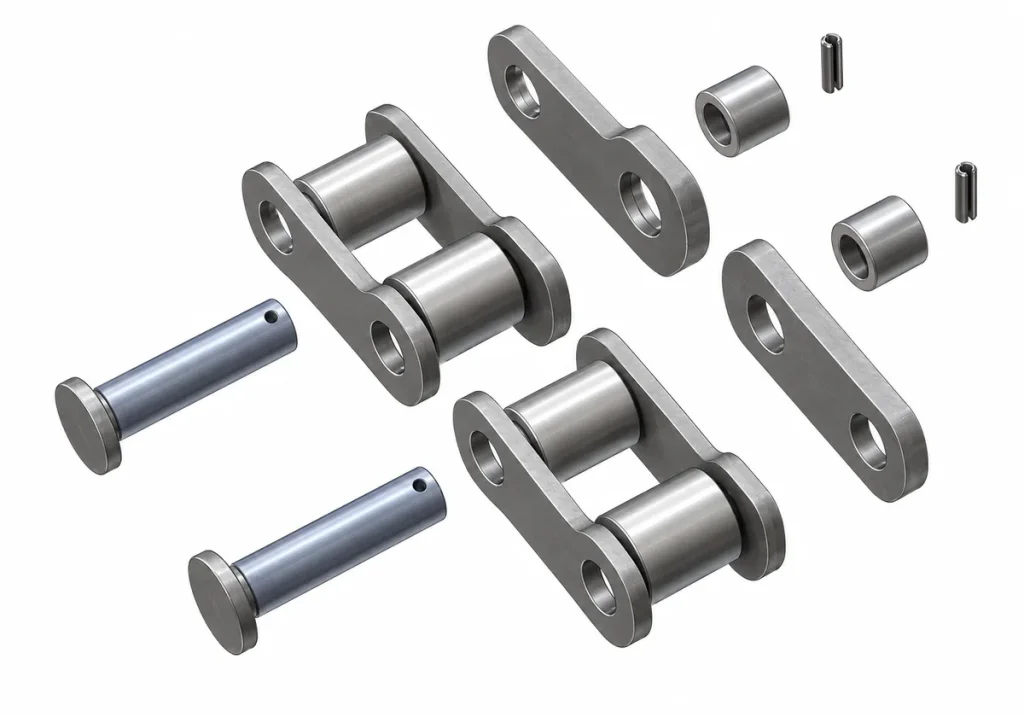
Map how Chain Sections, Flight Sections, attachment links, or other repeating elements appear through one complete unit. Count pitches between repeated flights and record whether the strands are paired and synchronized.
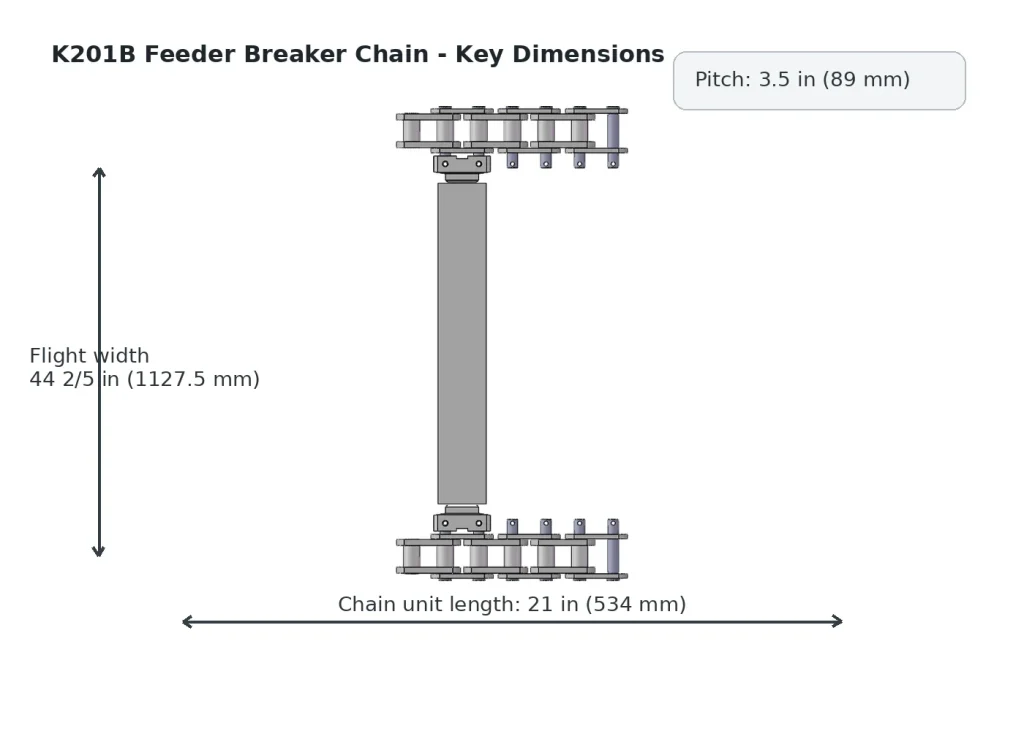
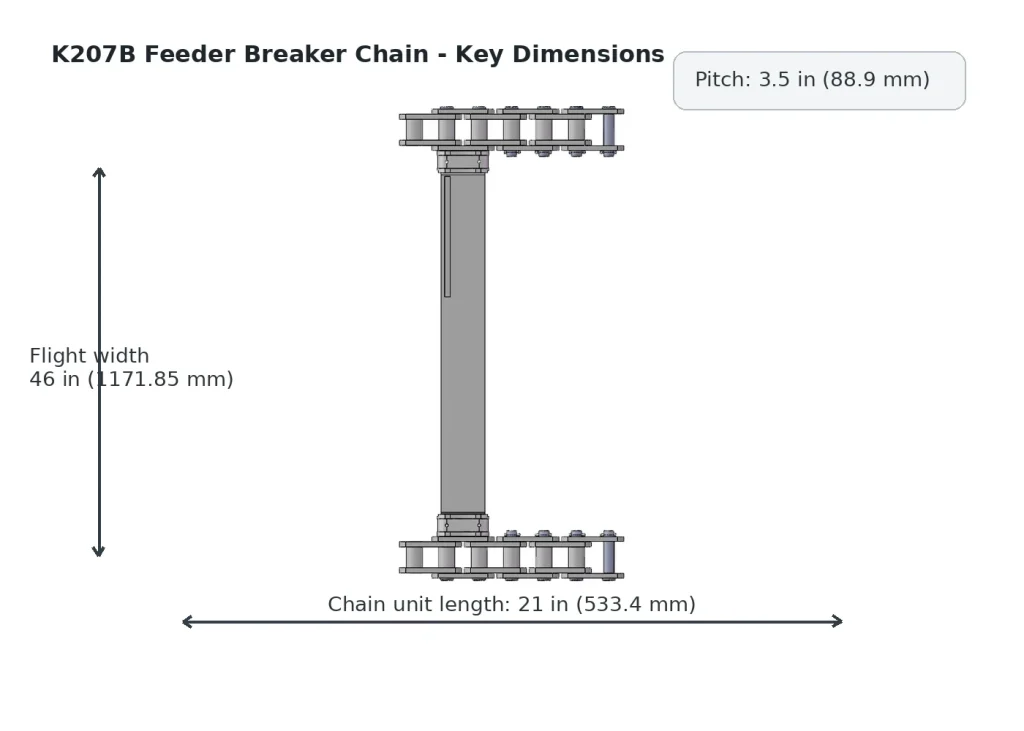
The verified feeder-breaker examples K201B and K207B use one Flight Section with two Chain Sections in a 21-inch unit, but this fact should be used as identification evidence only when the rest of the geometry also agrees.
4. Measure Pitch but Refuse to Stop at Pitch
Use the approved multi-pitch measurement method where practical and record both the total measured span and the number of pitch intervals. A single worn joint is a weak basis for nominal pitch identification.
Pitch helps narrow the search, but the same K Series contains several applications and sizes. Continue with scraper width, flight construction, strand relationship, unit length, and component geometry before routing the enquiry.
5. Capture Scraper or Flight Geometry in Full
Photograph the complete scraper/flight from the front, rear, and side. Record width between defined faces, attachment position, head and plate shape, hole or pin arrangement, and how the flight connects to the two strands.
Do not assume that a wide scraper means feeder breaker or that a particular shape means shuttle car. Use the geometry to compare with controlled evidence, not as a visual stereotype.
6. Preserve Markings and Previous Purchase References
Record every stamp, cast mark, plate mark, repair code, tag, drawing number, and old purchase description without rewriting it. Photograph the marking together with enough surrounding geometry to prove which component carries it.
A previous purchase reference can be useful, but it should be reconciled with the current machine and chain. Sites may move spare parts or reuse descriptions, so history is evidence rather than automatic proof.
7. Use Application-Specific Catalogue Evidence Carefully
The verified K Series source identifies shuttle-car chains separately from feeder-breaker scraper chains and also states that the family serves underground feeder breaker chain conveyors. That supports keeping these enquiries distinct even when they share a broader chain family.
Do not import dimensions from a shuttle-car model into a feeder-breaker product page. Keep related products available for internal comparison while preserving the site taxonomy around the feeder-breaker models actually supported for publication.
Feeder breaker vs shuttle car enquiry routing
Evidence
Feeder breaker route
Shuttle car / unclear route
Machine context
Installed feeder breaker clearly shown
Shuttle car shown or machine type uncertain
Installed path
Feeder/breaker conveyor path documented
Mobile haulage/shuttle context or no path evidence
Chain pattern
Compare with verified feeder-breaker model structure
Compare with appropriate non-core K Series evidence
Dimensions
Use pitch + unit + width + construction
Do not route from pitch alone
Markings/drawing
Reconcile with feeder-breaker evidence
Preserve exact reference for separate technical review
Conflict
Hold for engineering review
Hold for engineering review
Record rule
Application identity is a routing decision first. Product compatibility requires complete interface confirmation afterward.
8. Route a Clear Feeder Breaker Enquiry into the Core Workflow
When the machine context clearly shows an underground feeder breaker and the chain evidence is coherent, continue with feeder-breaker identification: pitch, unit length, scraper width, full component pattern, drawings, quantity, duty context, and sample condition.
If K201B or K207B is proposed, compare the complete evidence package with the listed model data. Both are 3 1/2-inch nominal pitch feeder-breaker scraper chains, which is exactly why pitch by itself cannot decide between them.
9. Route a Clear Shuttle Car Enquiry Outside the Core Feeder Breaker Product Path
If the machine is a shuttle car and the chain evidence corresponds to a shuttle-car application, keep the request labeled as such. The internal technical team can then compare it with the appropriate technical information without publishing it as a feeder-breaker model.
This routing discipline protects both technical accuracy and SEO taxonomy. A feederbreaker-chain.com product page should not become a catch-all listing simply because related K Series chains exist in the same catalogue.
Equipment context
Evidence showing the machine type, function, and physical chain location.
Application routing
Directing the enquiry to the correct technical/product workflow without yet claiming compatibility.
Repeating unit
The sequence of chain and flight elements that repeats along the assembly.
Conflict case
An enquiry in which machine context, chain geometry, markings, or documents do not agree.
10. Escalate Conflicts Instead of Choosing the Nearest Model
Escalate when the customer calls the machine a feeder breaker but the photographed chain resembles another application, when dimensions conflict, when the chain appears modified, or when only loose components are available. State the conflict explicitly.
Engineering review should define what additional evidence is needed: machine drawing, sample, clearer photos, sprocket information, strand-center relationship, attachment detail, or purchase history. The correct output from an uncertain case may be a better evidence request, not a model number.
Use this handoff checklist to close the field record for Feeder Breaker or Shuttle Car Chain? How to Route an Unclear Enquiry. The goal is not to create another generic maintenance form. It is to preserve the specific observations, reference points and machine context that the next reviewer needs in order to understand how the result was obtained. Keep machine-specific acceptance limits under the approved drawing, maintenance procedure or engineering instruction rather than inventing a universal web value.
Checkpoint
What to record
How the record is used
Ask What the Machine Does, Not Only What the Chain Is Called
Record the exact machine location, strand or side, current operating/shutdown state, and the observation that relates to ask what the machine does, not only what the chain is called. Include a photograph that lets another reviewer find the same area.
Establishes the context so later measurements are not detached from the machine and chain position.
Request Installed-Path Photographs Before Close-Ups
Capture the physical reference used for request installed-path photographs before close-ups. Keep the raw dimension, image or marking beside the interpretation, and note any wear, repair, build-up or access limitation that could affect the reading.
Makes the result repeatable and prevents a damaged or poorly defined reference from becoming the replacement requirement.
Record the Repeating Chain Pattern
Cross-check record the repeating chain pattern against any controlled drawing, previous purchase reference or retained spare that is available. Keep current field data and historical information in separate fields when they differ.
Preserves traceability when field condition, historical records and nominal product information do not agree perfectly.
Measure Pitch but Refuse to Stop at Pitch
For measure pitch but refuse to stop at pitch, state what is confirmed, what is only observed, and what still needs engineering confirmation. Attach the image or measurement that supports the statement rather than relying on a product name alone.
Gives maintenance, purchasing and the supplier a clear list of what can be acted on now and what must be resolved before release.
Separate as-found condition from required replacement geometry. A worn, repaired, dirty or partially dismantled component may still be very useful for identification, but its current shape is not automatically the manufacturing requirement. Label field measurements as observed data, retain the original unit and measurement method, and identify any feature that may have been altered by service. For feeder breaker vs shuttle car chain identification, photographs should show the measurement endpoints or component relationship clearly enough that a remote reviewer can reproduce the logic.
Resolve conflicting information instead of hiding it. If a drawing, old order, marking and current measurement point in different directions, keep each source visible and describe the conflict. Do not average values or silently choose the most convenient one. Use additional photographs, measurements from another intact repeating unit, machine interface information and the controlled document revision to determine which value governs. If escalate conflicts instead of choosing the nearest model cannot be confirmed during the shutdown, state that limitation explicitly so the open question survives the handoff.
Make the next action obvious for Feeder Breaker or Shuttle Car Chain? How to Route an Unclear Enquiry. The completed record should tell maintenance what should be rechecked, tell purchasing what information belongs in the RFQ, and tell engineering which dimensions or interfaces still need approval. Before the machine returns to service, confirm that the file set includes an overall machine view, a complete repeating chain/flight view, close-ups of relevant components or markings, and the dimensions used in this guide. For feeder breaker vs shuttle car chain identification, a traceable set of observations is more useful than a long narrative with no datum, and it reduces the risk that a replacement decision is made from pitch, appearance or an old part number alone.
Field Decision Notes for This Task
The inspection record for Feeder Breaker or Shuttle Car Chain? How to Route an Unclear Enquiry should be easy to use after the shutdown is over. The following three notes convert the article into a practical handoff without creating a machine-specific acceptance limit. They are especially useful when maintenance observations must be reviewed later by engineering or purchasing and the original chain is no longer accessible.
Confirm Ask What the Machine Does, Not Only What the Chain Is Called
Start by identifying where and how the observation was made. Record the machine, chain side or strand, repeating unit or flight location, and the state of the chain when the check was performed. If the component was dirty, loaded, slack, removed, repaired or visibly deformed, keep that condition beside the reading. A photograph should include enough surrounding structure to let another person find the same location. For this article, the aim is to preserve the context behind ask what the machine does, not only what the chain is called rather than to reduce it to an isolated number.
Cross-check Request Installed-Path Photographs Before Close-Ups
Use a second observation or controlled reference to challenge the first result. That may be a neighbouring intact repeating unit, another chain strand, a drawing revision, an earlier purchase record, or a retained spare part. Keep the original field value visible even when the comparison suggests a different nominal requirement. When the two do not agree, describe why the difference may exist and identify what must be confirmed next. This is particularly important for request installed-path photographs before close-ups, because service wear, measurement method and prior repair can affect the as-found condition.
Prepare Record the Repeating Chain Pattern for review
Package the result so it can be checked remotely. Include the raw measurement or observation, its unit, reference faces or endpoints, at least one close photograph and one context photograph, and any drawing or marking used during identification. State whether the item is confirmed, candidate or unknown. If record the repeating chain pattern depends on an assumption, write the open question in the RFQ instead of converting the assumption into a specification. The receiving reviewer should be able to understand the chain condition without reconstructing the method from memory.
Keep the decision boundary visible. Measure Pitch but Refuse to Stop at Pitch may influence the next maintenance or sourcing step, but the website does not set a universal discard, tension or interchangeability limit. Use the equipment procedure, approved drawing and order-specific engineering requirements for acceptance decisions. The purpose of this record is to make the observation behind feeder breaker vs shuttle car chain identification traceable enough that the correct product or engineering route can be chosen without guessing.
Questions to Resolve Before the Next Decision
Can a K Series name prove the chain is for a feeder breaker?
No. The K Series includes more than one underground mining application. Confirm the machine context and complete chain geometry.
Can a 3.5-inch pitch identify K201B?
No. K201B and K207B are both feeder-breaker scraper chains at nominal 3 1/2-inch pitch but have different scraper widths and component structures.
What if the customer calls a shuttle car a feeder breaker?
Preserve the customer wording, request full-machine photos and chain-path evidence, and route the enquiry from the physical context rather than the label alone.
Should related shuttle-car models be published on the core feeder-breaker category page?
Not merely because they share the K Series. Keep the public taxonomy aligned with the feeder-breaker product evidence and use related models only where technically and commercially appropriate.
Route the Enquiry Before You Name the Replacement
The safest way to separate a feeder breaker chain enquiry from a shuttle-car chain enquiry is to work from equipment context into complete chain geometry. Wide machine photos, installed path, repeating unit, pitch, flight geometry, markings, and controlled drawings together create a defensible routing decision.
If those evidence streams disagree, hold the model selection and escalate. A correct request for more evidence is more valuable than a confident but unsupported chain identification.