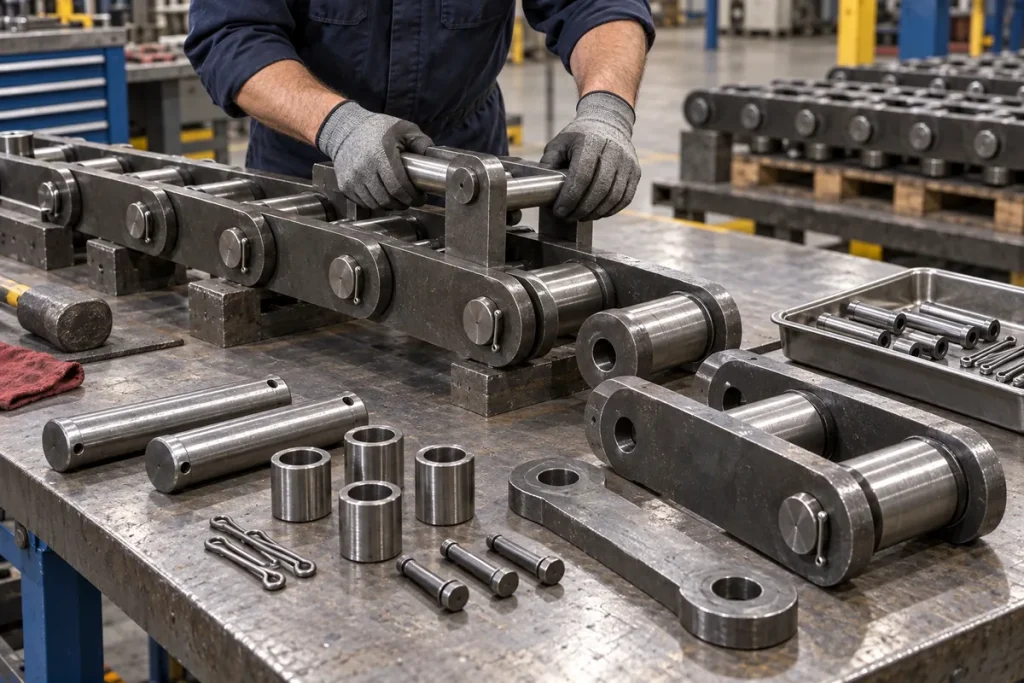
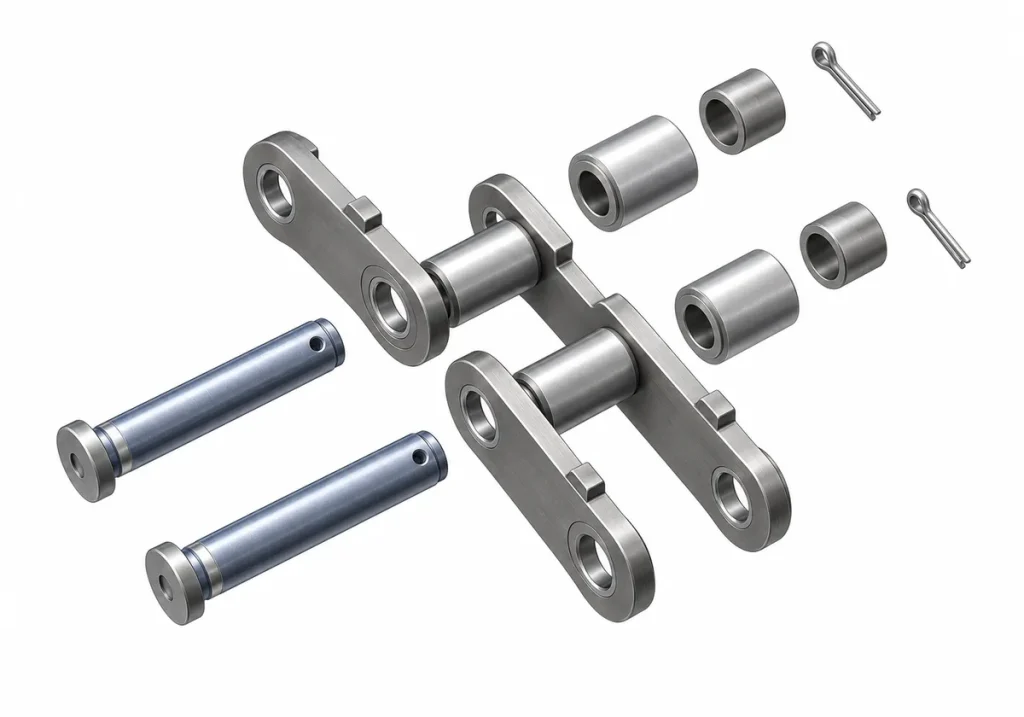
Why Does a Feeder Breaker Chain Need Repeated Tension Adjustment?
Repeated feeder breaker chain adjustment can signal wear, sprocket engagement, alignment, build-up, mixed repairs, or take-up issues. Use a structured.
Guía de ingenieríaActualizado el 16 de septiembre de 2026
A feeder breaker chain that repeatedly needs tension or take-up adjustment is telling the maintenance team that something in the system is changing. The change may be expected service wear, but it may also involve uneven joint wear, sprocket condition, misalignment, flight damage, material build-up, mixed replacement sections, take-up mechanics, or a difference between the installed chain and the assumed configuration. Repeating the same adjustment without recording the evidence can hide the trend until the machine is short of adjustment range or begins to show more severe symptoms.
This troubleshooting guide does not provide a universal feeder breaker tension value. Correct tension, sag, take-up position, and adjustment procedure are machine specific. Instead, the guide uses a symptom-to-evidence path: confirm the adjustment history, measure the chain consistently, inspect sprocket engagement, compare both strands where applicable, examine the flight and chain path, and decide whether the next action is maintenance, component replacement, drawing review, or engineering escalation.
The aim is to separate “the chain was adjusted again” from the root cause. A take-up can compensate for geometric change, but it cannot repair a worn sprocket, straighten a misaligned path, or prove that an unknown replacement chain matches the original design.
Trend first
List dates, before/after take-up positions, sides/strands, reason for adjustment, and whether the symptom returned.
Inspect the system
Measure chain condition and inspect sprocket engagement, alignment evidence, flights, contact points, and build-up.
Stop repeating blind changes
When the same symptom returns, escalate the inspection rather than moving the take-up without a root-cause plan.
1. Reconstruct the Adjustment History Before Touching the Machine Again
Gather the last several maintenance entries and put them in chronological order. Record the date, operating context, reason for adjustment, before and after take-up positions, which side moved, any chain section replaced, and whether the symptom disappeared. If the records only say “adjusted chain,” interview the crew while details are still available and improve the form for future events.
The pattern can immediately narrow the investigation. Equal gradual movement on both sides presents a different question from repeated movement on one strand, a sudden large change after a repair, or an adjustment that fails to correct sprocket climbing. Treat the history as evidence rather than background paperwork.
2. Measure Chain Change with a Repeatable Multi-Pitch Method
Wear at articulated pin/bush joints can increase the effective chain length over time. To evaluate whether chain geometry is changing, use the approved inspection method and record a repeatable span over multiple pitch intervals when safe access permits. Keep the raw span, pitch count, location, chain condition, and photographs. Compare like with like across inspections.
Do not import a generic elongation rejection percentage from an unrelated chain and declare the feeder breaker chain unserviceable. Use the machine or chain specification for the decision limit. The troubleshooting purpose of the measurement is to establish whether a real trend exists and whether it is uniform or concentrated.
3. Inspect Sprocket Tooth Condition and Chain Seating
A chain can be adjusted to the nominal take-up position and still engage poorly if the sprocket tooth profile is worn, contaminated, damaged, or misaligned. Inspect accessible tooth spaces for unusual polishing, hooked or asymmetric wear, side scoring, and inconsistent seating. Photograph the same area over time when possible.
Pay attention to whether the chain climbs, hesitates, snaps into engagement, or contacts the sprocket side. Those symptoms should trigger inspection of both chain and sprocket rather than another automatic take-up movement. Running a new or less-worn chain on a badly worn sprocket can also complicate engagement, so replacement planning should consider the pair.
Repeated-adjustment symptom-to-check map
Observed pattern
Priority evidence
Possible route
Both sides move gradually over time
Repeatable chain measurements, joint condition, take-up history
Compare trend with controlled maintenance criteria.
Inspect contamination effects under site procedure.
Regla de registro
These are diagnostic routes, not universal causes. Confirm the condition with the machine-specific inspection and maintenance procedure before disposition.
4. Compare Strands and Look for Uneven Effective Length
On a paired scraper-chain system, one strand may accumulate different wear, damage, or repair history from the other. Compare take-up positions, multi-pitch measurements at corresponding areas, joint articulation, flight squareness, and side contact. If one strand repeatedly requires more correction, preserve that asymmetry instead of averaging it away.
Uneven effective length can skew flights and alter load sharing or tracking. The exact allowable relationship is machine specific, but the diagnostic observation is general: unexplained strand-to-strand difference deserves investigation before additional adjustment.
5. Check for Alignment and Tracking Evidence
Look for side-polished link plates, tapered sprocket wear, repeated contact on one guide, skewed flights, unequal clearance, or a chain that consistently walks toward one side. These observations do not prove shaft or track misalignment by themselves, but they provide a reason to check alignment under the machine maintenance procedure.
If a previous adjustment temporarily centered the chain and the symptom returned, ask what is causing the path to change. Loose or damaged guiding components, sprocket alignment, structural wear, debris, or a distorted flight may all contribute. Record the evidence before correcting it so the next review can see what changed.
6. Inspect Flights, Attachments, and Repaired Sections
A bent flight or altered attachment can impose local geometry on both strands. Photograph flights for squareness, scraper width, attachment integrity, extended pins or retention features, and signs of field welding or component substitution. Compare suspect units with an intact repeating unit from the same chain.
Mixed repair history is particularly important. If a replacement Chain Section has different joint condition or geometry from the surrounding chain, the take-up history may change after the repair. That does not mean the repair is automatically wrong, but it should be considered in the diagnostic timeline.
7. Remove Material Build-Up from the Diagnosis, Not Just from the Chain
Coal fines, packed material, or other debris can hide joints, restrict articulation, change visible clearances, and interfere with accurate measurement. Photograph the as-found condition first, then clean only under the approved procedure and repeat the inspection. Record whether the chain behavior changed after cleaning.
If repeated adjustment events occur during periods of heavy build-up, that correlation belongs in the maintenance history. It may not prove causation, but it helps engineering decide whether contamination control, access, cleaning method, or component inspection deserves attention.
8. Inspect the Take-Up Mechanism Itself
A take-up system can create misleading chain symptoms if its reference indicators, threads, hydraulic components, guides, locking features, or left/right movement are not functioning as intended. Confirm that the adjustment mechanism moves and holds position in line with the machine procedure. Record any difference between indicated movement and physically observed chain response.
Do not compensate for a mechanical take-up problem by applying more chain tension. If the mechanism does not hold or moves unevenly, repair the machine-side cause under the approved maintenance process before using chain adjustment as the diagnostic variable.
9. Review Configuration and Replacement Evidence
If repeated adjustment began after a chain replacement, section repair, or component change, verify the installed configuration. Measure pitch, repeating unit length, scraper width, flight spacing, and visible joint/attachment details. Compare them with the approved drawing or prior controlled record rather than with memory.
This is where pitch-only identification can create problems. K201B and K207B share nominal 3 1/2 inch pitch and a 21 inch repeating unit but differ in width and component structure. A chain selected on incomplete evidence could introduce a configuration difference that adjustment cannot correct.
10. Decide Whether the Next Step Is Adjustment, Repair, or Engineering Review
After the evidence is assembled, classify the cause as confirmed, likely, or unresolved. If the controlled maintenance procedure shows that a normal adjustment is due and the chain/system evidence is otherwise consistent, perform and verify that adjustment. If a damaged sprocket, flight, joint, take-up, or guide is identified, correct the component issue under the approved procedure.
If the chain identity is uncertain, measurements conflict with drawings, one strand behaves differently without explanation, or repeated adjustments fail to restore expected operation, escalate to engineering review. The escalation package should include the timeline, measurements, photos, drawing references, and open questions so the review begins with evidence rather than another guess.
Repeated adjustment
Successive take-up changes that form a trend rather than an isolated maintenance event.
Effective chain length change
A field-observed change in the chain system that may include articulation wear, repair effects, or measurement/state differences.
Engagement symptom
Climbing, impact, hesitation, side contact, or another visible behavior as chain meets a sprocket.
Root-cause escalation
Stopping routine adjustment so wear, alignment, configuration, take-up, or machine conditions can be investigated systematically.
Lista de verificación práctica para la transferencia de información
Utilice esta lista de verificación de traspaso para cerrar el registro de campo para Why Does a Feeder Breaker Chain Need Repeated Tension Adjustment?El objetivo no es crear otro formulario de mantenimiento genérico, sino preservar las observaciones específicas, los puntos de referencia y el contexto de la máquina que el siguiente revisor necesita para comprender cómo se obtuvo el resultado. Mantenga los límites de aceptación específicos de la máquina según el plano aprobado, el procedimiento de mantenimiento o las instrucciones de ingeniería, en lugar de inventar un valor universal para la malla.
Control
Qué grabar
Cómo se utiliza el registro
Reconstruct the Adjustment History Before Touching the Machine Again
Record the exact machine location, strand or side, current operating/shutdown state, and the observation that relates to reconstruct the adjustment history before touching the machine again. Include a photograph that lets another reviewer find the same area.
Establece el contexto para que las mediciones posteriores no se desvinculen de la máquina y la posición de la cadena.
Measure Chain Change with a Repeatable Multi-Pitch Method
Capture the physical reference used for measure chain change with a repeatable multi-pitch method. Keep the raw dimension, image or marking beside the interpretation, and note any wear, repair, build-up or access limitation that could affect the reading.
Garantiza la repetibilidad del resultado y evita que una referencia dañada o mal definida se convierta en el requisito de reemplazo.
Inspect Sprocket Tooth Condition and Chain Seating
Cross-check inspect sprocket tooth condition and chain seating against any controlled drawing, previous purchase reference or retained spare that is available. Keep current field data and historical information in separate fields when they differ.
Preserva la trazabilidad cuando las condiciones sobre el terreno, los registros históricos y la información nominal del producto no coinciden a la perfección.
Compare Strands and Look for Uneven Effective Length
For compare strands and look for uneven effective length, state what is confirmed, what is only observed, and what still needs engineering confirmation. Attach the image or measurement that supports the statement rather than relying on a product name alone.
Proporciona al departamento de mantenimiento, al de compras y al proveedor una lista clara de lo que se puede hacer ahora y lo que debe resolverse antes del lanzamiento.
Separe el estado actual de la geometría de reemplazo necesaria. A worn, repaired, dirty or partially dismantled component may still be very useful for identification, but its current shape is not automatically the manufacturing requirement. Label field measurements as observed data, retain the original unit and measurement method, and identify any feature that may have been altered by service. For feeder breaker chain repeated adjustment, photographs should show the measurement endpoints or component relationship clearly enough that a remote reviewer can reproduce the logic.
Resuelva la información contradictoria en lugar de ocultarla. If a drawing, old order, marking and current measurement point in different directions, keep each source visible and describe the conflict. Do not average values or silently choose the most convenient one. Use additional photographs, measurements from another intact repeating unit, machine interface information and the controlled document revision to determine which value governs. If decide whether the next step is adjustment, repair, or engineering review cannot be confirmed during the shutdown, state that limitation explicitly so the open question survives the handoff.
Make the next action obvious for Why Does a Feeder Breaker Chain Need Repeated Tension Adjustment?. El registro completo debe indicar a mantenimiento qué se debe volver a comprobar, a compras qué información pertenece a la RFQ y a ingeniería qué dimensiones o interfaces aún necesitan aprobación. Antes de que la máquina vuelva a estar en servicio, confirme que el conjunto de archivos incluye una vista general de la máquina, una vista completa de la cadena/vuelo repetitiva, primeros planos de los componentes o marcas relevantes y las dimensiones utilizadas en esta guía. Para feeder breaker chain repeated adjustmentUn conjunto de observaciones rastreables es más útil que una narración larga sin datos, y reduce el riesgo de que la decisión de reemplazar se tome basándose únicamente en el tono, la apariencia o un número de pieza antiguo.
Cuestiones que deben resolverse antes de la próxima decisión.
Does repeated adjustment always mean the chain is worn out?
No. It can be associated with chain wear, but sprocket condition, alignment, repairs, build-up, take-up behavior, and configuration also need to be checked. Use the controlled replacement criteria for the final decision.
Can I solve the problem by using a tighter setting?
Do not exceed or invent the machine-specific setting. Excessive tension can create additional loads and does not correct a worn sprocket, misalignment, damaged flight, or incorrect configuration.
Why measure both strands separately?
A paired system can develop asymmetric wear, repairs, or tracking. Separate records reveal differences that an average or single take-up value would hide.
What should I send for engineering review?
Send the adjustment timeline, before/after positions, chain measurements, sprocket and tracking photos, flight/component condition, drawing or previous order reference, and a list of unresolved discrepancies.
Siguiente paso: Cerrar el registro técnico.
Repeated feeder breaker chain adjustment should trigger a change in maintenance behavior: from “move the take-up again” to “identify what is changing.” The history, multi-pitch measurements, sprocket condition, strand comparison, tracking evidence, flights, contamination, take-up mechanism, and configuration together form the diagnostic path.
The final decision still belongs to the controlled machine and chain criteria. The value of this workflow is that the next adjustment, repair, or replacement is based on evidence and that unresolved conditions are escalated before the machine consumes more adjustment range or damages surrounding components.