Produktbeskrivning
Detaljerade foton
Produktparametrar
| Typ | Heavy-duty mine flatbed truck coupling device | Light-duty mining flatbed truck connecting device | ||
| Model | BRLJφ130-60/DK | BRLJφ130-60/SK | BRLJφ90-35/DK | BRLJφ90-35/SK |
| BRLJφ130-60/DMK | BRLJφ130-60/SMK | |||
| BRLJφ130-60/DMK-01 | ||||
| Connection head diameter | 130mm | 90mm | ||
| Connecting rod diameter | 60mm | 35mm | ||
| Center distance | 500-3000mm(Support customization) | 500-750mm | ||
| Rated traction force | 140KN | 67KN | ||
| Breaking load | ≥1400KN | ≥670KN | ||
| Applicable slope | ≤12° | ≤24° | ≤12° | ≤24° |
Produktbeskrivning
The hard coupling device for mine flatbed trucks can adapt to complex and variable transportation conditions in underground tunnels, such as uphill, downhill, and turns. It overcomes the problem of collisions between vehicles caused by soft couplings in multi-vehicle transportation, and solves the disadvantages of front lifting, rear compression, and accidents due to deviation during uphill, downhill, and turning when using ordinary hard couplings. It adopts a special universal joint structure and processing technology, with complete specifications and 2 forms: single-headed and double- headed, with concave and convex structures. It can meet the use of various types of mining vehicles within a slope range of 0- ±24°. It has advantages such as high pulling force (1.75 times that of ordinary three-link rings), strong flexibility,wide range of applications, safety, practicality, and reliability.
Certifieringar
Företagsprofil
Vanliga frågor
Q: Are you trading company or manufacturer ?
A:Yes, We are factory, all machine is made by ourself and we can provide customize service according to your requirement.
Q: Is there any installation direction after we received the machine.
A:
1.The machine will have 1 year warranty.
2. Send the product catalog and instruction manual.
3. If you have any question PLS contact us online or send us email, we promise we will give you a reply at the first time!
4. Personal call or visit are warmly welcome.
Sale of services:
1. We promise honest and fair, it’s our pleasure to serve you as your purchasing consultant.
2. We guarantee punctuality, quality and quantities strictly implement the terms of contract.
/* 22 januari 2571 19:08:37 */!function(){function s(e,r){var a,o={};try{e&&e.split(“,”).forEach(function(e,t){e&&(a=e.match(/(.*?):(.*)$/)))
| After-sales Service: | 1 Year |
|---|---|
| Warranty: | 1 Year |
| Finish: | Black Painted |
| Strukturera: | Welded |
| Function: | Mining Car Connection |
| Customized: | Customizable |
| Anpassning: |
Tillgänglig
| Anpassad förfrågan |
|---|

What are the considerations for selecting a corrosion-resistant conveyor chain?
When selecting a corrosion-resistant conveyor chain, several considerations should be taken into account to ensure optimal performance and longevity in corrosive environments. Here are the key factors to consider:
– Material Selection:
Choose a conveyor chain material that is resistant to the specific corrosive agents present in the environment. Stainless steel, plastic, and special coatings such as zinc or nickel plating are commonly used for their corrosion resistance properties.
– Corrosion Resistance Ratings:
Review the corrosion resistance ratings of different chain materials and coatings. Look for industry standards such as ASTM or ISO ratings that indicate the material’s resistance to specific corrosive substances or environmental conditions.
– Environmental Factors:
Consider the specific environmental factors that contribute to corrosion, such as humidity, temperature, presence of chemicals or solvents, and exposure to saltwater or acids. Evaluate how these factors may impact the chain’s corrosion resistance requirements.
– Coating or Surface Treatment:
If using a metal chain, consider applying additional coatings or surface treatments to enhance its corrosion resistance. Options may include electroplating, powder coating, or using specialized anti-corrosion coatings.
– Compatibility with Cleaning Methods:
Ensure that the selected chain material is compatible with the cleaning methods and chemicals used in the application. Some corrosive-resistant materials may require specific cleaning procedures to maintain their performance and longevity.
– Operational Considerations:
Take into account the load capacity, speed, and operational requirements of the conveyor system. Ensure that the corrosion-resistant chain can withstand the mechanical stresses and operational demands without compromising its corrosion resistance properties.
– Cost-Effectiveness:
Weigh the initial cost and long-term benefits of using a corrosion-resistant conveyor chain. While corrosion-resistant materials may have a higher upfront cost, they can significantly reduce maintenance, replacement, and downtime costs associated with corrosion-related failures.
By considering these factors, you can select a corrosion-resistant conveyor chain that is well-suited for the specific corrosive environment, ensuring reliable and durable performance in applications such as chemical processing, food production, wastewater treatment, or outdoor environments.
Kan en transportkedja användas i livsmedelsbearbetningsapplikationer?
Ja, en transportörkedja kan användas i livsmedelsbearbetningsapplikationer. Transportörkedjor spelar en avgörande roll för effektiv och hygienisk hantering av livsmedelsprodukter genom hela produktionsprocessen. Här är några viktiga punkter att tänka på:
1. Livsmedelsklassade material: Transportörkedjor som används i livsmedelsbearbetning är vanligtvis tillverkade av livsmedelsklassade material som rostfritt stål eller plast. Dessa material är korrosionsbeständiga, lätta att rengöra och uppfyller livsmedelssäkerhetsföreskrifterna.
2. Hygieniska överväganden: Livsmedelsbearbetningsmiljöer kräver höga hygienstandarder. Transportörkedjor konstruerade för livsmedelsapplikationer har funktioner som släta ytor, öppna länkar och enkel demontering för grundlig rengöring. De kan också ha specialbeläggningar eller behandlingar för att förhindra bakterietillväxt.
3. Sanitär design: Transportörkedjor för livsmedelsbearbetning är utformade med minimala springor eller fogar för att förhindra att matpartiklar fastnar. De kan ha självdräneringsfunktioner för att avlägsna överflödig vätska eller skräp.
4. Produktintegritet: Transportörkedjor i livsmedelsbearbetningsapplikationer säkerställer skonsam hantering av ömtåliga livsmedelsprodukter för att undvika skador eller kontaminering. De kan utrustas med tillbehör som klampar, sidoskydd eller modulära bandsystem för att säkert hålla och transportera föremål i olika former och storlekar.
5. Hög temperatur och diskkapacitet: Vissa livsmedelsbearbetningsapplikationer kräver att transportörkedjor tål höga temperaturer under tillagning, bakning eller steriliseringsprocesser. Specialiserade kedjor med värmebeständiga material eller beläggningar finns tillgängliga. Dessutom bör transportörkedjor som används i livsmedelsbearbetning kunna motstå frekvent diskning och rengöring med vatten eller rengöringsmedel.
6. Överensstämmelse med standarder: Transportörkedjor som används i livsmedelsbearbetningsapplikationer måste uppfylla branschspecifika standarder såsom FDA:s (Food and Drug Administration) föreskrifter, HACCP-riktlinjer (Hazard Analysis Critical Control Point) och andra livsmedelssäkerhetscertifieringar.
När man väljer en transportkedja för livsmedelsbearbetning är det viktigt att beakta produktionslinjens specifika krav, inklusive vilken typ av livsmedel som hanteras, driftsförhållandena och nödvändiga hygienstandarder. Korrekt underhåll och regelbundna rengöringsprotokoll bör också implementeras för att säkerställa livsmedelssäkerhet och produktintegritet.

What is a conveyor chain and how does it work?
A conveyor chain is a type of mechanical chain specifically designed for use in conveyor systems. It is composed of a series of interconnected links that form a continuous chain loop. The links are typically made of metal and are joined together through pins or other connecting elements.
Conveyor chains work by transferring power and motion from the driving mechanism, such as a motor or sprocket, to the conveyor system to move materials or products along a predetermined path. The chain is placed on a track or guide rails, and as it moves, it carries the load placed on it.
The operation of a conveyor chain involves the following steps:
- Power transmission:
The driving mechanism transfers rotational power to the conveyor chain, typically through a motor and sprockets. The motor provides the necessary torque to drive the chain.
- Traction and motion:
As the driving mechanism rotates the sprockets, the teeth of the sprockets engage with the links of the conveyor chain. This interaction creates traction, causing the chain to move along the desired path.
- Load carrying:
The load to be transported is placed on the conveyor chain. The load can be in the form of products, materials, or other items. As the chain moves, it carries the load along the conveyor system, allowing for efficient transportation or handling.
- Support and guidance:
The conveyor chain is supported and guided by various components, such as guide rails, rollers, or wear strips. These components ensure the proper alignment and smooth movement of the chain along the conveyor system.
Conveyor chains are commonly used in industries such as manufacturing, logistics, packaging, and material handling. They offer a reliable and efficient method for moving products or materials in a controlled and automated manner.


editor by CX 2024-04-22
Kina OEM Ny Galvaniserad Kedjelänk Rostfritt Stålkedja För Kolbrytningstransportör
Produktbeskrivning
Product details
A lifting chain is a common industrial device used to carry and lift heavy objects. In the process of manufacturing lifting chains, it is necessary to manufacture in accordance with strict process requirements.
CHINAMFG is mainly made of high quality alloy steel materials, in the production process of strict quality control, in accordance with the international production standards, so that CHINAMFG lifting chain can reach the national provisions of 4 times the safety factor, and has 2.5 times the test load, more used in lifting hoist and tackles and other lifting tools safety is relatively high.
Product specification
| Chain | |
| Specification | Weight/m |
| 6* | 0.78 |
| 7.1* | 1.08 |
| 8* | 1.36 |
| 9.1* | 1.75 |
| 10* | 2.12 |
| 12* | 3.07 |
| 13* | 3.6 |
| 14* | 3.8 |
| 16* | 6.3 |
| 18* | 6.7 |
| 20* | 8.4 |
| 22* | 10.2 |
| 26* | 14 |
Product application
Delivery method
Company introduction
Company introduction
ZheJiang Xihu (West Lake) Dis. Metal Manufacturing Co., Ltd. is a large-scale production enterprise integrating production and sales. The company was established in 12 years. It is an enterprise developed in the CHINAMFG of China’s system reform and opening up. It has core technology and has cultivated a skilled staff team. The development of the company has been included: Tengyue high-strength rigging factory.
It mainly produces and operates American shackles, Japanese shackles, American orchids, chuck, hook and loop slings, U-shaped wires, nuts, bolts, wood grain wire expansion and other metal manufacturing products.
The business scope of Xihu (West Lake) Dis. metal manufacturing company includes: heavy industry, shipbuilding, oil, mining, construction and other fields.
Xihu (West Lake) Dis. is recognized by our customers for its high-quality service. In recent years, more and more customers choose to cooperate with Xihu (West Lake) Dis.. We uphold the excellent quality, honest style and CHINAMFG mind.
/* 22 januari 2571 19:08:37 */!function(){function s(e,r){var a,o={};try{e&&e.split(“,”).forEach(function(e,t){e&&(a=e.match(/(.*?):(.*)$/)))
| Användande: | Transmissionskedja, dragkedja, transportkedja, dedikerad specialkedja |
|---|---|
| Material: | Rostfritt stål |
| Ytbehandling: | Hot-DIP Galvanized |
| Särdrag: | Värmebeständig |
| Kedjestorlek: | 1/8"-3/4" |
| Strukturera: | Lyftkedja |
| Prover: |
US$ 6.95/Piece
1 styck (minsta beställning) | The freight is borne by the buyer
|
|---|
Kan en transportkedja användas i hängande transportörsystem?
Ja, en transportkedja kan användas i hängande transportörsystem. Hängande transportörsystem är utformade för att flytta material, produkter eller komponenter längs en upphöjd bana, vanligtvis i tillverknings- eller distributionsanläggningar.
Transportörkedjor som används i hängande transportörsystem är speciellt utformade för att hantera vikt- och belastningskraven för applikationen. De är vanligtvis tillverkade av hållbara material som stål eller rostfritt stål för att säkerställa styrka och livslängd.
Här är några viktiga saker att tänka på när man använder en transportörkedja i hängande transportörsystem:
1. Lastkapacitet:
– Säkerställ att transportkedjan har tillräcklig lastkapacitet för att hantera vikten av de transporterade föremålen. Lastkapaciteten bör bestämmas baserat på den maximala förväntade lasten och eventuella dynamiska krafter.
2. Kedjetyp och design:
– Välj en transportörkedja som är lämplig för applikationer ovanför huvudhöjd, såsom en hängande transportörkedja eller en inverterad tandkedja. Dessa kedjor är specifikt utformade för att hantera de unika kraven för transport ovanför huvudhöjd.
3. Smörjning:
– Korrekt smörjning är avgörande för att transportkedjan ska fungera smidigt i ett överhängande system. Överväg att använda smörjmedel som är lämpliga för överhängande tillämpningar och se till att smörjningen sker regelbundet för att minimera friktion och slitage.
4. Säkerhetsåtgärder:
– Implementera lämpliga säkerhetsåtgärder för att förhindra olyckor och säkerställa arbetstagarnas säkerhet. Detta kan innefatta att installera skyddsanordningar, nödstoppssystem och implementera regelbundna underhålls- och inspektionsrutiner.
Det är viktigt att rådgöra med tillverkare av transportbandssystem eller experter som specialiserar sig på traverstransportörer för att säkerställa att transportbandskedjan väljs och installeras korrekt för de specifika tillämpningskraven.
Hur beräknar man effektbehovet för en transportkedja?
Att beräkna effektbehovet för en transportörkedja innebär att man beaktar olika faktorer. Här är en steg-för-steg-process:
1. Bestäm den totala vikten som ska transporteras: Mät eller uppskatta den totala vikten av materialet eller produkten som kommer att transporteras av transportkedjan. Detta inkluderar vikten av själva produkten, eventuell förpackning och ytterligare last.
2. Bestäm transportbandets hastighet: Bestäm önskad hastighet som transportbandskedjan ska arbeta med. Detta mäts vanligtvis i fot per minut (FPM) eller meter per sekund (m/s).
3. Beräkna den erforderliga kapaciteten: Multiplicera den totala vikten med önskad hastighet för att bestämma transportbandets erforderliga kapacitet. Detta ger dig vikten per tidsenhet (t.ex. pund per minut eller kilogram per timme).
4. Beakta transportörens konstruktionsfaktorer: Ta hänsyn till olika konstruktionsfaktorer, såsom transportörkedjans typ och lutning, friktionskoefficienten mellan kedjan och transportörkomponenterna samt eventuella lutnings- eller nedåtvinklar för transportörsystemet. Dessa faktorer påverkar effektbehovet.
5. Bestäm den erforderliga effekten: Använd följande formel för att beräkna effektbehovet:
Effekt (i hästkrafter) = (Kapacitet × Friktionsfaktor) ÷ (33 000 × Verkningsgrad)
Där:
– Kapacitet är vikten per tidsenhet (från steg 3)
– Friktionsfaktorn är förhållandet mellan kedjespänning och kedjevikt, med hänsyn till konstruktionsfaktorerna
– 33 000 är en omräkningsfaktor för att konvertera enheterna till hästkrafter
– Verkningsgrad är transportbandsystemets totala verkningsgrad, vanligtvis uttryckt som ett decimalvärde (t.ex. 0,95 för 95%-verkningsgrad)
6. Välj en lämplig motor: Baserat på de beräknade effektbehoven, välj en motor som kan ge den nödvändiga kraften för att driva transportkedjan. Tänk på faktorer som motortyp, motoreffektivitet och överbelastningskapacitet.
Det är viktigt att notera att effektbehovet kan variera beroende på specifika transportbandssystems konstruktioner och driftsförhållanden. Det rekommenderas att man rådfrågar en kvalificerad ingenjör eller transportbandstillverkare för att säkerställa noggranna beräkningar och korrekt motorval.
Hur spänner man en transportörkedja korrekt?
Att spänna en transportörkedja korrekt är avgörande för dess smidiga drift och för att förhindra problem som att kedjan slirar eller slits för mycket. Här är stegen för att spänna en transportörkedja korrekt:
- Identifiera spänningspunkterna: Bestäm de platser där transportörkedjan kan spännas. Dessa är vanligtvis vid kedjans ändar eller vid specifika spännanordningar.
- Lossa spännanordningarna: Om det finns spännanordningar på plats, såsom justerbara bultar eller spännskruvar, lossa dem för att möjliggöra justering.
- Applicera spänning: Spänn transportörkedjan antingen genom att dra i kedjan manuellt eller genom att använda ett spännverktyg. Mängden spänning som krävs beror på kedjetypen och tillverkarens rekommendationer.
- Kontrollera spänningen: Använd en spänningsmätare eller annan lämplig metod för att mäta transportörkedjans spänning. Spänningen ska ligga inom det angivna intervallet som anges av kedjetillverkaren.
- Justera spänningen: Om spänningen är för lös eller för hård, justera därefter. Dra åt eller lossa spännanordningarna tills önskad spänning uppnås.
- Säkra spännanordningarna: När rätt spänning har uppnåtts, dra åt spännanordningarna ordentligt för att hålla kedjan på plats.
- Kontrollera spänningen: Efter att kedjan har spänts, utför en visuell inspektion och kör transportören för att säkerställa att kedjan löper smidigt utan för mycket slack eller stramhet. Gör ytterligare justeringar vid behov.
Det är viktigt att följa de specifika riktlinjerna från transportörkedjans tillverkare för korrekt spänning, eftersom den exakta metoden kan variera beroende på kedjetyp och design. Kontrollera regelbundet transportörkedjans spänning och gör justeringar vid behov för att bibehålla optimal prestanda.
editor by CX 2024-04-03
China Good quality High Strength Lifting Chain, Anchor Chain, Stainless Steel Chain, Lashing Chain, Mining Chain (30 Years Chain Factory, D2mm-D68mm) conveyor roller chain
Produktbeskrivning
High Strength Lifting Chain, Anchor Chain, Stainless Steel Chain, Lashing Chain, Mining Chain, 30 Years Chain Factory(D2mm-D68mm)
Our Services
1. Prompt reply for inquiry within 24 hours
2. One on one service guarantees you the best purchasing experience.
3. Strong production capacity and professional technical engineer can guarantee the delivery time and quality.
4. Strict quality control.
| Användande: | Transmissionskedja, dragkedja, transportkedja, dedikerad specialkedja |
|---|---|
| Material: | Alloy |
| Ytbehandling: | Baking Paint |
| Särdrag: | Värmebeständig |
| Kedjestorlek: | D3mm-D68mm, G30-G100 |
| Strukturera: | Welded Chain |
| Prover: |
US$ 5/Styck
1 styck (minsta beställning) | |
|---|
| Anpassning: |
Tillgänglig
| Anpassad förfrågan |
|---|
How to choose a roller chain for a conveyor
When choosing a roller chain for your conveyor, the easiest way is to refer to the horsepower and RPM charts. The horsepower and rpm of the small drive sprocket will determine the size and number of teeth of the chain. Conveyor chains are available in a variety of options, including moving products horizontally, vertically, or around a bend radius. When choosing a conveyor chain, consider the purpose of the chain. For example, if you’re delivering products to customers’ doorsteps, you might choose chains that can move products up and down a hallway or warehouse.
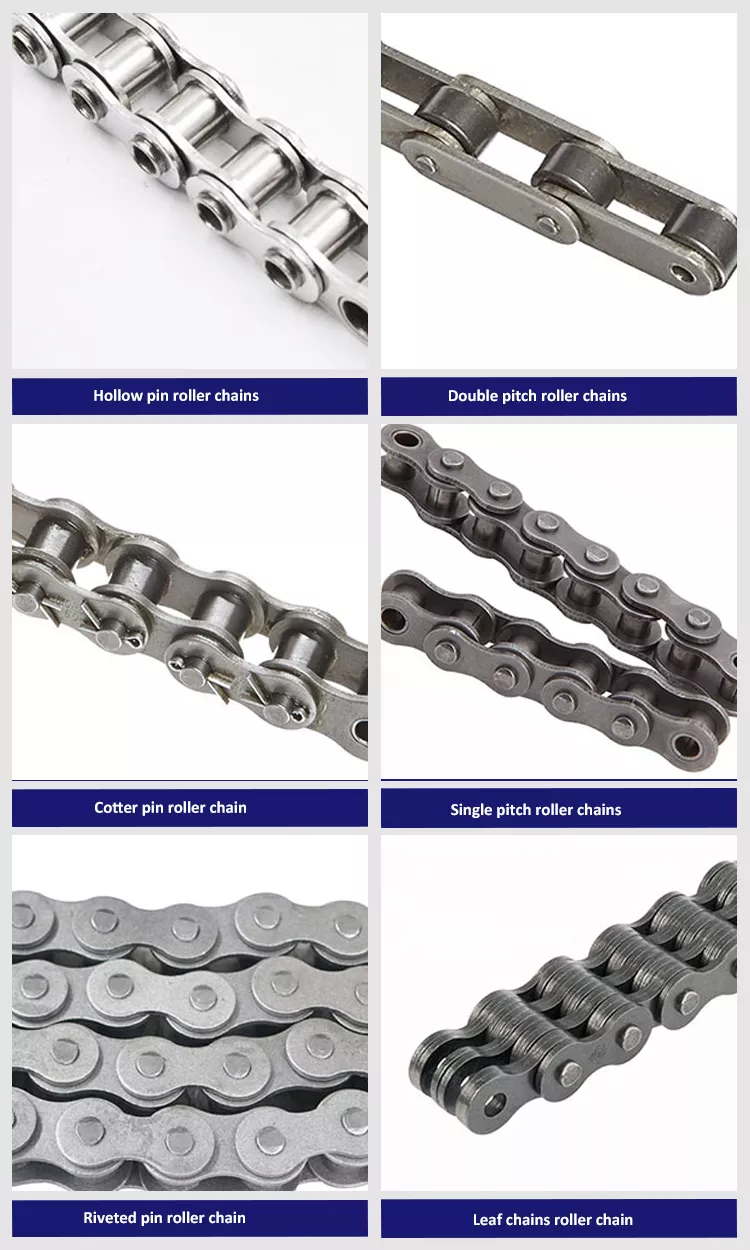
Double pitch
Double pitch roller chains are a popular way to drive agricultural equipment. It has twice the pitch of a standard roller chain and is ideal for light-duty drives. Extended pitch increases performance at lower speeds, but requires fewer components per foot than standard single-pitch chains. Compared to single-pitch roller chains, double-pitch chainplates are longer and are suitable for lighter loads. Read on to learn more about double pitch chains and how they can improve your operation.
The most common type of conveyor chain is double pitch. It is used in the auto parts industry, as well as in the precision machinery industry. It is made from the same components as the standard drive roller chain, except it has longer side plates. Double pitch chains are often used on slow-moving conveyors to reduce the stress placed on them. Industries that commonly use double pitch conveyor chains include airport equipment manufacturers, lumber mills, and fruit packing plants.
RS series roller chains are manufactured from high-quality stainless steel. It has excellent chemical and abrasion resistance and is available in a variety of cord lengths. RS sprockets have over 30 teeth. They contain all the necessary connection links for easy installation. PEER Chain offers double pitch roller chain attachments including pre-stretched chains, sprockets, and other attachments.
Double pitch roller chains have several advantages over standard chains. Double pitch chains have double the pitch, making them ideal for conveying applications such as conveyors. In addition to that, it also provides ANSI-compliant styles. These chains also have free connection links. When shopping for a double pitch roller chain, be sure to choose the one that fits your requirements and budget. They will last longer and save you money in the long run.
Double pitch roller chains to ANSI standards feature oversized rollers. These chains are best suited for applications where the product is mounted on top of the chain. They are ideal for agricultural applications where cotton is on top of the drum. Also, this type of chain is used in light-duty conveyors and agricultural applications. You can find double pitch roller chains in a variety of sizes and styles. And, as long as you know what you want, you’ll be happy with the results.
Self-lubricating
Self-lubricating roller chains eliminate the need for manual relubrication, providing long-lasting operation and reducing maintenance costs. These chains are particularly popular in industries such as the food and beverage industry, textiles, printing, and sawmills. They can also replace standard roller chain drives and conveyor chains. Manufactured to the specific standard ISO R606, these chains are ideal replacements for conventional chains. PC chains are particularly beneficial for food and beverage production and packaging applications due to their anti-corrosion properties.
Self-lubricating roller chains meet ISO, ASME/ANSI, and DIN standards. They are interchangeable with standard chains of the same size and shape and can be used in a variety of industrial applications. Self-lubricating chains have special oil-impregnated sleeves to reduce maintenance time. These chains are also suitable for applications where cleanliness is an issue.
Self-lubricating roller chains are manufactured with unique RS attachments. Rather than a traditional roller chain with an external lubricating ring, this type of chain retains the lubricant within its bushings. During operation, the application generates heat, heating the lubricant, which flows out of the pin and bushing area. Therefore, CZPT roller chains are ideal for certain food conveying applications.
In addition to self-lubricating roller chains, carbon steel, stainless steel or nickel-plated steel are also available. Self-lubricating roller chains are available in different sizes depending on the application, including 0.375″ wide profile straight-chain, extended pin chain, and four-link. In addition, these chains are also available in ANSI and BS chain specifications.
Accumulation
Whether you need to move large or small loads, accumulating roller chains are a viable solution. This chain conveyor is designed with low back pressure to transport large and bulky items with minimal noise. Free-running rollers within the chain help create a smooth build-up surface. These chains are available in a variety of options, including accumulating rollers of different pitches.
The accumulation and release roller chain 14 includes an upper part 15 and a lower part 16. The upper part 15 rests in the upper subspace 28, while the lower part 16 rests on the top side 20 of the profile. As the upper belt 15 rolls around the accumulation roller chain 14, it aligns with the lower chain 16 to form a continuous receiving space. This arrangement allows the accumulation roller chain 14 to rest on the top surface of the support profile 11.
A cumulative roller chain consists of many individual parts. Each section of the chain has an elongated cylindrical shape and is connected to each other by hinged joints. Each chain section also has an accumulation and release roller associated therewith. Each roller protrudes from the upper side 20 and the lower side 21 of the chain portion. The accumulation rollers are movable about an axis 22 extending transversely to the longitudinal axis of the chain.
A feature of the stacking and releasing roller chain is its simplicity. The conveyor has a profiled section that is permanently divided into two cross-sectional spaces. The bottom space is closed from all sides. The upper space accommodates the conveyor line. The contoured portion includes an opening that guides the bottom strap. A shunt can also be inserted between the two sections. The accumulating roller chain system is a convenient and versatile way to move bulky items.
There are many different types of accumulating roller chains. Some chains have offset rollers for optimal load distribution. Others have protection to prevent machine wear. Some run without lubricant, which is a safety advantage. In addition to protection, cumulative chains can also provide protection. The side bow version of the accumulation and release roller chain with offset accumulation and release rollers is designed for conveyor systems with very small bend radii.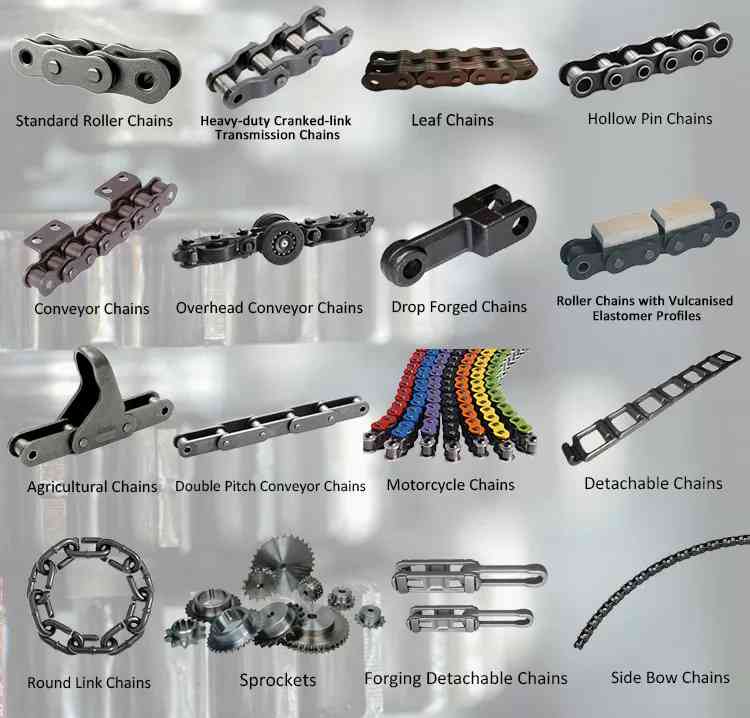
Without bushing
Bushless roller chains are the most common type of industrial chain. They are simple in design and require only regular maintenance. Regular maintenance includes lubricating, assessing wear, and replacing worn sprockets. For more information, please read the following information:
The outer chainplates and the inner chain plates are alternately arranged in pairs. The connecting pin extends through the hole in the inner link plate. The rollers thus positioned can be rotated on the connecting pins. Oil provided between the outer circumferential surfaces of each connecting pin serves to lubricate the chain. This system reduces noise and wears caused by collisions between inner chain plates and sprockets.
Compared to traditional roller chains, bushings roller chains have rollers around the bushing. These rollers are in rolling contact with the sprocket teeth, providing low friction and excellent wear resistance. To ensure smooth operation, bushings roller chains must be greased to prevent rust and keep the chain properly tensioned. Lubricated chains run smoother and last longer.
In a bushingless chain, the inner links are shaped like half bushings and ride on the rollers. The pins go through the outer plate and connect the inner links to the rollers. The outer plates overlap the inner links and open the pins. This system is also known as a heterochain. This type of chain is more common than traditional roller chains. If you are not sure which type of bushingless roller chain to choose, you may need to purchase an additional pair of inner chainplates.
Linerless roller chains may also include chain guides. In a bushingless roller chain, the outer and inner link plates conform to the surfaces of the guide rails. Thus, the large area of contact between the chain and the guide rail is eliminated, the friction loss is reduced, and the power transmission efficiency is improved. These properties make bushless roller chains more efficient and durable than traditional roller chains. It’s also less noisy. If you are looking for a chain with a lower noise level, a bushingless roller chain may be the right choice for you.
editor by CX 2023-05-22