A replacement feeder breaker chain should be selected from evidence, not from appearance alone. Chains that share a similar pitch can differ in scraper width, repeating unit length, link geometry, pins, flight arrangement, and attachment details. The safest replacement workflow is therefore to identify the existing chain, record the dimensions that control fit, and compare the complete configuration with a product model or approved drawing.
When to Start a Replacement Review
Begin a replacement review before the chain becomes impossible to identify. Useful triggers include planned shutdown work, visible damage to flights or links, repeated adjustment, changes in chain/sprocket engagement, missing or unreadable model information, or a purchasing requirement to establish a replacement source.
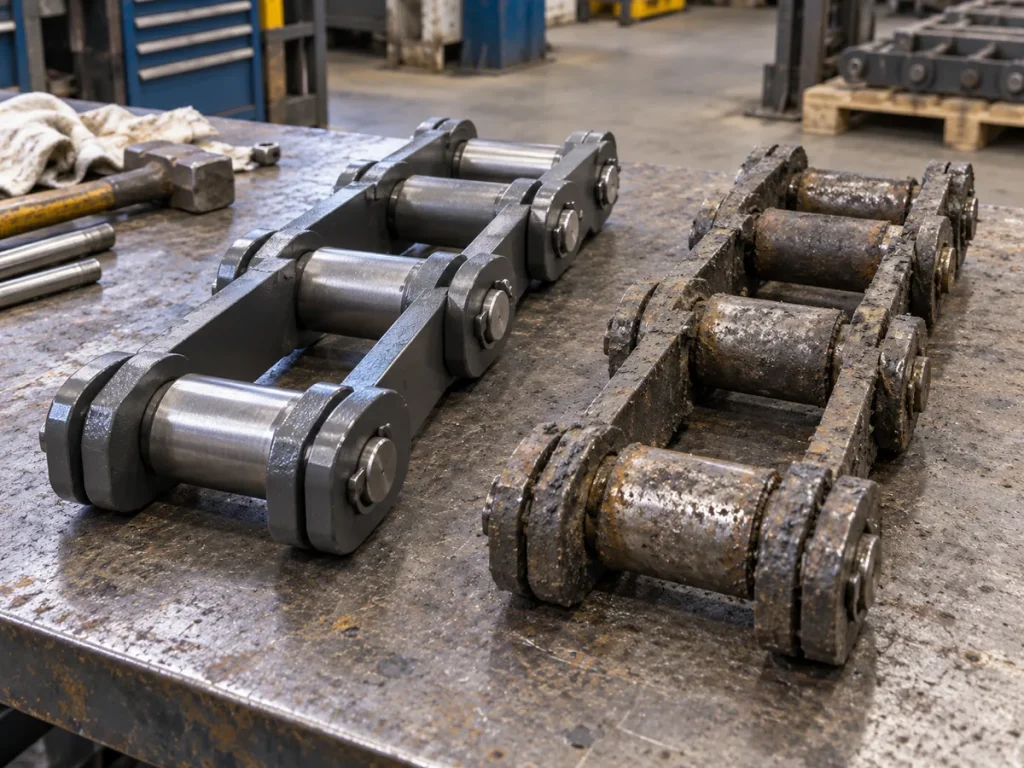
A damaged chain can still provide valuable evidence, but photograph an intact section as well. If the chain has already been removed, keep representative components together and label where they came from in the assembly. Avoid mixing parts from different chain runs or repair histories when preparing the identification package.
Measurements to Collect

A minimum measurement set should include pitch, chain unit length, scraper width, and the dimensions needed to understand the flight and link arrangement. Photographs should show the entire repeating chain section, joint areas, scraper or flight components, and any special pins or attachment links.
Sân bóng đá is measured between corresponding joint centres. Where access and the machine procedure allow, measuring across several pitches can reduce the effect of a single worn joint, but the method and span should be recorded clearly. Chiều dài đơn vị chuỗi should correspond with the repeating assembly rather than an arbitrary length of chain. Chiều rộng của máy cạo helps distinguish configurations that use the same nominal pitch.
Also record any markings on plates, pins, links, or flights. If a drawing or old purchase specification exists, include it even when the current chain appears to have been modified. The differences between the drawing and the installed chain are themselves useful evidence.
K201B and K207B Reference

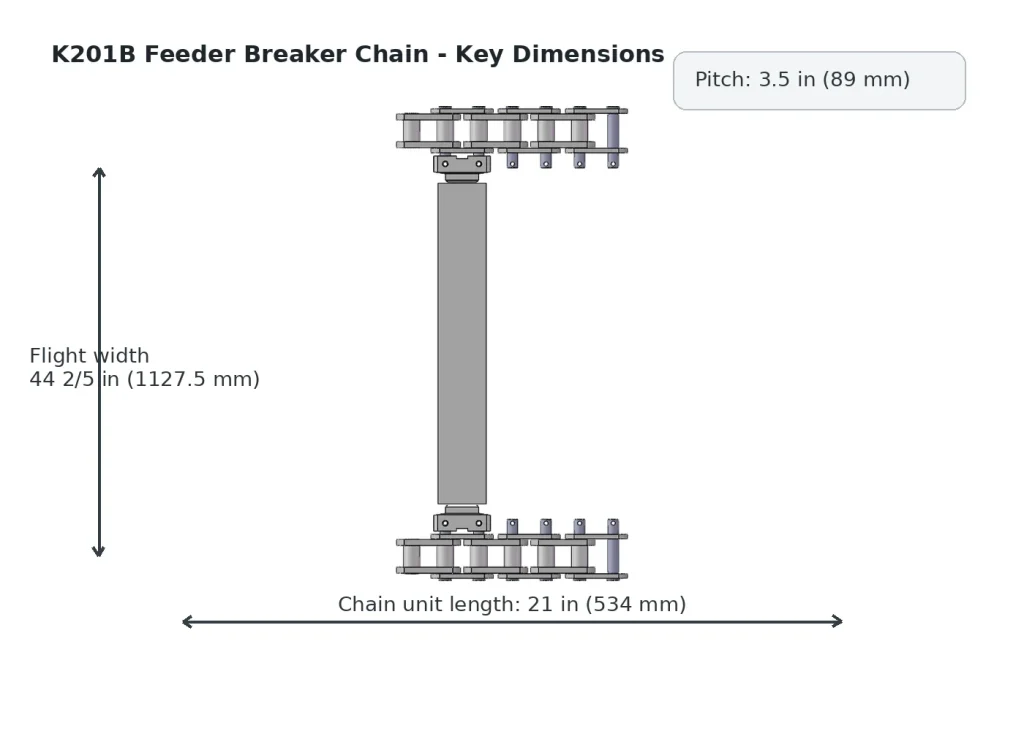
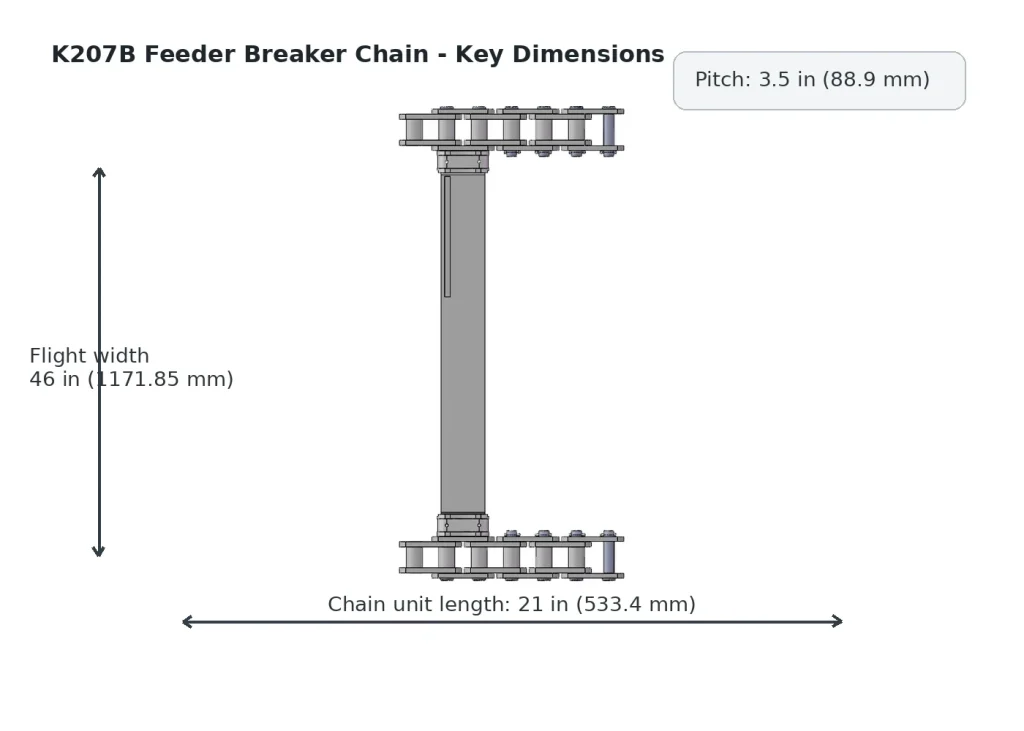
| Model | Sân bóng đá | Chiều dài đơn vị chuỗi | Chiều rộng của máy cạo |
|---|---|---|---|
| K201B | 3 1/2 inch (89 mm) | 21 inch (534 mm) | 44 2/5 inch (1127,5 mm) |
| K207B | 3 1/2 inch (88,9 mm) | 21 inch (533,4 mm) | 46 inch (1171,85 mm) |
These dimensions are useful comparison points, but they do not prove that an unidentified chain is K201B or K207B. Compare the structure as well. K201B identifies a locating bush and spring pin within its component tree; K207B identifies a scraper outer link, extended pin, and T-pin. A replacement match should be based on the full chain arrangement and equipment interface.
Chain and Sprocket Context
Chain wear and sprocket condition interact. A replacement review should therefore include photographs of chain engagement where safely possible, especially when the old chain shows uneven tracking, abnormal wear, or repeated tension adjustment. This does not mean a web page can decide whether a sprocket must be replaced. The decision depends on the equipment condition, approved maintenance criteria, tooth geometry, chain wear, and the machine manufacturer’s instructions.
Document what is visible: tooth contact pattern, unusual side contact, damaged or deformed components, and whether the chain is seating consistently. If a new chain is proposed for a heavily worn existing system, ask for an engineering review rather than assuming the surrounding components are suitable.
RFQ Evidence Checklist
A complete replacement enquiry should contain:
- chain model or part reference if known;
- equipment type and application;
- existing drawing, manual excerpt, or approved specification if available;
- pitch measurement and measurement span;
- chain unit length;
- scraper width;
- flight/scraper spacing and geometry;
- close-up photographs of links, pins, bushes, attachments, and retention features;
- overall photographs of the chain run and flight arrangement;
- photographs of an intact section when the damaged area is severe;
- required quantity;
- customer-controlled requirements for material, treatment, inspection, testing, marking, or documentation.
If the chain cannot be positively matched to a product model, the quotation should be based on a confirmed drawing or custom specification.
Câu hỏi thường gặp
Can I order a replacement from pitch only?
Pitch is an important first measurement, but it is not sufficient. Width, unit length, flight arrangement, joint construction, and equipment interface also matter.
Can K201B replace K207B because both are 3.5 inch pitch?
No interchangeability is claimed. Their documented scraper widths and component structures differ.
What if I do not have a drawing?
Send photographs and a measured sketch showing pitch, unit length, scraper width, link arrangement, flight/scraper geometry, and any distinctive pins or attachments.
Should I send the worn chain measurement or the original dimension?
Send the actual measured condition and clearly state how it was measured. If an original drawing exists, include that too. Do not silently “correct” the worn measurement to a guessed original value.
Can a sample chain section be used for identification?
A representative sample can be useful when it clearly preserves the normal link and flight arrangement. Keep the sample labelled and provide the equipment/application context.
Do I need to inspect the sprocket as well?
When chain engagement or wear is a concern, documenting the sprocket and surrounding chain path can help the engineering review. Machine-specific replacement criteria should come from the approved maintenance documentation.
Request a Replacement Review
Send the measurement set and photographs above. If the evidence supports a K201B or K207B match, the quotation can proceed on that basis. If not, the chain should be handled as a custom or unidentified configuration until a drawing is confirmed.
Request Replacement Review
Replacement Decision Path
A replacement enquiry can be classified into three paths. product model replacement applies when the model and its dimensions/structure are confirmed. Measured replacement applies when the model is unknown but the existing chain can be documented accurately. Custom engineering review applies when the current chain differs from available model data, the drawing conflicts with the installed assembly, or the equipment requires a special configuration.
Keeping those paths separate prevents a common sourcing problem: a measured chain is sometimes labelled with the nearest product model simply to make an RFQ easier to describe. That may simplify the email, but it transfers uncertainty into the order. It is better to state “model unknown, dimensions attached” than to assign an unsupported model number.
How to Handle Conflicting Evidence
If the drawing says one dimension and the installed chain measures another, keep both values in the record. Identify the technical data of each value, date the field measurement, and photograph the measurement points. Do the same when an old invoice names a model but the current chain structure looks different. The correct engineering response is to resolve the conflict, not to choose the more convenient source silently.
For damaged chains, avoid using a deformed flight or broken joint as the only dimensional reference. Look for an intact repeating section on the same chain run and record both the damaged and intact condition. If no intact reference remains, the drawing or a retained spare can become especially important.
Procurement Handover
Before the RFQ becomes a purchase order, carry the confirmed technical reference forward: approved drawing revision, model or custom identifier, quantity, required documentation, and any customer-controlled material or inspection requirements. Do not let the purchase order collapse the description back to a generic phrase such as “3.5 inch feeder breaker chain” if the engineering review established a more specific configuration.
Control the Drawing Revision Used for the Replacement
A replacement chain drawing should be treated as a controlled technical reference. Record the drawing number or project identifier used for the review, its revision or issue date when available, and the person or team that approved the final configuration. If a later field measurement conflicts with that drawing, retain both records and resolve the difference explicitly before the new order is released.
Avoid circulating several unlabeled sketches that appear to describe the same chain. When a hand sketch, customer drawing, supplier drawing, and historical order all exist, identify which one is the current reference and why. Older material can remain in the file for traceability, but it should not silently override the approved replacement definition.
For custom or unidentified chains, the replacement drawing should capture the features that actually control fit and assembly: pitch, repeating unit length, flight/scraper width, flight spacing when relevant, link and joint arrangement, attachment geometry, and any customer-controlled material, treatment, inspection, marking, or documentation requirements that have been specifically confirmed.
Handling a Physical Sample
A retained sample can be valuable when the original model is unknown, but its condition must be recorded. Photograph the sample before cleaning or disassembly when practical, identify which parts are damaged or worn, and note whether the sample represents a complete repeating unit. If the sample contains a repaired flight or a visibly deformed joint, do not use that feature as an unquestioned design reference.
Measure an intact area when possible and keep the photographs with the measurements. If only a damaged sample exists, combine it with drawings, historical photos, purchase records, sprocket/flight evidence, and measurements from the machine before deciding what the replacement should be.
Comparing Quotations on the Same Technical Basis
When more than one quotation is being reviewed, compare the technical definition before comparing commercial terms. Check that each proposal refers to the same model or controlled drawing, the same pitch and repeating unit length, the same scraper width and flight arrangement, and the same requested inspection/documentation scope. If one proposal substitutes a different configuration, make the difference visible rather than treating the quotes as like-for-like.
A concise technical comparison sheet can list the controlled requirement in one column and each supplier response beside it. Unknown or unconfirmed items should remain marked for clarification. This prevents a lower price from being accepted simply because an important configuration detail was omitted from the quotation.