How to Prepare a Damaged Chain Sample for Identification
Prepare a damaged feeder breaker chain sample for identification with traceable location, orientation, as-found photos, safe cleaning, dimensions.
Guía de ingenieríaActualizado el 16 de septiembre de 2026
A damaged feeder breaker chain sample can reveal geometry that photographs cannot: pin projection, plate thickness, bush condition, attachment detail, hole shape, hidden markings, and the relationship between failed surfaces. But a sample loses much of its value if it arrives in a box with no record of where it came from, which way it faced, or what work was performed before removal.
Preparation should therefore start while the part is still on the machine. Mark the chain location, direction of travel, strand/side, parent repeating unit, and sample boundaries. Photograph the damage in context. Record the dimensions that can be taken in place. Then remove the sample under the approved maintenance procedure and carry its identity into cleaning, measurement, packaging, and shipment.
This article is about traceability and engineering identification, not failure-analysis laboratory procedure. If the sample may be needed for metallurgical, fracture, or formal quality investigation, follow the organization’s evidence-preservation instructions and avoid cleaning or marking the failure surfaces without approval.
Preserve context
Assign machine, strand, direction, repeating-unit and damage-location IDs before the sample is removed.
Preserve condition
Take as-found photographs and avoid altering fracture, wear, marking, or contact surfaces that may matter to later review.
Preserve custody
Carry the sample ID through cleaning decision, measurements, packaging, shipment, and the engineering report.
1. Decide What Question the Sample Is Supposed to Answer
A sample taken for model identification needs enough intact geometry to measure and compare components. A sample taken to investigate a broken pin needs the pin, mating bush, surrounding plates, and fracture context. A sample taken to reproduce an unknown attachment needs the complete attachment relationship, not just the visibly damaged plate.
Write the question before cutting or separating anything. This prevents the maintenance crew from discarding the undamaged neighboring part that engineering later needs as a reference.
Give the sample a code tied to the machine, side/strand, flight or repeating-unit number, and date. Photograph a tag beside the sample while it is still installed and take a wider image showing the machine location. Record direction of travel and material-facing orientation.
If several samples are removed, use unique IDs and a simple map. Never rely on the order in which parts are placed on a pallet or bench to preserve identity.
Parent location
The exact position in the installed chain from which the sample was removed.
As-found condition
The sample state before cleaning, separation, repair, or handling changes its surfaces.
Orientation mark
A non-destructive approved identifier for travel direction, material side, or strand relationship.
Bench record
Measurements and photos taken after removal, clearly separated from installed-chain observations.
3. Capture As-Found Damage Before Cleaning
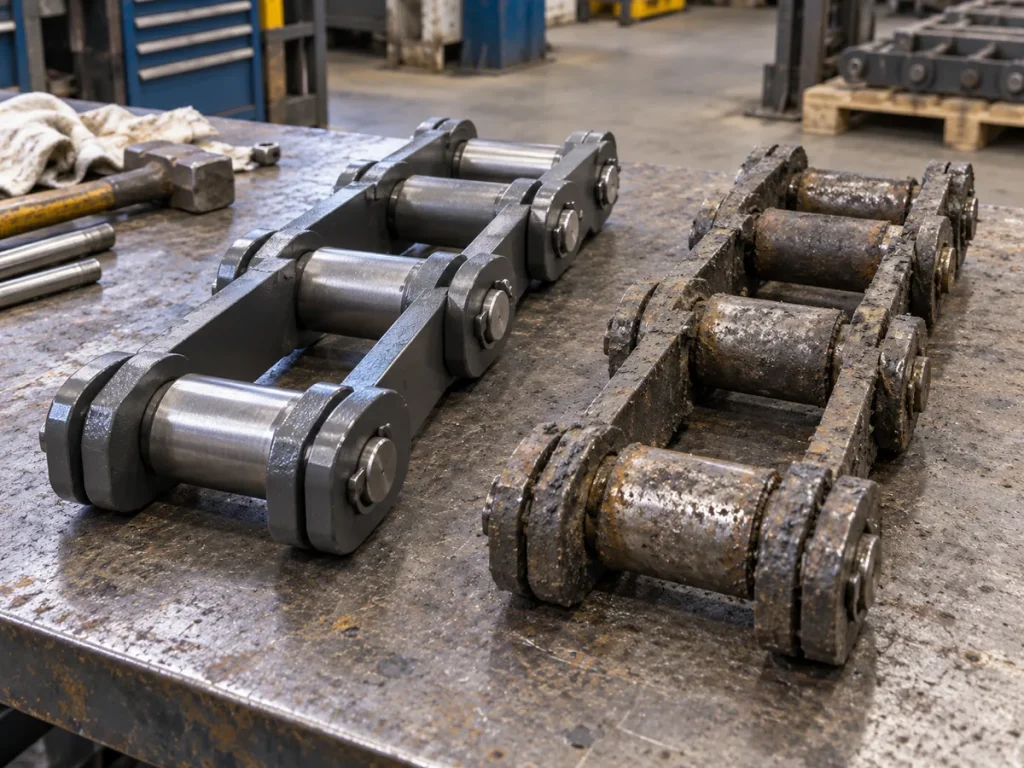
Photograph the sample dry/dirty/as found, including build-up, polishing, corrosion, impact marks, deformation, fracture position, missing retention, and nearby component condition. Use an intact comparable component in another photograph when possible.
Do not scrape, wire-brush, grind, paint, or oil a critical surface before the responsible engineer decides whether that treatment could remove useful evidence. Identification-only samples may later be cleaned, but the as-found record should already exist.
4. Record Installed Dimensions and Reference Points
Measure pitch spans, unit relationships, flight width/spacing, and relevant interface dimensions while the sample is still connected to the known chain where practical. Some relationships are easier to understand in the assembly than on a loose part.
Mark the endpoints in photographs. After removal, repeat selected dimensions and label them as bench measurements so changes in posture or cleaning do not create unexplained differences.
5. Remove Enough Adjacent Geometry for Identification
Where the maintenance and engineering plan allows, retain neighboring links or the associated flight connection rather than sending a single isolated plate. A pin without its bush can hide the mating relationship; a scraper plate without its head can hide the attachment; one chain link can hide the repeating pattern.
The correct sample size depends on the question and safe removal method. If shipping size is constrained, photograph and dimension the larger assembly before separating it and record exactly which child components came from which parent section.
6. Decide Whether and How the Sample May Be Cleaned
For dimensional identification, loose dirt may need to be removed so edges and markings can be measured. Use a method approved for the material and investigation. Keep photos before and after cleaning and note any coating, residue, or embedded material that was removed.
If formal failure analysis is possible, seek engineering or quality direction first. Cleaning can alter fracture deposits, corrosion products, lubrication evidence, or wear debris that may matter to the investigation.
7. Create a Bench Measurement Sheet
Record the sample ID, orientation marks, component names, raw dimensions, units, tools, measurement datums, and photo IDs. For a chain joint, useful records can include plate shape and thickness where controlled, pin diameter/location, bush geometry, hole locations, attachment relationships, and the distance to neighboring features. Do not invent tolerances.
Compare with candidate drawings in a separate column. Mark each feature as matches, differs, or cannot be verified because of damage. That gives engineering a clear path to the next measurement instead of a vague “sample similar to K201B.”
Damaged sample identification record
Record
What to include
Reason
Sample ID
Machine, strand, unit/flight, date
Keeps the component tied to original context.
Orientation
Travel direction, material side, left/right
Preserves asymmetric wear and attachment meaning.
As-found photos
Wide, medium, close defect views
Shows condition before cleaning or removal.
Installed measurements
Pitch/unit/width/interface values and endpoints
Preserves assembly relationships.
Bench measurements
Raw dimensions, tools, datums, post-clean state
Supports drawing/model comparison.
Cleaning record
Method, before/after photos, restrictions
Prevents loss of condition evidence.
Drawing comparison
Candidate model/revision, match/difference fields
Keeps identification transparent.
Regla de registro
If a formal failure investigation may be required, follow the responsible quality/engineering evidence-preservation procedure before cleaning or modifying the sample.
8. Protect the Sample During Packaging and Shipment
Secure heavy components so they cannot strike each other and create new dents or polished surfaces. Keep tags attached to packaging as well as to the sample where permitted. Protect sharp edges and fracture surfaces under the organization’s handling requirements.
Place the sample index, contact information, and electronic photo/drawing references in the shipment documentation. Do not put the only copy of the evidence sheet loose inside a wet or dirty package.
9. Reconcile the Sample with the Installed-Chain Record
When engineering receives the sample, compare the sample ID with the pre-removal map and photographs. Confirm that orientation and parent location are understood before the sample dimensions are used to define a replacement.
If the sample is a repaired or abnormal unit, it may be useful for diagnosing the problem but poor as the sole master for the complete replacement chain. Use intact-chain evidence and drawings alongside it.
Lista de verificación práctica para la transferencia de información
Utilice esta lista de verificación de traspaso para cerrar el registro de campo para How to Prepare a Damaged Chain Sample for IdentificationEl objetivo no es crear otro formulario de mantenimiento genérico, sino preservar las observaciones específicas, los puntos de referencia y el contexto de la máquina que el siguiente revisor necesita para comprender cómo se obtuvo el resultado. Mantenga los límites de aceptación específicos de la máquina según el plano aprobado, el procedimiento de mantenimiento o las instrucciones de ingeniería, en lugar de inventar un valor universal para la malla.
Control
Qué grabar
Cómo se utiliza el registro
Decide What Question the Sample Is Supposed to Answer
Record the exact machine location, strand or side, current operating/shutdown state, and the observation that relates to decide what question the sample is supposed to answer. Include a photograph that lets another reviewer find the same area.
Establece el contexto para que las mediciones posteriores no se desvinculen de la máquina y la posición de la cadena.
Assign the Sample Identity in the Machine
Capture the physical reference used for assign the sample identity in the machine. Keep the raw dimension, image or marking beside the interpretation, and note any wear, repair, build-up or access limitation that could affect the reading.
Garantiza la repetibilidad del resultado y evita que una referencia dañada o mal definida se convierta en el requisito de reemplazo.
Capture As-Found Damage Before Cleaning
Cross-check capture as-found damage before cleaning against any controlled drawing, previous purchase reference or retained spare that is available. Keep current field data and historical information in separate fields when they differ.
Preserva la trazabilidad cuando las condiciones sobre el terreno, los registros históricos y la información nominal del producto no coinciden a la perfección.
Record Installed Dimensions and Reference Points
For record installed dimensions and reference points, state what is confirmed, what is only observed, and what still needs engineering confirmation. Attach the image or measurement that supports the statement rather than relying on a product name alone.
Proporciona al departamento de mantenimiento, al de compras y al proveedor una lista clara de lo que se puede hacer ahora y lo que debe resolverse antes del lanzamiento.
Separe el estado actual de la geometría de reemplazo necesaria. A worn, repaired, dirty or partially dismantled component may still be very useful for identification, but its current shape is not automatically the manufacturing requirement. Label field measurements as observed data, retain the original unit and measurement method, and identify any feature that may have been altered by service. For damaged feeder breaker chain sample identification, photographs should show the measurement endpoints or component relationship clearly enough that a remote reviewer can reproduce the logic.
Resuelva la información contradictoria en lugar de ocultarla. If a drawing, old order, marking and current measurement point in different directions, keep each source visible and describe the conflict. Do not average values or silently choose the most convenient one. Use additional photographs, measurements from another intact repeating unit, machine interface information and the controlled document revision to determine which value governs. If reconcile the sample with the installed-chain record cannot be confirmed during the shutdown, state that limitation explicitly so the open question survives the handoff.
Make the next action obvious for How to Prepare a Damaged Chain Sample for Identification. El registro completo debe indicar a mantenimiento qué se debe volver a comprobar, a compras qué información pertenece a la RFQ y a ingeniería qué dimensiones o interfaces aún necesitan aprobación. Antes de que la máquina vuelva a estar en servicio, confirme que el conjunto de archivos incluye una vista general de la máquina, una vista completa de la cadena/vuelo repetitiva, primeros planos de los componentes o marcas relevantes y las dimensiones utilizadas en esta guía. Para damaged feeder breaker chain sample identificationUn conjunto de observaciones rastreables es más útil que una narración larga sin datos, y reduce el riesgo de que la decisión de reemplazar se tome basándose únicamente en el tono, la apariencia o un número de pieza antiguo.
Notas de decisión de campo para esta tarea
El registro de inspección para How to Prepare a Damaged Chain Sample for Identification Debería ser fácil de usar una vez finalizado el cierre. Las siguientes tres notas convierten el artículo en una transferencia práctica sin establecer un límite de aceptación específico para la máquina. Son especialmente útiles cuando las observaciones de mantenimiento deben revisarse posteriormente por ingeniería o compras y la cadena original ya no está disponible.
Confirm Decide What Question the Sample Is Supposed to Answer
Comience por identificar dónde y cómo se realizó la observación. Registre la máquina, el lado de la cadena o el hebra, la unidad repetitiva o la ubicación del vuelo, y el estado de la cadena cuando se realizó la verificación. Si el componente estaba sucio, cargado, flojo, retirado, reparado o visiblemente deformado, mantenga esa condición junto a la lectura. Una fotografía debe incluir suficiente estructura circundante para que otra persona pueda encontrar la misma ubicación. Para este artículo, el objetivo es preservar el contexto detrás de decide what question the sample is supposed to answer en lugar de reducirlo a un número aislado.
Cross-check Assign the Sample Identity in the Machine
Utilice una segunda observación o referencia controlada para cuestionar el primer resultado. Puede tratarse de una unidad repetitiva intacta vecina, otro hilo de la cadena, una revisión del dibujo, un registro de compra anterior o una pieza de repuesto conservada. Mantenga visible el valor del campo original incluso cuando la comparación sugiera un requisito nominal diferente. Cuando los dos no coincidan, describa por qué puede existir la diferencia e identifique qué debe confirmarse a continuación. Esto es particularmente importante para assign the sample identity in the machine, porque el desgaste por el uso, el método de medición y las reparaciones previas pueden afectar el estado en el que se encuentra.
Prepare Capture As-Found Damage Before Cleaning for review
Empaquete el resultado para que pueda verificarse de forma remota. Incluya la medición u observación bruta, su unidad, caras de referencia o puntos finales, al menos una fotografía de primer plano y una fotografía de contexto, y cualquier dibujo o marca utilizada durante la identificación. Indique si el elemento está confirmado, es candidato o desconocido. Si capture as-found damage before cleaning Depende de una suposición; escriba la pregunta abierta en la solicitud de cotización en lugar de convertir la suposición en una especificación. El revisor receptor debería poder comprender la condición de la cadena sin reconstruir el método de memoria.
Mantén visible el límite de decisión. Record Installed Dimensions and Reference Points may influence the next maintenance or sourcing step, but the website does not set a universal discard, tension or interchangeability limit. Use the equipment procedure, approved drawing and order-specific engineering requirements for acceptance decisions. The purpose of this record is to make the observation behind damaged feeder breaker chain sample identification lo suficientemente rastreable como para que se pueda elegir el producto o la ruta de ingeniería correcta sin tener que adivinar.
Cuestiones que deben resolverse antes de la próxima decisión.
Should I clean a broken chain part before sending it?
Only after considering the purpose of the sample. For simple dimensional identification, controlled cleaning may help. For possible failure analysis, obtain engineering/quality guidance first and preserve as-found photographs.
How much chain should I send?
Send enough geometry to answer the identification question. One isolated component may be insufficient if its relationship to adjacent links, pins, bushings, or a flight must be understood.
Can I mark the sample with a grinder or punch?
Do not alter stressed or evidential surfaces unless an approved procedure permits it. Use non-damaging tags, paint markers, packaging labels, and photographs as appropriate.
What if the sample comes from a repaired area?
Label it as repaired and collect an intact comparison from the installed chain if possible. A repair sample may not represent the original design geometry.
Siguiente paso: Cerrar el registro técnico.
A damaged chain sample is most valuable when its identity, orientation, as-found condition, and parent location are preserved from the machine to the engineering bench. That context allows dimensions and component features to be interpreted correctly.
Plan the sample around the question you need answered, retain enough adjacent geometry, and keep installed and bench measurements separate. If failure analysis may be required, preserve evidence first and clean later under the responsible procedure.