Feeder breaker chain maintenance should combine safe access, repeatable observations, machine-specific adjustment procedures, and clear records. A generic chain page cannot replace the feeder breaker manufacturer’s maintenance instructions, so this guide focuses on what to observe and document rather than prescribing universal intervals, tension values, lubrication quantities, or discard limits.
Inspection Before Work
Before any physical inspection, measurement, cleaning, or adjustment, follow the equipment and site procedures for isolation and stored-energy control. The machine manual and mine maintenance requirements take precedence over this guide. Do not reach into a chain path or attempt to measure a moving or energised conveyor.
Once access is authorised, clean only as required to expose the areas being inspected. Material build-up can hide joint condition and can alter the apparent alignment of the chain or flight assembly.
Link, Pin and Bush Condition
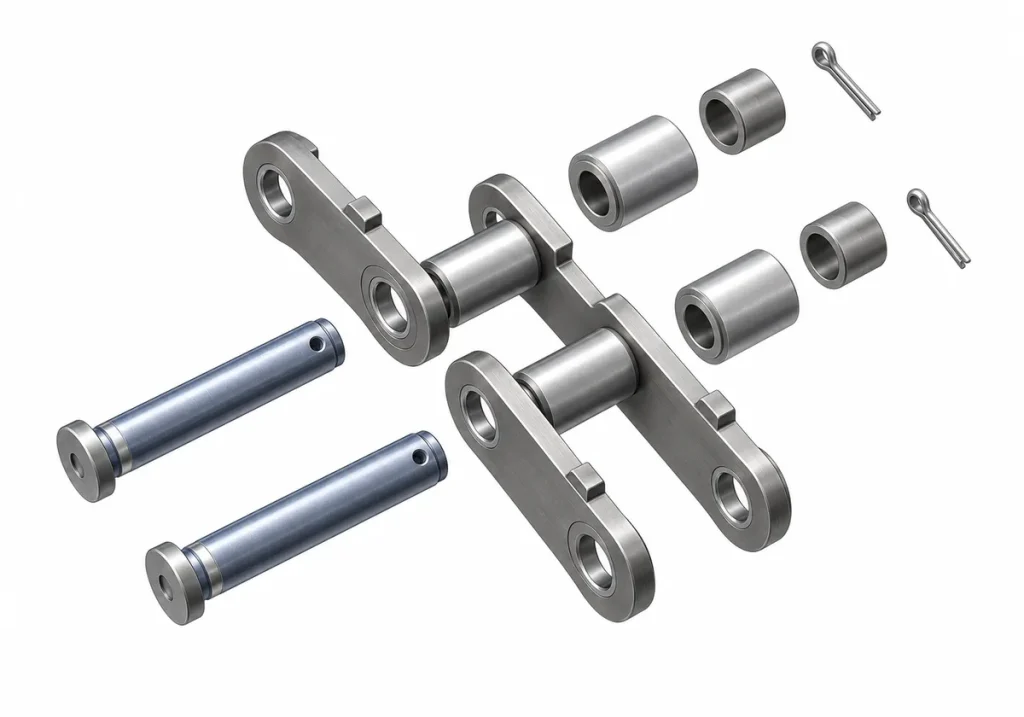
Inspect representative chain sections and compare similar positions on both strands where the design uses paired chains. Record visible plate deformation, cracking or damage indications, unusual edge contact, distorted holes or attachment areas, missing retention features, and changes in pin/bush relationship that can be observed safely.
Joint wear accumulates across the chain, so a single visibly loose joint should not be treated as a complete diagnosis. Where the approved procedure includes dimensional measurement, record the span, number of pitches, measurement points, machine condition, and date so the result can be compared over time.
Flight and Scraper Condition

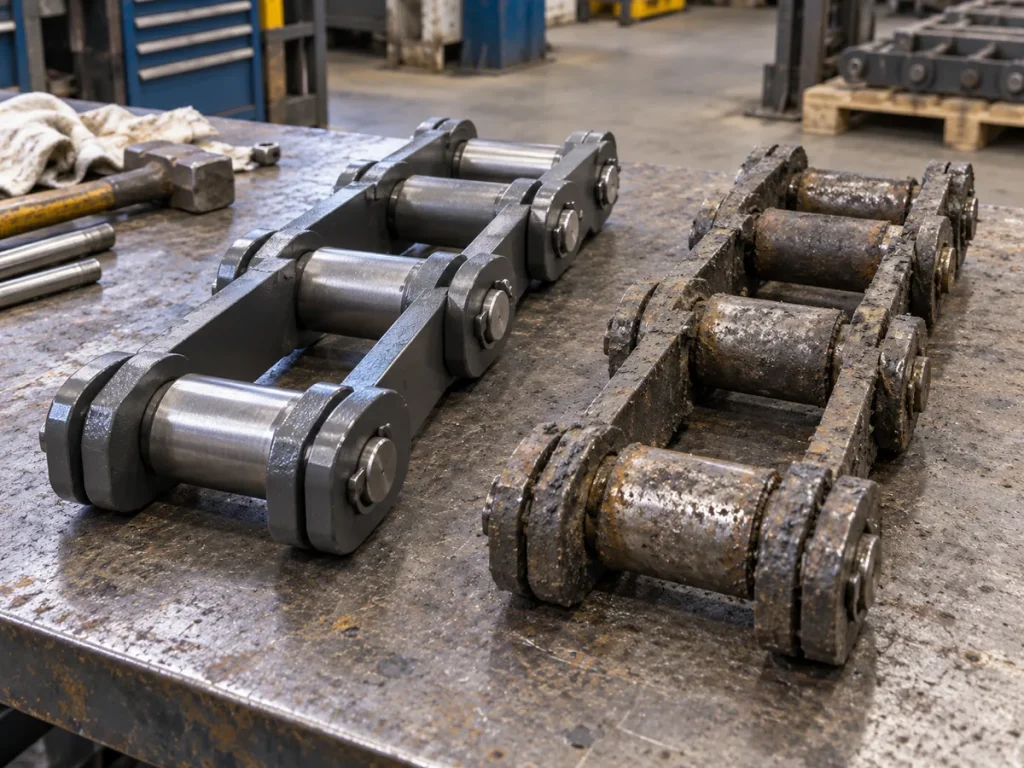

Flights and scraper components should be reviewed for deformation, damage, looseness, unequal geometry, and unusual contact with the conveyor path. The K201B and K207B models use documented scraper-head and scraper-plate components, and their flight-section arrangements differ. That makes intact flight geometry valuable evidence during replacement planning.
If one flight is badly damaged, photograph several intact flights before removal. Record scraper width and spacing pattern rather than assuming the damaged component represents the original configuration.
Alignment and Tension Observations

Look for symptoms rather than guessing a tension value: uneven sag, inconsistent engagement, chain tracking to one side, repeated adjustment, unusual contact marks, or a change in operating noise or vibration reported by the maintenance team. Any adjustment should follow the machine-specific procedure and should be applied to the correct adjustment mechanism.
If the chain cannot be brought back to normal tracking or engagement within the approved adjustment method, investigate wear, sprocket condition, guides, flight alignment, and chain identity rather than continuing to tighten the system.
How to Check Chain Tension
Contamination and Operating Environment
Feeder breaker chains may operate around abrasive or wet bulk material, fines, and build-up. Contamination can obscure joint condition, interfere with visual inspection, and contribute to abnormal contact. Record where build-up repeatedly occurs and whether it coincides with flight damage, tracking problems, or difficult chain movement.
The correct cleaning and lubrication method is machine- and chain-specific. Do not introduce a lubricant or cleaning process solely because it is common on another chain type.
Documenting Wear Trends
A useful inspection record is consistent. Photograph the same reference locations where practical, include a scale or measurement reference, note the number of operating hours or service interval if your maintenance system tracks it, and record any adjustment, component replacement, or abnormal event that could change the next reading.
For dimensional wear tracking, keep the raw measurements as recorded. Do not overwrite earlier values with a “corrected” number. Trend information is more useful when the measurement method is stable and the history is preserved.
Replacement Planning

Replacement planning should start while the chain is still identifiable. When damage, wear trend, adjustment history, or engagement concerns indicate that a replacement review is needed, capture the chain geometry before removal. Measure pitch, chain unit length, scraper width, and flight configuration; photograph joints and attachments; and collect the machine drawing or previous purchase record if available.
A replacement quotation should distinguish between a positively identified model, a measured but unidentified chain, and a custom configuration. That distinction prevents model assumptions from becoming procurement errors.
Maintenance FAQ
How often should a feeder breaker chain be inspected?
Use the feeder breaker manufacturer’s maintenance schedule and the site’s approved procedure. This guide does not publish a universal interval.
What is the maximum allowable chain elongation?
No universal discard value is published here. Use the machine/chain specification or an approved engineering criterion for the actual equipment.
Can I adjust tension when the chain looks loose?
Follow the machine-specific adjustment procedure. First confirm that the observed condition is not caused by wear, sprocket issues, misalignment, or damaged components.
Should I replace the sprocket when I replace the chain?
The chain and sprocket should be evaluated together when engagement or wear is a concern, but the replacement decision depends on the actual machine condition and approved maintenance criteria.
What records are most useful for a replacement RFQ?
Photographs, pitch/span measurements, scraper width, chain unit length, flight arrangement, component markings, equipment context, and the existing drawing where available.
Creating a Repeatable Inspection Route
A consistent inspection route makes condition records more comparable. Define the same observation points for each scheduled check: selected chain joints on each strand, representative flight assemblies, visible sprocket engagement areas, chain guides, and the approved take-up reference. The machine manual should decide where inspection is safe and practical; the record should simply preserve the same reference locations where possible.
Number or label photographs so another reviewer can tell where each image came from. An overall photo should establish orientation, followed by close-ups. If an inspection identifies a defect, add a wider view to show its relationship to the chain path. This prevents a close-up from being interpreted without context.
Distinguishing Local Damage from Systematic Change
One damaged flight or link may result from a local event, while similar marks appearing at repeated positions can indicate a broader interaction. The maintenance record should therefore compare several locations before drawing a conclusion. Record whether the condition appears on one strand or both, one flight or multiple flights, one side of the scraper or both sides, and whether contact marks repeat at a consistent machine position.
This approach does not diagnose the cause by itself. It creates the evidence required to test possibilities such as alignment, sprocket engagement, guide contact, flight geometry, or contamination. Avoid replacing a component and deleting the record of the condition that led to replacement.
Joint Measurement Records
When dimensional measurement is part of the approved procedure, record the span, number of pitches, reference points, units, and condition of the chain. A multi-pitch span can be more useful for trend analysis than an isolated single-pitch reading, but only when the method is repeatable. Keep the original measurements even if a later check produces a different result.
If the chain is K201B or K207B, the nominal model values can be kept alongside the field record for reference, but do not use nominal dimensions as a substitute for measuring the installed chain. If the current assembly conflicts with the nominal model, flag it for engineering review.
Flight and Scraper Documentation
For flights, record scraper width, spacing, visible deformation, attachment condition, and any side contact. Use an intact flight as the dimensional reference whenever a damaged one is present. On K201B and K207B, the documented Scraper Head and Scraper Plate are useful location terms for the inspection record, but numerical acceptance limits must still come from the approved technical criteria.
When a flight has been repaired, note the date and describe what changed. Future reviewers need to know whether a dimensional difference is progressive wear or the result of a previous repair.
Chain Path and Sprocket Engagement
A chain can show symptoms at one location while the cause lies elsewhere in the path. Photograph visible engagement at accessible sprockets, guide contact, and the relationship between the two chain strands. Note whether abnormal contact is consistent or intermittent and whether it changes after an approved adjustment.
Do not use a photograph to infer hidden sprocket dimensions or a replacement criterion. The goal is to preserve the visible condition so it can be considered together with measurements and machine documentation.
After Maintenance Work
After an approved adjustment or component replacement, record what was changed and repeat the same observation points used before the work. This creates a before-and-after comparison. If the machine is returned to service through a defined test process, note the outcome and any remaining abnormal observation.
A good record should make it possible to answer: what was observed, what evidence supported the maintenance action, what was changed, and what changed afterwards. That level of traceability is useful for both reliability work and future replacement-chain sourcing.
Preparing for a Planned Shutdown
Before a planned shutdown, decide which information must be captured while the chain is accessible. Prepare measurement forms, drawing references, photo labels, and any approved tools needed for inspection. If replacement sourcing may be required, include pitch, unit length, scraper width, flight spacing, model/component markings, and photographs of an intact repeating unit in the shutdown task list.
Collecting that evidence during a controlled shutdown is usually more reliable than reconstructing it after a damaged chain has been removed and mixed with discarded parts.
When to Escalate the Inspection
Escalate from routine inspection to engineering or replacement review when measurements conflict with historical records, the chain requires repeated adjustment, component damage repeats, the chain no longer tracks or engages as expected, the installed assembly cannot be matched to the known drawing, or the model identity is uncertain. The escalation should carry the inspection record with it so the reviewer can see the evidence rather than only a short problem description.
Build an Inspection Record That Can Be Repeated
A maintenance inspection becomes more useful when the next technician can repeat it. Use consistent observation points and photograph the same areas over time where practical. Record the chain path or side, the specific joint or flight used as a reference, the measurement endpoints, and any change in access or machine condition that could affect the result.
A simple inspection record can include the date, equipment identifier, operating context reported by the site, chain model if known, representative photographs, visible joint condition, flight/scraper condition, chain/sprocket engagement observations, any pitch/span measurement required by the site’s procedure, adjustment position when relevant, and open actions. The website should not prescribe a universal pass/fail number where the technical data does not support one; the site or machine-specific maintenance criteria remain controlling.
When an inspection finds an unusual condition, record both the symptom and the evidence. “Chain worn” is less useful than a photograph and note showing where the wear appears, whether it is symmetric, whether nearby joints show the same pattern, and whether the sprocket or flight geometry also shows a change.
A Consistent Photo Protocol
Photographs should be planned, not collected randomly. Start with an orientation image that shows where the chain is installed. Add a view of an intact repeating unit, close-ups of representative joints, the flight/scraper connection, and chain engagement with the sprocket when safely accessible. For a suspected defect, take one context image and one close-up with a scale or measurement reference where appropriate.
Keep the camera angle and reference area reasonably consistent across periodic inspections. This makes visual comparison more meaningful. Avoid editing photographs in a way that changes geometry or hides damage; only basic exposure/crop adjustments should be used for the maintenance record if needed.
If markings are present, photograph them separately and keep the image at a resolution that preserves legibility. Do not rely on handwritten transcription alone when the original marking can be captured.
From Maintenance Finding to Procurement Action
Maintenance and procurement need different outputs from the same evidence. Maintenance needs to understand the condition, trend, and required site action. Procurement needs a controlled chain identity and the specifications required to obtain a replacement. The handover should therefore include the model or “unknown” status, controlling drawing if available, key dimensions, component/flight structure, photographs, quantity, and the reason the replacement review was opened.
Do not turn a condition observation into a product specification without measurement support. For example, a worn dimension should not automatically become the drawing dimension for a new chain. Keep nominal references and field observations separate, and flag any discrepancy that engineering must resolve.
Maintenance History for Repeat Problems
When the same issue recurs, collect the history before making another adjustment. Review previous observations, adjustment dates, repair locations, chain/sprocket findings, material build-up notes, and any change in machine operation reported by the site. A repeated symptom can have several possible contributors, and the website should not diagnose the machine remotely from one photograph.
The value of the history is that it shows what changed and what did not. If one side repeatedly shows a different condition from the other, preserve that asymmetry in the record. If the same flight position is repeatedly repaired, keep that location information. If a new chain was installed but the surrounding sprocket or guide condition was not documented, note the evidence gap for the next review.
Maintenance-to-RFQ Checklist
Before a maintenance issue becomes a replacement RFQ, confirm that the file contains: chain identity or unknown status; current photographs; pitch, repeating unit length and scraper width; flight spacing/configuration where relevant; drawing or previous-order reference; chain/sprocket context; repair and adjustment history; quantity; and any customer-controlled inspection or documentation requirements.
A complete handover does not guarantee a model match, but it makes uncertainty visible and gives the engineering review a defensible starting point.