Scraper Head vs Scraper Plate: What Is the Difference?
Compare scraper heads and scraper plates in feeder breaker chain flight assemblies, including identification, inspection, photographs, damage records.
Engineering GuideUpdated सितम्बर 16, 2026
When a feeder breaker flight is damaged, people often use “scraper,” “scraper head,” “scraper plate,” and “flight” as though they describe one piece. On the K201B and K207B component trees, Scraper Head and Scraper Plate are listed as separate tertiary components. That distinction matters because a worn plate surface does not automatically mean the supporting head or attachment is undamaged, and a cracked head cannot be described adequately by sending only the outside width of the plate.
The exact geometry of these parts is model dependent. This article therefore focuses on how to identify and document the two component roles without inventing dimensions or assuming every feeder breaker chain uses the same construction. K201B and K207B are used as technically specified examples because both document a Scraper Head and Scraper Plate inside their flight-related component structure.
Before inspection, isolate and access the machine under the approved maintenance procedure. Do not reach into a chain path to obtain a close-up or try to move a loaded flight by hand. If the connection cannot be seen safely in place, use an approved drawing, spare part, or removed sample for the detailed review.
Scraper Head
Treat it as the structural part of the flight assembly that supports or connects the material-moving scraper geometry.
Scraper Plate
Treat it as a distinct plate component documented within the flight assembly, often the most visually exposed part in service.
Flight Section
Treat it as the broader assembly context that shows how head, plate, links, pins, and attachments work together.
1. Use the Component Tree to Keep the Names Separate
K201B lists K201B007 as Scraper Head and K201B008 as Scraper Plate. K207B lists K207B008 as Scraper Head and K207B009 as Scraper Plate. The fact that each model assigns separate identifiers tells the RFQ writer not to collapse the two names into one generic “scraper” item when component-level scope matters.
The component tree does not, by itself, define commercial availability or field replacement procedure. It is an identification framework. A purchaser who needs a complete Flight Section should say so; a purchaser who believes only the Scraper Plate is required should still show the surrounding head and attachment so engineering can confirm that the proposed scope is sensible.
2. Inspect the Scraper Plate as a Material-Contact Component
The scraper plate is exposed to the conveyed material and may show edge loss, polishing, gouging, impact marks, bending, cracking, or build-up. Photograph the full plate face before focusing on one damaged corner. Record which edge leads in the direction of travel if that can be established safely, and note whether the wear appears reasonably symmetric or concentrated at one side.
Avoid translating visual wear directly into a universal discard percentage. The website evidence does not provide a model-specific scraper-plate wear limit. Instead, preserve the measured remaining geometry, the nominal drawing if available, the wear pattern, and any clearance or tracking concern for engineering or the machine-specific maintenance criterion.
3. Inspect the Scraper Head as the Supporting and Attachment Structure
A scraper head should be documented around its connection to the plate and to the chain-side attachment. Look for deformation, cracks, fretting or movement at connections, altered holes, field welds, missing retention features, or asymmetry between the two sides. The head may remain visually intact even when the exposed plate is worn, or it may carry structural damage that is hidden by a relatively serviceable plate.
Take at least one oblique photograph that shows depth and attachment geometry. A flat front view is good for width, but it can hide bent lugs, pin projection, offset, or the relationship between the head and chain link. If the flight has been repaired, note which geometry is original and which appears to be a site modification.
4. Evaluate Head and Plate Together Inside the Flight Section
The two components should not be assessed as unrelated parts. A plate can transfer material forces into the head, and the head transfers those forces through the flight attachment into the chain. Uneven wear on the plate can therefore be a reason to inspect the head, attachment link, pin, and neighboring chain path rather than simply replacing the visible wear surface.
Likewise, a damaged head can change the plate orientation or effective scraper geometry. If the plate sits skewed, do not assume the plate was manufactured incorrectly until the head, attachment, and chain alignment have been examined. The inspection record should show the condition chain-side and material-side.
Scraper head and scraper plate inspection focus
Component
Primary evidence to capture
What not to assume
Scraper Plate
Full face, edges, remaining geometry, wear pattern, bends/cracks, build-up
Visible wear automatically equals a model-specific reject condition.
Scraper Head
Connection to plate, chain-side attachment, deformation, holes, welds, retention
An intact-looking plate proves the head and attachment are sound.
Flight Section
Complete assembly, both strand connections, orientation, width and spacing
One damaged component represents the condition of the entire chain.
Adjacent Chain Section
Pins/bushes, links, side contact, nearby wear or repair
The scraper problem is isolated from chain tracking or engagement.
Record rule
Separate the observed component condition from the diagnosis and from the final supply scope; all three may require different evidence.
5. Record Width Without Losing the Component Boundary
Scraper width is typically recorded across the conveying element, but the RFQ should state whether the dimension belongs to the plate edge, head reference, or complete flight assembly. If the plate overhangs the head, or if wear has reduced one edge, those features can change the observed outside width. Mark the endpoints on a photograph.
The K201B scraper width is 44 2/5 inches and the K207B scraper width is 46 inches. Those are model-level dimensions, not proof that every individual plate should be machined to a web-derived dimension without the controlled drawing. Use them for identification comparison and obtain the approved drawing for production control.
Scraper Head
A documented structural component of the K201B and K207B flight assemblies that is distinct from the scraper plate.
Scraper Plate
A separately identified plate component within the documented scraper/flight structure.
Flight Section
The broader assembly context that integrates scraper components with the chain.
Supply scope
The level actually requested in the quotation: component, section, repeating unit, or complete chain.
6. Photograph Damage with the Connection Still Visible
For a cracked, bent, or worn scraper component, capture the defect and at least one adjoining connection in the same frame. Then take a separate detail photo of the defect. This helps the reviewer determine whether the problem appears confined to the plate, concentrated at the head, or related to the attachment or chain path.
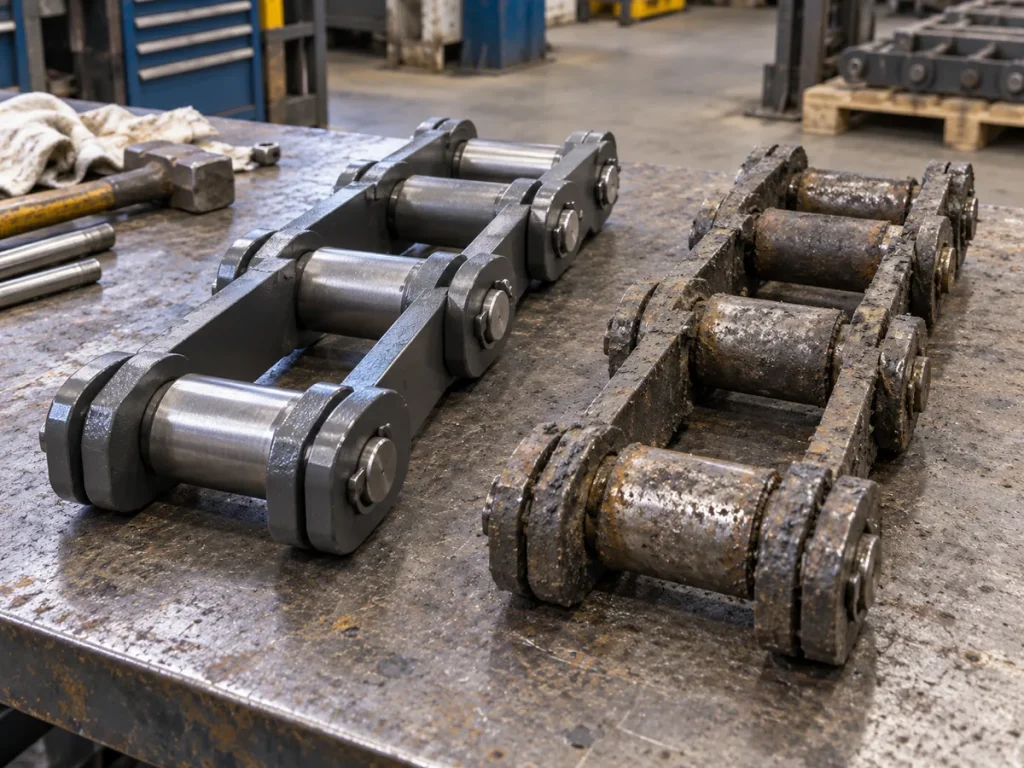
Add a comparison photograph of an intact flight from the same chain if available. Differences in plate shape, head angle, pin arrangement, or retention can become obvious when healthy and damaged units are shown side by side. Label the positions so the comparison cannot be confused with photos from another machine.
7. Use Damage Language That Does Not Overstate the Diagnosis
Write observations before conclusions. “Scraper plate has visible edge loss on discharge-side end” is an observation. “Chain misalignment caused the wear” is a diagnosis that requires additional evidence. A good inspection note can add “inspect tracking, sprocket engagement, and surrounding flights for cause” without pretending the cause is already proven.
The same discipline applies to cracks and deformation. State where the feature is, its orientation, whether it is open or surface-only if that can be determined through the approved inspection method, and what neighboring parts show. If nondestructive examination is required, that requirement belongs to the controlled inspection plan rather than an improvised web procedure.
8. Decide What the RFQ Is Actually Asking to Replace
An RFQ should make the desired scope explicit: complete chain, Flight Section, scraper head, scraper plate, or engineering review of a damaged assembly. If the site is uncertain whether the head and plate can or should be supplied separately, say so and request the supplier to confirm the appropriate assembly level.
Include the chain model if verified, complete flight photographs, the damaged component photos, relevant dimensions, quantity, and the controlled drawing if available. If the flight differs from the known K201B or K207B structure, do not use those part identifiers merely because the names “Scraper Head” and “Scraper Plate” appear similar.
9. Preserve Component Identity for Future Repeat Orders
When a replacement is approved, store the final drawing or supplier confirmation with photographs of the accepted head/plate assembly. Identify whether the order covered an individual component or a complete flight-related assembly. That record prevents the next maintenance team from assuming the old email phrase “scraper plate” described the entire flight.
If a field repair is later made, record it as a separate maintenance event. A repaired head, replacement plate, or modified fastening detail can change the visual evidence seen during the next RFQ. Keeping the approved configuration and repair history side by side makes later identification much more reliable.
Practical Handoff Checklist
Use this handoff checklist to close the field record for Scraper Head vs Scraper Plate: What Is the Difference?. The goal is not to create another generic maintenance form. It is to preserve the specific observations, reference points and machine context that the next reviewer needs in order to understand how the result was obtained. Keep machine-specific acceptance limits under the approved drawing, maintenance procedure or engineering instruction rather than inventing a universal web value.
Checkpoint
What to record
How the record is used
Use the Component Tree to Keep the Names Separate
Record the exact machine location, strand or side, current operating/shutdown state, and the observation that relates to use the component tree to keep the names separate. Include a photograph that lets another reviewer find the same area.
Establishes the context so later measurements are not detached from the machine and chain position.
Inspect the Scraper Plate as a Material-Contact Component
Capture the physical reference used for inspect the scraper plate as a material-contact component. Keep the raw dimension, image or marking beside the interpretation, and note any wear, repair, build-up or access limitation that could affect the reading.
Makes the result repeatable and prevents a damaged or poorly defined reference from becoming the replacement requirement.
Inspect the Scraper Head as the Supporting and Attachment Structure
Cross-check inspect the scraper head as the supporting and attachment structure against any controlled drawing, previous purchase reference or retained spare that is available. Keep current field data and historical information in separate fields when they differ.
Preserves traceability when field condition, historical records and nominal product information do not agree perfectly.
Evaluate Head and Plate Together Inside the Flight Section
For evaluate head and plate together inside the flight section, state what is confirmed, what is only observed, and what still needs engineering confirmation. Attach the image or measurement that supports the statement rather than relying on a product name alone.
Gives maintenance, purchasing and the supplier a clear list of what can be acted on now and what must be resolved before release.
Separate as-found condition from required replacement geometry. A worn, repaired, dirty or partially dismantled component may still be very useful for identification, but its current shape is not automatically the manufacturing requirement. Label field measurements as observed data, retain the original unit and measurement method, and identify any feature that may have been altered by service. For scraper head vs scraper plate feeder breaker, photographs should show the measurement endpoints or component relationship clearly enough that a remote reviewer can reproduce the logic.
Resolve conflicting information instead of hiding it. If a drawing, old order, marking and current measurement point in different directions, keep each source visible and describe the conflict. Do not average values or silently choose the most convenient one. Use additional photographs, measurements from another intact repeating unit, machine interface information and the controlled document revision to determine which value governs. If preserve component identity for future repeat orders cannot be confirmed during the shutdown, state that limitation explicitly so the open question survives the handoff.
Make the next action obvious for Scraper Head vs Scraper Plate: What Is the Difference?. The completed record should tell maintenance what should be rechecked, tell purchasing what information belongs in the RFQ, and tell engineering which dimensions or interfaces still need approval. Before the machine returns to service, confirm that the file set includes an overall machine view, a complete repeating chain/flight view, close-ups of relevant components or markings, and the dimensions used in this guide. For scraper head vs scraper plate feeder breaker, a traceable set of observations is more useful than a long narrative with no datum, and it reduces the risk that a replacement decision is made from pitch, appearance or an old part number alone.
Questions to Resolve Before the Next Decision
Are scraper head and scraper plate interchangeable terms?
No. K201B and K207B each document separate Scraper Head and Scraper Plate components. Use the specific term when the RFQ or inspection is component-level.
If only the plate looks worn, can I order only a plate?
Do not assume supply scope from appearance alone. Photograph the complete flight and attachment, identify the chain model if possible, and ask the supplier to confirm whether component-level supply is appropriate.
Can I use the published scraper width as the plate manufacturing dimension?
Not by itself. The web value is model identification data. Production control should use the approved drawing or customer specification that defines the exact reference faces and tolerances.
Why photograph an intact flight as well as the damaged one?
The comparison helps distinguish design geometry from deformation, field repair, or unusual wear and gives engineering a reference from the same installed chain.
Next Step: Close the Technical Record
Scraper Head and Scraper Plate are separate documented components inside the feeder breaker flight system. Treating them separately improves condition reporting; viewing them together improves diagnosis.
For replacement sourcing, identify the assembly level, show the complete flight and chain-side interface, then describe the specific head or plate condition. If the supply scope or model identity is uncertain, request engineering review instead of converting a component name into an unsupported part-order assumption.