Flight, scraper, and scraper-bar terminology can vary across equipment and chain documentation. For the K Series models on this site, the technical data uses 비행 섹션, Scraper Head, and Scraper Plate as formal component descriptions. Understanding that relationship helps buyers document the material-moving part of the chain without assuming that a generic “flight bar” from another conveyor is equivalent.
Flight Section vs Scraper Bar
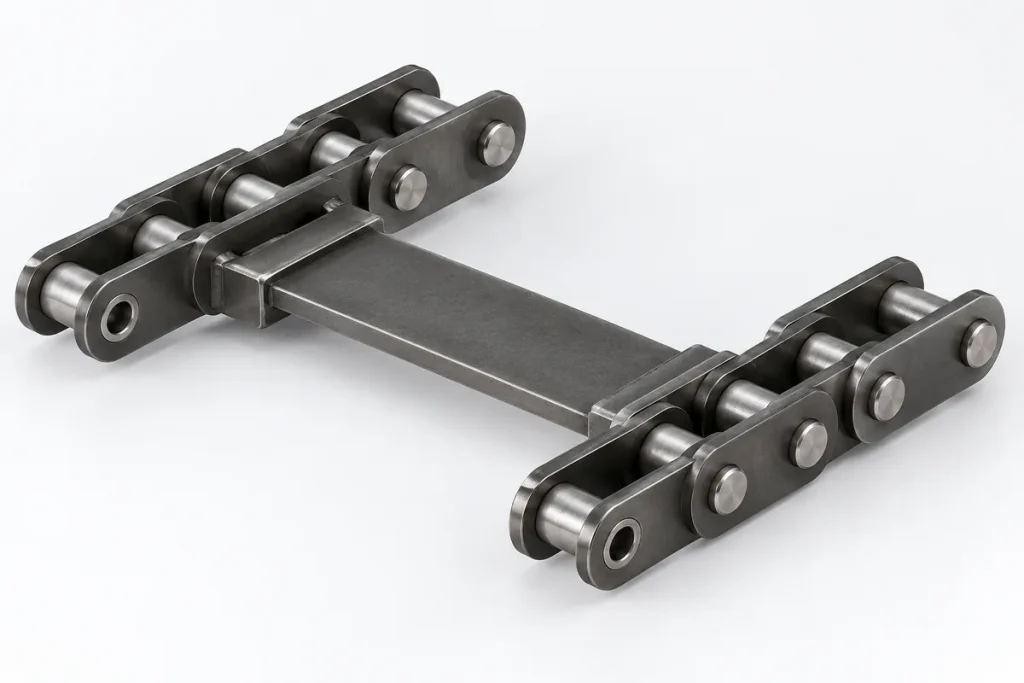
A Flight Section is the assembled chain position that carries the material-moving scraper components. The market may call a similar functional element a flight, scraper bar, flight bar, or scraper assembly. Those terms are useful for conversation, but the model drawing and component identifiers should control the RFQ.
K201B identifies K201B04 as the Flight Section. K207B identifies K207B05 as the Flight Section and also identifies K207B04 as a Scraper Outer Link. That difference is one reason this site preserves model-specific component naming rather than forcing both chains into one generic parts diagram.
Scraper Head and Scraper Plate Relationship
K201B documents K201B007 Scraper Head and K201B008 Scraper Plate. K207B documents K207B008 Scraper Head and K207B009 Scraper Plate. These items form part of the material-moving flight configuration and help define the effective scraper geometry.
The K Series family description also supports custom chain configurations, dimensions, and scraper-bar heads. Customisation therefore requires a controlled drawing or measurement set. It does not justify publishing a universal scraper-head dimension or claiming that any head style fits any feeder breaker.
Spacing and Configuration Factors



Flight spacing should be documented from the existing chain or machine drawing. The appropriate arrangement depends on the chain unit, conveyor geometry, material-handling duty, sprocket timing, and machine design. This site does not publish a universal spacing recommendation.
When documenting a chain, photograph at least two consecutive flight positions so the repeating pattern is visible. Record the distance between equivalent reference points, scraper width, chain pitch, and repeating unit length. If the chain contains adjustment or attachment links, show their position relative to the flights.
K201B and K207B Examples


K201B is specified with a 21 inch chain unit length containing one Flight Section and two Chain Sections, plus a 44 2/5 inch scraper width. K207B uses the same nominal 21 inch unit description but a 46 inch scraper width and a different component tree.
Those examples show why flight geometry should be checked alongside pitch. A chain with a 3 1/2 inch pitch may still have a different flight width, spacing, attachment structure, or scraper profile.
RFQ Inputs
For a flight/scraper enquiry, provide:
- chain model if known;
- pitch and chain unit length;
- 스크레이퍼 너비;
- flight spacing with reference points shown;
- front, side, and connection photographs of an intact flight;
- scraper head and plate details;
- link/attachment geometry around the flight;
- drawing or measured sketch;
- application/equipment context;
- quantity.
If only a damaged flight is available, provide an intact reference from the same chain run if possible. Do not infer missing geometry from another chain model.
Identify Flight Geometry Before Discussing a Replacement
A flight or scraper assembly does more than span the conveyor width. Its geometry defines how the chain carries and moves material, how the flight connects to the chain, and how loads are transferred through the assembly. For replacement identification, record the complete shape rather than only the overall width.
Start with an intact flight. Photograph it from the front, side and connection side. Mark the left and right chain interfaces, the scraper head or plate arrangement, and any bends, offsets, bosses, holes or fastening features that control assembly. If a separate scraper plate is fitted, show how it relates to the scraper head. If the flight is repaired, identify the repair so it is not mistaken for an original feature.
For K201B and K207B, the technical data confirms model-specific flight-related components, but those component trees should not be generalized into every feeder breaker chain. K201B documents a Flight Section together with Scraper Head and Scraper Plate. K207B documents a Flight Section, Scraper Outer Link, Scraper Head and Scraper Plate. That difference is one reason a replacement review needs structure as well as pitch.
Measure Flight Spacing With Reference Points
Flight spacing should be recorded using repeatable reference points. Select the same identifiable feature on consecutive flights and show the endpoints in a photograph or sketch. If several spaces are measured, record each result rather than reporting only an average. This helps identify whether a chain contains a regular pattern, a repaired section, or a deliberately different arrangement.
Do not convert a field spacing observation into a universal recommendation. The K Series technical data lists that scraper-bar spacing can be adjusted and that custom configurations are available, but it does not publish one spacing that is correct for every machine. The installed equipment, approved drawing and process requirement must control the final configuration.
If the chain is paired, verify that the flight relationship is consistent across both sides. A bent flight, shifted attachment or previous repair can make one side look correct while the opposite connection is not. Photograph both interfaces when the geometry cannot be understood from one view.
Paired-Chain Symmetry and Alignment Evidence
A paired chain system should be documented as an assembly. During an approved shutdown, record whether corresponding flights appear aligned, whether the chain paths are at comparable positions, and whether one side shows different wear, repair history or attachment condition. These observations are not a substitute for the machine’s alignment procedure, but they help a replacement reviewer understand the configuration that is actually installed.
When a flight is removed, label its orientation and the side from which it came. If left/right parts differ, keep that distinction in the drawing or RFQ. Avoid rotating or mirroring a photographed part in a way that could hide the original orientation.
Damaged Flight vs Intact Reference
A bent, cracked, worn or repaired flight should be documented because it explains the service condition, but it should not automatically define the new-part geometry. Find an intact reference from the same chain run when possible. Measure and photograph both the damaged and intact parts, clearly labelling which one supplied each value.
If every accessible flight is worn, combine field measurements with the approved drawing, historical photographs, retained spare parts or prior order records. When evidence conflicts, keep the conflict visible until engineering resolves it. Do not copy geometry from K201B to K207B, or from another K Series chain, simply because the flight looks similar.
What a Custom Flight Drawing Should Show
A custom flight drawing should define the geometry needed to manufacture and assemble the part without relying on a verbal description. At minimum, capture the overall scraper/flight width, chain interface locations, hole or attachment positions, relevant thicknesses or profiles, relationship to scraper head/plate components, and the repeating spacing or unit relationship where it controls the assembly.
Also record the parent chain identification and pitch. A flight drawing without the chain context can be ambiguous because the same overall width does not prove the same attachment or joint geometry. If the customer specifies material, heat treatment, surface treatment, marking, inspection, test documentation or other technical requirements, place those confirmed requirements on the controlled drawing or specification. If such data are unknown, leave them for confirmation rather than borrowing values from another product.
Inspect the Connection, Not Just the Scraping Surface
Flights often attract attention because their working edges are visible, but the connection region can be equally important for identification and maintenance. Inspect the transition between the flight and chain attachment, pin or retaining features, scraper head/plate relationship, and the surrounding link geometry. Photograph any elongation, deformation, loose feature, local repair or unusual contact mark that the maintenance team considers relevant.
If a component has been replaced previously, note whether the replacement matches the rest of the chain. A non-original fastener or repair plate can change the apparent geometry and should not silently become the pattern for a new order.
Flight Configuration Review for K201B
For K201B, begin with the specified 3 1/2 inch pitch, 21 inch chain unit length and 44 2/5 inch scraper width, then compare the Flight Section and its relationship to the Chain Section, Outer Link and Inner Link. At the tertiary level, the technical data identifies Scraper Head and Scraper Plate components along with the plate, bush, pin, locating bush and spring pin elements of the chain structure.
This component list supports identification, but it does not establish that every K201B component is supplied as a standalone spare or that an installed repaired assembly remains identical to the original. Confirm commercial scope during the RFQ and use the actual drawing for fit.
Flight Configuration Review for K207B
For K207B, begin with the specified 3 1/2 inch pitch, 21 inch chain unit length and 46 inch scraper width. Then compare the documented Chain Section, Outer Link, Inner Link, Scraper Outer Link and Flight Section. The component tree also identifies an Extended Pin, T-Pin, Scraper Head and Scraper Plate.
The presence of the Scraper Outer Link and the K207B-specific component arrangement makes structural comparison important when an existing chain has lost its marking. Do not classify an unknown chain as K207B from the 3.5 inch pitch alone.
Flight and Scraper Bar RFQ Checklist
A complete flight-related RFQ should state whether the request is for a full chain assembly, complete flight section, or an individual flight-related component. Include the parent chain model if confirmed; otherwise state that the model is unknown. Provide pitch, repeating chain unit length, overall scraper width, measured flight spacing, attachment/interface photographs, and a drawing or measured sketch.
For a physical sample, photograph the sample before disassembly and identify wear or deformation. For a repeat order, attach the previously approved drawing and note any field change. For a custom arrangement, state which dimensions and requirements are customer-controlled and which remain open for engineering review.
자주 묻는 질문
Is scraper width enough to identify a flight?
No. Scraper width is important, but attachment geometry, chain pitch, repeating unit length, flight spacing and the parent chain structure also matter.
Can I copy the flight spacing from another feeder breaker chain?
Not safely. The available evidence supports configurable scraper-bar spacing in the K Series, not one spacing for every machine. Use the installed equipment and approved drawing.
What if only a damaged flight is available?
Document the damage, then look for an intact reference, historical drawing, retained spare or previous order. Keep damaged and nominal evidence separate.
Are K201B and K207B flights the same because both use 3.5 inch pitch?
No interchangeability claim is supported. Their documented widths and component structures differ, so each configuration should be confirmed independently.
Should flight-related parts be ordered by component code alone?
Only when the code is tied to the confirmed parent model and drawing. For an unknown chain, send geometry and photographs rather than borrowing a code from a similar model.