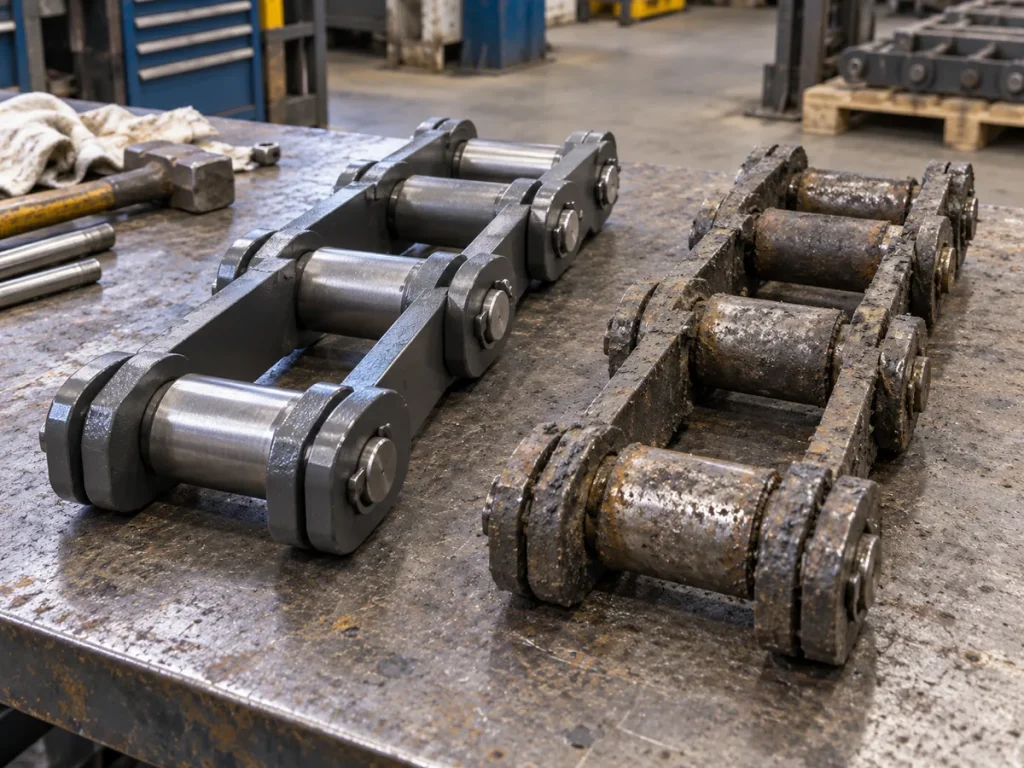
How Chain and Sprocket Wear Affect Feeder Breaker Replacement Planning
Plan feeder breaker chain replacement with sprocket inspection, engagement evidence, alignment observations, wear history, and coordinated shutdown.
Panduan KejuruteraanDikemas kini pada 16 September 2026
Feeder breaker chain replacement is often triggered by visible chain condition: damaged flights, repeated take-up adjustment, joint wear, broken retention, or a planned service interval in the machine maintenance program. Yet the chain does not operate alone. Every pitch engages the sprocket, every flight follows the chain path, and any misalignment or tooth wear can influence how the replacement assembly loads and tracks.
General conveyor-chain engineering practice therefore treats chain and sprocket condition as related evidence. A worn chain can alter engagement; a worn or misaligned sprocket can accelerate abnormal contact on a new chain. The exact acceptance criteria, wear limits, and replacement thresholds must come from the controlled feeder breaker and chain documentation. This article focuses on how to inspect and plan the two components together without importing an unrelated numeric discard rule.
The planning objective is to enter the shutdown with enough evidence to decide whether the scope is chain only, sprocket work, alignment correction, take-up repair, flight or guide work, or a coordinated replacement. That reduces the risk of installing a correct new chain into an unresolved machine condition.
Inspect together
Photograph chain joints, flights, and sprocket tooth spaces during the same shutdown and note their relative location.
Separate symptoms from causes
Chain elongation, tooth wear, side scoring, and tracking are observations; use alignment and engagement checks before assigning cause.
Plan the interface
Replacement scope should include fit, engagement, alignment, take-up range, and controlled restart checks, not only a chain part number.
1. Understand Why Wear at Chain Joints Changes Sprocket Engagement
Articulated chain joints work through pins and bushes or equivalent bearing surfaces. As those surfaces wear, the effective distance through a sequence of joints can change. The chain may then seat differently as it approaches the sprocket. A repeatable multi-pitch measurement can help document that trend, but the final service limit remains specification dependent.
During replacement planning, record the chain measurement and the sprocket condition at the same time. If the chain shows a strong length-change trend and the sprocket shows unusual engagement or tooth wear, engineering can review the pair instead of assuming one component alone explains the behavior.
2. Inspect Sprocket Tooth Spaces for Pattern, Not Just Depth
Clean enough of the accessible tooth profile under the approved procedure to see where the chain has been contacting. Look for consistent polished areas, asymmetric side wear, hooking or profile change, impact marks, and tooth-to-tooth variation. Photograph several consecutive teeth rather than choosing only the worst-looking tooth.
Do not convert a visual impression into a universal wear percentage. The important planning question is whether the tooth profile and contact pattern remain suitable under the machine specification and whether the wear pattern suggests alignment, engagement, or contamination issues that should be corrected before a new chain is installed.
3. Compare Left and Right Sprocket Evidence on Paired Systems
Where two strands use paired sprockets, compare corresponding sides. Differences in side scoring, tooth wear, chain seating, or take-up history can reveal an asymmetric system condition. Record which sprocket belongs to which chain strand so a later reviewer can connect tooth evidence with chain measurements and flight alignment.
If one side has a different replacement history, note it. Mixing a newer sprocket with an older worn component may create a different engagement history from the opposite side. The replacement plan should work from the actual installed condition rather than assuming both sides have aged equally.
4. Check Alignment and Tracking Evidence Before Installing New Parts
Abnormal side wear on links or sprocket teeth, flights that run skewed, repeated guide contact, or a chain that consistently tracks toward one side are reasons to inspect shaft, sprocket, and track alignment under the machine procedure. These symptoms do not automatically prove misalignment, but they justify checking it.
If the shutdown includes sprocket replacement, preserve the old sprocket photographs before removal and record shim, shaft, hub, or mounting observations relevant to alignment. A new chain and new sprocket can still wear poorly if the underlying geometry is not corrected.
5. Include Take-Up Range and Adjustment History in the Replacement Decision
A chain near the end of available take-up range may have a very different maintenance risk from one with substantial controlled adjustment remaining, but the meaning of the position is machine specific. Record the actual take-up positions and the history of recent changes. If one side has consumed more range, keep that asymmetry visible.
Replacement planning should also consider what the take-up will need after new components are installed. The machine procedure should define reset and initial adjustment. Do not fabricate a web-based starting position; make the required setup value part of the shutdown work pack.
6. Inspect Flight and Chain Damage for Engagement Clues
Bent flights, uneven scraper wear, damaged attachment links, polished plate sides, or repeated pin/retention problems can be downstream evidence of how the chain has been running. Map those findings to chain location and, where possible, to the corresponding sprocket or path area.
For K201B/K207B replacement review, keep model-specific configuration evidence separate from wear evidence. A worn scraper width should not be used as the nominal replacement width, and a damaged attachment should not be assumed to represent the original component geometry.
7. Decide Whether Chain and Sprocket Work Should Be Coordinated
The correct scope depends on the controlled inspection criteria, available downtime, component condition, and risk of leaving a worn interface in service. The planning team should explicitly decide whether the sprockets will remain, be repaired under an approved method, or be replaced, and document the evidence supporting that decision.
Avoid a procurement process where chain and sprocket decisions happen in separate departments with no shared inspection record. A coordinated package can include chain model/dimensions, sprocket drawings or measurements, tooth-condition photos, shaft/interface details, and alignment findings.
Chain-and-sprocket replacement planning matrix
Bukti
Chain question
Sprocket/system question
Multi-pitch measurement
Is effective chain length changing consistently?
Does engagement show climbing, impact, or uneven seating?
Side wear
Are plates or pins showing asymmetric contact?
Are tooth sides, shaft alignment, or guides showing the same side bias?
Flight condition
Are flights skewed, bent, or unevenly worn?
Is the paired sprocket/track relationship consistent across strands?
Take-up history
How much and how often has adjustment changed?
Does the take-up mechanism hold and move evenly?
Repair history
Are mixed sections or repaired attachments present?
Did symptoms begin after sprocket or machine-side work?
Incoming parts
Does chain match approved configuration?
Does sprocket match approved tooth/interface drawing?
Peraturan rekod
Use the controlled machine and chain criteria for disposition; the matrix ensures the chain and engaging system are reviewed together.
8. Plan the New-Component Verification Before the Shutdown Starts
Before installation, confirm that the supplied chain matches the approved pitch, repeating unit, scraper width, component arrangement, and drawing. Confirm the sprocket part or drawing independently. Then define the checks that will be performed after installation: alignment, seating, clearances, take-up setup, flight tracking, retention, and controlled initial operation.
This preplanned verification matters because a shutdown is the worst time to discover that the incoming chain and sprocket were specified from different revisions. Put the chain drawing, sprocket drawing, inspection report, and purchase order in the same work pack.
Engagement
The way chain joints or bushings enter, seat in, and leave the sprocket tooth spaces.
Wear pattern
The location and shape of material loss or polished contact used as evidence of how components interact.
Coordinated replacement
A shutdown scope in which chain, sprocket, alignment, take-up, and restart verification are planned together.
Baseline
The first controlled condition and measurement record after approved new components are installed.
9. Use Post-Installation Observation to Close the Replacement Record
After the controlled restart, observe chain entry and exit at sprockets, flight tracking, side contact, unusual impact, and take-up behavior from approved safe positions. Compare the observations with the pre-replacement symptoms. Record whether the original issue was resolved rather than assuming new parts guarantee a correct system.
Schedule follow-up checks under the machine maintenance plan and preserve the same reference locations. The first post-replacement measurements become the baseline for future trend comparison.
Senarai Semak Serah Terima Praktikal
Gunakan senarai semak serah terima ini untuk menutup rekod lapangan bagi How Chain and Sprocket Wear Affect Feeder Breaker Replacement PlanningMatlamatnya bukanlah untuk mencipta borang penyelenggaraan generik yang lain. Ia adalah untuk memelihara pemerhatian khusus, titik rujukan dan konteks mesin yang diperlukan oleh pengulas seterusnya untuk memahami bagaimana keputusan diperoleh. Kekalkan had penerimaan khusus mesin di bawah lukisan, prosedur penyelenggaraan atau arahan kejuruteraan yang diluluskan dan bukannya mencipta nilai web universal.
Pusat Pemeriksaan
Apa yang perlu direkodkan
Bagaimana rekod digunakan
Understand Why Wear at Chain Joints Changes Sprocket Engagement
Record the exact machine location, strand or side, current operating/shutdown state, and the observation that relates to understand why wear at chain joints changes sprocket engagement. Include a photograph that lets another reviewer find the same area.
Menetapkan konteks supaya pengukuran kemudian tidak terpisah daripada kedudukan mesin dan rantai.
Inspect Sprocket Tooth Spaces for Pattern, Not Just Depth
Capture the physical reference used for inspect sprocket tooth spaces for pattern, not just depth. Keep the raw dimension, image or marking beside the interpretation, and note any wear, repair, build-up or access limitation that could affect the reading.
Menjadikan keputusan boleh diulang dan menghalang rujukan yang rosak atau kurang jelas daripada menjadi keperluan penggantian.
Compare Left and Right Sprocket Evidence on Paired Systems
Cross-check compare left and right sprocket evidence on paired systems against any controlled drawing, previous purchase reference or retained spare that is available. Keep current field data and historical information in separate fields when they differ.
Mengekalkan kebolehkesanan apabila keadaan lapangan, rekod sejarah dan maklumat produk nominal tidak sepadan dengan sempurna.
Check Alignment and Tracking Evidence Before Installing New Parts
For check alignment and tracking evidence before installing new parts, state what is confirmed, what is only observed, and what still needs engineering confirmation. Attach the image or measurement that supports the statement rather than relying on a product name alone.
Memberikan senarai yang jelas kepada pembekal tentang apa yang boleh diambil tindakan sekarang dan apa yang mesti diselesaikan sebelum pelepasan.
Asingkan keadaan seperti yang ditemui daripada geometri penggantian yang diperlukan. A worn, repaired, dirty or partially dismantled component may still be very useful for identification, but its current shape is not automatically the manufacturing requirement. Label field measurements as observed data, retain the original unit and measurement method, and identify any feature that may have been altered by service. For feeder breaker chain sprocket wear, photographs should show the measurement endpoints or component relationship clearly enough that a remote reviewer can reproduce the logic.
Selesaikan maklumat yang bercanggah dan bukannya menyembunyikannya. If a drawing, old order, marking and current measurement point in different directions, keep each source visible and describe the conflict. Do not average values or silently choose the most convenient one. Use additional photographs, measurements from another intact repeating unit, machine interface information and the controlled document revision to determine which value governs. If use post-installation observation to close the replacement record cannot be confirmed during the shutdown, state that limitation explicitly so the open question survives the handoff.
Make the next action obvious for How Chain and Sprocket Wear Affect Feeder Breaker Replacement Planning. Rekod yang telah lengkap harus memberitahu pihak penyelenggaraan apa yang perlu diperiksa semula, memberitahu pihak pembelian maklumat apa yang termasuk dalam RFQ, dan memberitahu pihak kejuruteraan dimensi atau antara muka yang masih memerlukan kelulusan. Sebelum mesin kembali berfungsi, sahkan bahawa set fail tersebut merangkumi pandangan keseluruhan mesin, pandangan rantai/penerbangan berulang yang lengkap, pandangan dekat komponen atau tanda yang berkaitan, dan dimensi yang digunakan dalam panduan ini. Untuk feeder breaker chain sprocket wear, satu set pemerhatian yang boleh dikesan adalah lebih berguna daripada naratif panjang tanpa datum, dan ia mengurangkan risiko keputusan penggantian dibuat daripada nada, penampilan atau nombor bahagian lama sahaja.
Nota Keputusan Lapangan untuk Tugasan Ini
Rekod pemeriksaan untuk How Chain and Sprocket Wear Affect Feeder Breaker Replacement Planning sepatutnya mudah digunakan selepas penutupan tamat. Tiga nota berikut menukar artikel tersebut kepada penyerahan praktikal tanpa mewujudkan had penerimaan khusus mesin. Ia amat berguna apabila pemerhatian penyelenggaraan mesti disemak kemudian oleh kejuruteraan atau pembelian dan rantai asal tidak lagi boleh diakses.
Confirm Understand Why Wear at Chain Joints Changes Sprocket Engagement
Mulakan dengan mengenal pasti di mana dan bagaimana pemerhatian dibuat. Catatkan mesin, sisi atau untaian rantai, unit berulang atau lokasi penerbangan, dan keadaan rantai semasa pemeriksaan dilakukan. Jika komponen kotor, dimuatkan, kendur, ditanggalkan, dibaiki atau kelihatan cacat, simpan keadaan tersebut di sebelah bacaan. Gambar hendaklah merangkumi struktur sekeliling yang mencukupi untuk membolehkan orang lain menemui lokasi yang sama. Untuk artikel ini, tujuannya adalah untuk memelihara konteks di sebalik understand why wear at chain joints changes sprocket engagement daripada mengurangkannya kepada jumlah yang terpencil.
Cross-check Inspect Sprocket Tooth Spaces for Pattern, Not Just Depth
Gunakan pemerhatian kedua atau rujukan terkawal untuk mencabar keputusan pertama. Itu mungkin unit pengulangan utuh bersebelahan, untaian rantai lain, semakan lukisan, rekod pembelian terdahulu atau alat ganti yang disimpan. Pastikan nilai medan asal kelihatan walaupun perbandingan menunjukkan keperluan nominal yang berbeza. Apabila kedua-duanya tidak bersetuju, huraikan mengapa perbezaan itu mungkin wujud dan kenal pasti apa yang mesti disahkan seterusnya. Ini amat penting untuk inspect sprocket tooth spaces for pattern, not just depth, kerana haus servis, kaedah pengukuran dan pembaikan terdahulu boleh menjejaskan keadaan seperti yang ditemui.
Prepare Compare Left and Right Sprocket Evidence on Paired Systems for review
Bungkuskan hasilnya supaya ia boleh disemak dari jauh. Sertakan ukuran atau pemerhatian mentah, unitnya, permukaan rujukan atau titik akhir, sekurang-kurangnya satu gambar dekat dan satu gambar konteks, dan sebarang lukisan atau tanda yang digunakan semasa pengenalpastian. Nyatakan sama ada item tersebut disahkan, calon atau tidak diketahui. Jika compare left and right sprocket evidence on paired systems bergantung pada andaian, tulis soalan terbuka dalam RFQ dan bukannya menukar andaian tersebut kepada spesifikasi. Penyemak penerima sepatutnya dapat memahami keadaan rantai tanpa membina semula kaedah tersebut daripada ingatan.
Pastikan sempadan keputusan kelihatan. Check Alignment and Tracking Evidence Before Installing New Parts may influence the next maintenance or sourcing step, but the website does not set a universal discard, tension or interchangeability limit. Use the equipment procedure, approved drawing and order-specific engineering requirements for acceptance decisions. The purpose of this record is to make the observation behind feeder breaker chain sprocket wear cukup boleh dikesan supaya produk atau laluan kejuruteraan yang betul boleh dipilih tanpa meneka.
Soalan untuk Dijawab Sebelum Keputusan Seterusnya
Should sprockets always be replaced with the chain?
Not as a universal rule. Inspect the sprocket condition and use the machine/chain criteria to decide. The key is to avoid installing a new chain without reviewing the engagement interface.
Can tooth wear be judged from one photograph?
A photograph is supporting evidence. Inspect several teeth, compare both sides where applicable, and use the controlled profile or acceptance method for disposition.
Why record alignment before replacing parts?
Abnormal alignment can create wear on both chain and sprocket. New parts may repeat the same pattern if the underlying machine geometry remains unresolved.
What should purchasing receive?
A coordinated specification package should identify the chain configuration, sprocket/drawing reference, relevant dimensions, condition evidence, quantity, and any inspection or documentation requirements.
Langkah Seterusnya: Tutup Rekod Teknikal
Feeder breaker chain and sprocket wear are connected through engagement. Replacement planning should therefore treat chain measurements, tooth condition, alignment evidence, flight behavior, and take-up history as one engineering record.
The controlled specifications decide when each component is repairable or replaceable. The planning workflow decides whether the shutdown will actually solve the system condition instead of swapping one worn part and leaving the interface that shaped its wear untouched.