Feeder Breaker Chains for Measured Replacement Review
Feeder breaker chains are heavy-duty scraper-chain assemblies used to move material through feeder breaker conveyor systems. The current range on this site is intentionally focused on K Series feeder breaker configurations rather than mixing feeder breaker chains with unrelated crawler, apron-feeder, continuous-miner or bolter-miner chain families.
The published feeder breaker models are K201B and K207B. Both use a nominal 3 1/2 inch pitch, but the specified scraper widths and component structures differ. For that reason, model selection should use the complete dimensional and structural record instead of treating pitch as the only identifier.
AVAILABLE MODELS
K Series Feeder Breaker Scraper Chains
The live category cards below show every product assigned to this feeder breaker chain category. Open the model page for the complete component list, dimensions, application guidance, inspection notes and RFQ requirements.
Corrente raspadora para alimentador/quebrador da Série K com unidade de repetição de 21 polegadas, largura do raspador de 46 polegadas e estrutura de elo externo do raspador específica para cada modelo.
Use these values as model-specific reference points. They do not establish interchangeability and should be checked against the installed chain, controlled drawing and equipment interface.
Ponto de seleção
K201B
K207B
Tom
3 1/2 polegadas (89 mm)
3 1/2 pol. (88,9 mm)
Comprimento da unidade de corrente
21 polegadas (534 mm)
21 polegadas (533,4 mm)
Largura do raspador
44 2/5 pol. (1127,5 mm)
46 polegadas (1171,85 mm)
Secondary components
Seção da corrente, elo externo, elo interno, seção de voo
Seção da corrente, elo externo, elo interno, raspador do elo externo, seção de voo
Distinctive items
Localizando Bush, pino de mola
Pino estendido, pino em T
The inch-to-millimetre values above follow the published model data. Small differences in the metric expression of a nominal 3 1/2 inch pitch are not a sufficient basis for model identification.
SELECTION VARIABLES
What to Compare Before Ordering
A good replacement review preserves both dimensions and structure. Use a consistent measurement method and photograph the reference points so another reviewer can understand how each value was obtained.
01
Tom
Measure corresponding joint centres and record the method. Several-pitch measurements can be useful when field access permits.
02
Chain Unit
Record the repeating length that contains the chain sections and the flight or scraper section.
03
Scraper Geometry
Measure the overall scraper width and document flight spacing, attachment form and any repaired areas.
04
Joint & Interface
Photograph links, bushes, pins, retention details and chain-to-sprocket engagement when safely accessible.
K Series information covers underground feeder breaker chain conveyors and coal-washing service. In these machines, the chain should be considered as part of the complete conveying system. Material loading, scraper arrangement, contamination, sprocket engagement, alignment, tensioning hardware and maintenance access can all affect service and replacement planning.
A category page cannot provide one universal tension value, lubrication interval or wear-discard limit for every feeder breaker. Those values depend on the equipment, chain specification, duty and approved maintenance procedure. Use the machine documentation for operating settings and use the chain data here for identification and RFQ preparation.
STRUCTURE
Why Component Structure Matters
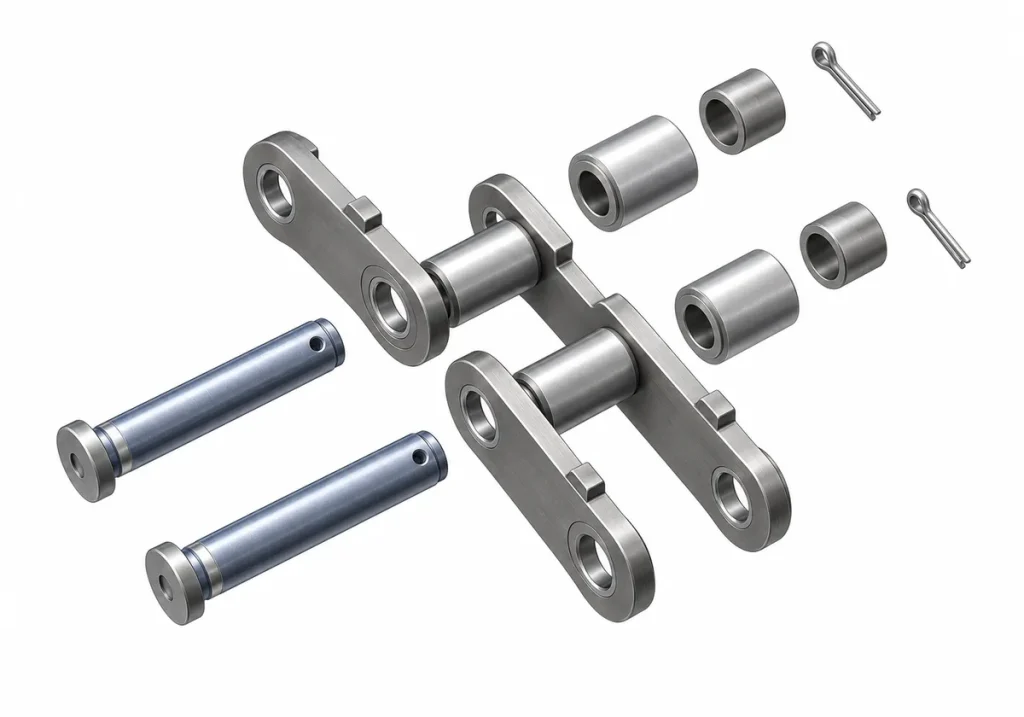
K201B and K207B both contain chain-section and link elements, bushes, pins and flight or scraper components, but the model-specific component trees are not identical. K201B identifies a locating bush and spring pin, while K207B identifies a scraper outer link, extended pin and T-pin. Those differences are useful when an installed chain has lost its model marking.
Component names on this site are used to describe structure and support technical review. They do not automatically mean that each item is stocked or sold as an independent spare. When the request concerns a single component, provide the confirmed parent model and the surrounding interface so supply scope can be reviewed.
REPLACEMENT RFQ
What to Send When the Model Is Unknown
Photographs alone can make different heavy chains look similar, especially after wear or field repair. Preserve the complete chain context before removal and pair visual evidence with measurements.
Overall chain viewShow one intact repeating unit and the flight arrangement.
TomRecord the joint-centre reference points and measurement method.
Comprimento da unidade de correnteMeasure the repeating assembly rather than an arbitrary length.
Largura do raspadorRecord the span and where the measurement was taken.
Joint detailsPhotograph pins, bushes, inner/outer links and retention features.
Machine contextInclude equipment type, material handled, drawing and quantity when available.
Where an old drawing and a field measurement disagree, retain both values and identify the origin of each. The difference should be resolved during technical review rather than silently forcing the installed chain to match an expected model.
Perguntas frequentes
Are K201B and K207B interchangeable?
No interchangeability claim is made. The models share a nominal 3 1/2 inch pitch, but their specified scraper widths and component structures differ. Confirm the complete dimensions and equipment interface.
Is 3.5 inch pitch enough to identify a feeder breaker chain?
No. Pitch is one identification value. Chain-unit length, scraper width, flight arrangement, joint structure and machine context should be checked together.
Can an unidentified chain be reviewed?
Yes. Send overall and close-up photographs, measured pitch, chain-unit length, scraper width, flight details, machine context and any drawing or markings that remain available.
Should a worn chain be measured before it is removed?
Where safe and permitted by the site procedure, documenting the installed arrangement before removal helps preserve flight spacing, chain path and interface context. Distinguish worn field measurements from nominal drawing values.