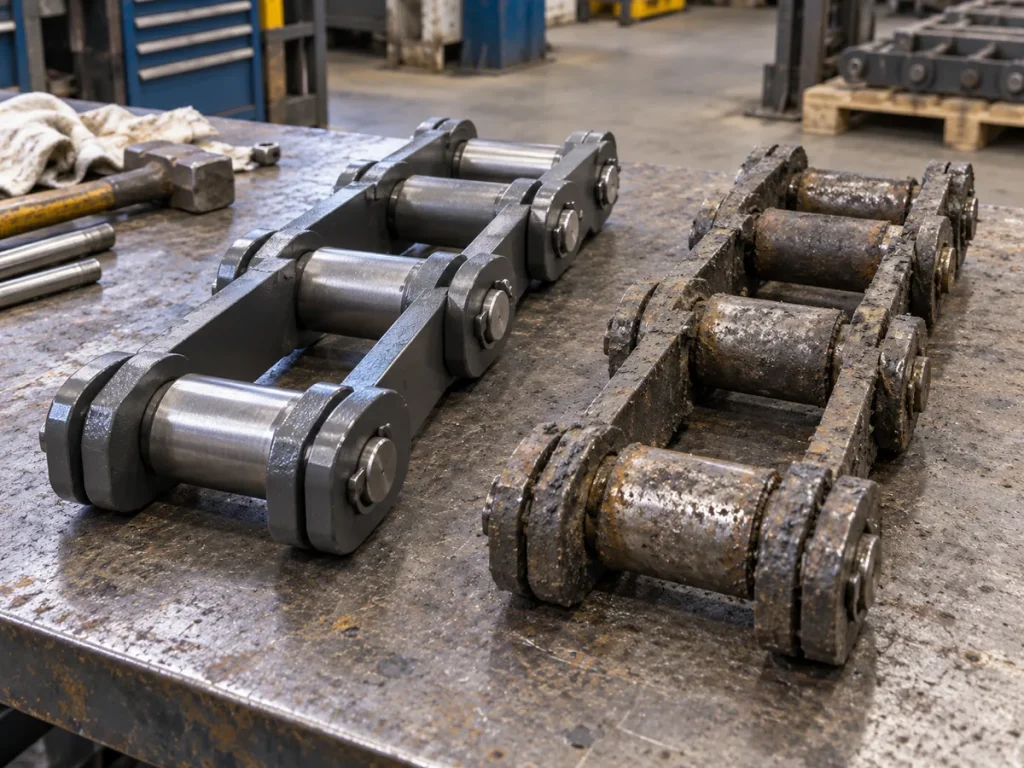
Lista de verificação para solicitação de cotação (RFQ) de correntes de disjuntores para alimentadores subterrâneos para equipes de manutenção.
Utilize esta lista de verificação para solicitação de cotação (RFQ) de corrente para alimentador subterrâneo para coletar informações sobre o contexto da máquina, geometria da corrente, fotos, desenhos, condição, quantidade e outros detalhes.
Engineering GuideUpdated setembro 16, 2026
An underground feeder breaker chain RFQ often starts during a shutdown, when the maintenance team has limited access time and purchasing needs a quotation quickly. The risk is that the request leaves the site with only a local part description and one dimension. The supplier then has to reopen basic identification questions, or worse, the commercial process proceeds on assumptions that were never verified.
A stronger RFQ is an evidence package. It identifies the machine and chain location, states whether the old chain model is confirmed or unknown, records pitch and repeating geometry from defined datums, includes scraper or flight width and spacing, photographs the complete assembly and components, attaches the latest available drawing or old purchase reference, describes the current condition, and states quantity and replacement scope.
The checklist below is designed for maintenance teams, planners, buyers, and engineers to share one record. It does not require the maintenance team to invent a product model or engineering limit. Unknown fields can remain explicitly unknown as long as the RFQ shows what was checked and what evidence is still needed.
Identity block
Machine, asset/location, application, chain model status, old PO/drawing reference, and who collected the evidence.
Geometry block
Multi-pitch measurement, unit length, scraper/flight width and spacing, strand relationship, component construction, and datum photos.
Commercial block
Required quantity, full assembly vs component scope, desired documentation, delivery destination, and the questions that remain open.
1. Start the RFQ with Machine and Application Context
Record the feeder breaker asset or machine designation used by the site, physical location, and whether the chain is at the drive/feeder/breaker conveyor location being quoted. Add a wide machine photograph and a photograph showing where the chain runs.
If the machine identity is uncertain, describe the material-handling function and keep the application field marked for verification. Do not use a guessed OEM or model to make the RFQ look complete.
2. State Whether the Existing Chain Model Is Confirmed
Use one of three statuses: confirmed from controlled document/marking and geometry; candidate model requiring confirmation; or unknown chain requiring identification. This single field prevents a tentative suggestion from being treated as a firm part number.
When K201B or K207B is a candidate, compare the complete verified geometry and component pattern rather than copying the model into the request because the pitch looks similar.
Measure over multiple pitch intervals where access permits, record the start and end pin-center references, total span, number of intervals, and chain condition during measurement. Keep a photograph with the measurement tool positioned at the datums.
Report both nominal interpretation and raw measured data. The supplier can then distinguish a nominal pitch decision from the actual field reading and assess whether wear or measurement method needs further review.
4. Add Unit Length, Flight Width, and Flight Spacing
Record the repeating unit from one equivalent feature to the next, scraper or flight width between defined faces, and spacing between equivalent flights. Note how many Chain Sections and Flight Sections occur in the unit when the construction is visible.
For each value, state the reference points. A number without a datum is difficult to reproduce and can create avoidable differences between the site, supplier, and drawing.
5. Photograph the Complete Chain Before Detail Shots
Include wide views of the complete installed path or removed chain sequence before sending close-ups of pins and plates. Show both strands, flight relationship, drive/return context, and any damaged area in relation to the rest of the assembly.
Then add close-ups of chain sections, flight sections, scraper heads/plates, retention, markings, and unusual wear. Use a scale only when it can be placed safely and clearly without hiding the feature.
6. Record Component Construction and Any Missing Parts
List visible component types and special retention features. If a chain is damaged, state which components are missing, broken, replaced, welded, or modified. Photograph repairs separately from original-looking areas.
Missing parts matter because a damaged sample may no longer show the original repeating architecture. The RFQ should tell engineering where reconstruction from drawings or a second sample is required.
7. Attach Controlled Drawings and Historical References Carefully
Attach the latest controlled drawing if available and record its drawing number and revision. Old purchase orders, supplier references, and previous quotes can be added as historical evidence, but label them with their dates and status.
If a drawing conflicts with the installed chain, do not choose one silently. Include the conflict table and request confirmation of the current production requirement.
8. Describe Current Condition Without Turning It into a Specification
Record visible wear, broken or bent flights, pin/bush concerns, cracks, repeated adjustment, sprocket condition, build-up, one-sided contact, and the reason replacement is being considered. Use photographs and measured trends where available.
Do not convert the damaged dimensions of a worn part into the manufacturing requirement. The RFQ should separate “as found” measurements from “required/new” dimensions supported by the drawing or engineering review.
9. State Quantity and Scope in Assembly Terms
Specify whether the request is for a complete chain set, one strand, a defined installed length, spare repeating units, flight assemblies, or specific components. Include the number of machines and whether both sides/strands are being replaced.
If chain and sprocket replacement are being coordinated, state that scope and attach the sprocket inspection record. Do not assume the supplier will infer sprocket requirements from a chain RFQ.
10. Include Operating Context That Changes the Engineering Review
Describe material handled, wet/dry or abrasive build-up conditions, shock events, loading pattern, known contamination, and any unusual operating change that is relevant to the chain. Use actual site observations rather than generic adjectives such as “heavy duty.”
If the replacement requirement is driven by a process change, say what changed. A supplier cannot evaluate a changed duty when the RFQ only repeats the previous part number.
Confirmed model
Identity supported by controlled reference and matching physical evidence.
Candidate model
A possible model that still requires one or more evidence checks before use in a quote.
As-found data
Measurements and observations describing the used or damaged assembly at inspection.
Required data
The controlled manufacturing/replacement requirement supported by drawing, specification, or engineering confirmation.
11. Ask Explicit Technical Questions
Write the open questions as a numbered list: confirm model from evidence, confirm dimensions, advise what additional measurement is required, review component repairability, confirm drawing revision, or identify whether a custom chain study is needed. Questions help the technical team focus on uncertainty instead of assuming every field is final.
If a certification, inspection document, material record, or test requirement is needed, ask for it explicitly and tie it to the purchasing specification. Do not assume a catalogue claim covers project-specific documentation.
12. Run a Pre-Send Completeness Check Across Maintenance and Purchasing
Before issuing the RFQ, have the maintenance owner confirm machine context and field measurements, purchasing confirm quantity and commercial scope, and engineering review unresolved technical conflicts when required. The goal is one coherent package rather than three email threads with different values.
Name files consistently and keep the RFQ summary tied to the same revision of the photo/measurement package. If new evidence arrives later, issue an updated revision so suppliers are not quoting against obsolete data.
Use this handoff checklist to close the field record for Underground Feeder Breaker Chain RFQ Checklist for Maintenance Teams. The goal is not to create another generic maintenance form. It is to preserve the specific observations, reference points and machine context that the next reviewer needs in order to understand how the result was obtained. Keep machine-specific acceptance limits under the approved drawing, maintenance procedure or engineering instruction rather than inventing a universal web value.
Checkpoint
What to record
How the record is used
Start the RFQ with Machine and Application Context
Record the exact machine location, strand or side, current operating/shutdown state, and the observation that relates to start the rfq with machine and application context. Include a photograph that lets another reviewer find the same area.
Establishes the context so later measurements are not detached from the machine and chain position.
State Whether the Existing Chain Model Is Confirmed
Capture the physical reference used for state whether the existing chain model is confirmed. Keep the raw dimension, image or marking beside the interpretation, and note any wear, repair, build-up or access limitation that could affect the reading.
Makes the result repeatable and prevents a damaged or poorly defined reference from becoming the replacement requirement.
Record Pitch with the Measurement Method
Cross-check record pitch with the measurement method against any controlled drawing, previous purchase reference or retained spare that is available. Keep current field data and historical information in separate fields when they differ.
Preserves traceability when field condition, historical records and nominal product information do not agree perfectly.
Add Unit Length, Flight Width, and Flight Spacing
For add unit length, flight width, and flight spacing, state what is confirmed, what is only observed, and what still needs engineering confirmation. Attach the image or measurement that supports the statement rather than relying on a product name alone.
Gives maintenance, purchasing and the supplier a clear list of what can be acted on now and what must be resolved before release.
Separate as-found condition from required replacement geometry. A worn, repaired, dirty or partially dismantled component may still be very useful for identification, but its current shape is not automatically the manufacturing requirement. Label field measurements as observed data, retain the original unit and measurement method, and identify any feature that may have been altered by service. For underground feeder breaker chain RFQ checklist, photographs should show the measurement endpoints or component relationship clearly enough that a remote reviewer can reproduce the logic.
Resolve conflicting information instead of hiding it. If a drawing, old order, marking and current measurement point in different directions, keep each source visible and describe the conflict. Do not average values or silently choose the most convenient one. Use additional photographs, measurements from another intact repeating unit, machine interface information and the controlled document revision to determine which value governs. If run a pre-send completeness check across maintenance and purchasing cannot be confirmed during the shutdown, state that limitation explicitly so the open question survives the handoff.
Make the next action obvious for Underground Feeder Breaker Chain RFQ Checklist for Maintenance Teams. The completed record should tell maintenance what should be rechecked, tell purchasing what information belongs in the RFQ, and tell engineering which dimensions or interfaces still need approval. Before the machine returns to service, confirm that the file set includes an overall machine view, a complete repeating chain/flight view, close-ups of relevant components or markings, and the dimensions used in this guide. For underground feeder breaker chain RFQ checklist, a traceable set of observations is more useful than a long narrative with no datum, and it reduces the risk that a replacement decision is made from pitch, appearance or an old part number alone.
Field Decision Notes for This Task
The inspection record for Underground Feeder Breaker Chain RFQ Checklist for Maintenance Teams should be easy to use after the shutdown is over. The following three notes convert the article into a practical handoff without creating a machine-specific acceptance limit. They are especially useful when maintenance observations must be reviewed later by engineering or purchasing and the original chain is no longer accessible.
Confirm Start the RFQ with Machine and Application Context
Start by identifying where and how the observation was made. Record the machine, chain side or strand, repeating unit or flight location, and the state of the chain when the check was performed. If the component was dirty, loaded, slack, removed, repaired or visibly deformed, keep that condition beside the reading. A photograph should include enough surrounding structure to let another person find the same location. For this article, the aim is to preserve the context behind start the rfq with machine and application context rather than to reduce it to an isolated number.
Cross-check State Whether the Existing Chain Model Is Confirmed
Use a second observation or controlled reference to challenge the first result. That may be a neighbouring intact repeating unit, another chain strand, a drawing revision, an earlier purchase record, or a retained spare part. Keep the original field value visible even when the comparison suggests a different nominal requirement. When the two do not agree, describe why the difference may exist and identify what must be confirmed next. This is particularly important for state whether the existing chain model is confirmed, because service wear, measurement method and prior repair can affect the as-found condition.
Prepare Record Pitch with the Measurement Method for review
Package the result so it can be checked remotely. Include the raw measurement or observation, its unit, reference faces or endpoints, at least one close photograph and one context photograph, and any drawing or marking used during identification. State whether the item is confirmed, candidate or unknown. If record pitch with the measurement method depends on an assumption, write the open question in the RFQ instead of converting the assumption into a specification. The receiving reviewer should be able to understand the chain condition without reconstructing the method from memory.
Keep the decision boundary visible. Add Unit Length, Flight Width, and Flight Spacing may influence the next maintenance or sourcing step, but the website does not set a universal discard, tension or interchangeability limit. Use the equipment procedure, approved drawing and order-specific engineering requirements for acceptance decisions. The purpose of this record is to make the observation behind underground feeder breaker chain RFQ checklist traceable enough that the correct product or engineering route can be chosen without guessing.
Questions to Resolve Before the Next Decision
What is the minimum information for a feeder breaker chain RFQ?
At minimum provide machine/application context, chain model status, repeatable dimensions from defined datums, full-chain photographs, quantity/scope, and any drawing or prior reference available.
Can I send only the old part number?
Send it, but also include current machine and chain evidence. A historical part number can be valuable yet should be reconciled with the actual installed assembly.
Should worn field measurements be used as new manufacturing dimensions?
Not automatically. Label them as as-found data and use controlled drawings or engineering confirmation for the required new dimensions.
What if we cannot identify the chain before the shutdown ends?
Preserve high-quality measurements, photographs, markings, samples where permitted, drawing references, and machine context so identification can continue after access is lost.
Make the RFQ a Technical Handoff, Not a Guessing Exercise
A complete underground feeder breaker chain RFQ allows maintenance, purchasing, supplier, and engineering teams to work from the same evidence. It states what is confirmed, what is measured, what is historical, what is damaged, what is required commercially, and what still needs technical confirmation.
When time is limited, prioritize evidence that cannot be recreated after the machine returns to service: installed-path photos, measurement datums, full repeating geometry, markings, damaged condition, sprocket context, and controlled document references.