Why Pitch Alone Cannot Identify a Replacement Feeder Breaker Chain
See why feeder breaker chain pitch is only one identification input and how width, unit length, flight layout, components, and machine context prevent.
Engineering GuideUpdated setembro 16, 2026
Pitch is attractive as an identification shortcut because it is easy to understand and usually easy to measure. When a maintenance team finds an old feeder breaker chain with no readable part number, the first question is often, “What pitch is it?” That is a sensible starting point. The problem begins when the answer is treated as the model name.
The K201B and K207B feeder breaker scraper chains show why that shortcut fails. Both are documented at a nominal 3 1/2 inch pitch. Both have a 21 inch repeating chain unit described as one Flight Section and two Chain Sections. Yet their scraper widths differ, and their component structures are not identical. A purchasing process that stops at pitch can therefore select between two genuinely different listed configurations without realizing that a decision has been made.
A replacement chain must work as a complete assembly inside a machine. Sprocket engagement, chain-section geometry, flight spacing, scraper width, pins, attachment links, retention details, take-up range, and surrounding structure all matter. The safest identification workflow treats pitch as the first filter and then proves the rest of the configuration.
Pitch filters
It can remove impossible candidates, but it does not prove flight geometry, width, or component structure.
The repeating unit identifies
Unit length, chain-section pattern, flight arrangement, and attachment details create a much stronger configuration fingerprint.
The machine verifies
Application context, sprocket engagement, clearances, and controlled drawings determine whether the candidate is appropriate for the installed system.
1. Understand What Pitch Describes – and What It Does Not
Pitch describes the repeating distance between corresponding chain joints. It is fundamental because the chain and sprocket must share compatible engagement geometry. A grossly different pitch will usually eliminate a candidate quickly. But pitch says nothing by itself about the scraper width, number and arrangement of chain strands, link-plate shape, attachment geometry, repeating flight interval, pin extension, retention system, or the way the chain interfaces with the machine.
That distinction is especially important for engineering-class conveyor chains, where application-specific assemblies can be built around a common joint spacing. The useful question is therefore not “Does the pitch match?” but “Does the pitch match, and do all the other controlled features also match?” The second question leads to a replacement decision; the first only begins one.
2. Use K201B and K207B as a Real Identification Example
K201B and K207B are both documented as Feeder Breaker Scraper Chain within the K Series. K201B is listed at 3 1/2 inch pitch (89 mm), 21 inch chain unit length (534 mm), and 44 2/5 inch scraper width (1127.5 mm). K207B is listed at 3 1/2 inch pitch (88.9 mm), 21 inch chain unit length (533.4 mm), and 46 inch scraper width (1171.85 mm).
Even before looking at the component tree, those figures prove that equal nominal pitch does not imply identical configuration. The component evidence increases the separation. K207B documents a Scraper Outer Link, Extended Pin, and T-Pin in its structure, while K201B documents its own set of Chain Section, Outer Link, Inner Link, Flight Section, Locating Bush, Spring Pin, Scraper Head, and Scraper Plate identifiers. This site does not claim interchangeability between the models.
K201B and K207B show why pitch is not a unique identifier
Identification field
K201B
K207B
Descrição do produto
Corrente raspadora do quebra-alimentador
Corrente raspadora do quebra-alimentador
Tom nominal
3 1/2 polegadas (89 mm)
3 1/2 pol. (88,9 mm)
Repeating chain unit
21 polegadas (534 mm)
21 polegadas (533,4 mm)
Unit description
Uma seção de voo + duas seções de corrente
Uma seção de voo + duas seções de corrente
Largura do raspador
44 2/5 pol. (1127,5 mm)
46 polegadas (1171,85 mm)
Distinct structural clues
Locating Bush, Spring Pin, listed K201B flight structure
Matching pitch is necessary evidence for these models, but it is not sufficient evidence of interchangeability or final model identity.
3. Add Repeating Unit Length and Flight Spacing
The next identification layer is the repeating assembly. Measure the distance that defines one repeat and document how many chain sections and flight sections occur inside it. If flights are spaced at a regular interval, record that interval using clearly defined reference points. A chain with the right pitch but a different flight interval can change material engagement and can place attachments where the existing machine is not designed to receive them.
K201B and K207B happen to share a documented 21 inch repeating unit, so unit length does not separate those two by itself. That is instructive rather than inconvenient: identification works by accumulating independent evidence. When pitch and unit length both agree, scraper width and component arrangement become more important rather than less.
4. Treat Scraper Width as Configuration Evidence, Not a Machine-Width Guess
Scraper width should be measured from defined faces on an intact or best-available flight. Do not infer it from conveyor casing width, pan width, visible clearance, or the overall machine dimensions. A worn flight may also be narrower than the original design, so the inspection record must distinguish observed field width from nominal drawing width.
For the two listed models, width is a clear discriminator: 44 2/5 inches for K201B versus 46 inches for K207B. If a 3.5 inch pitch chain measures near neither figure, that does not mean the tape should be rounded to the closest model. It means the reviewer should check measurement endpoints, wear, repairs, drawings, and the possibility of another or custom configuration.
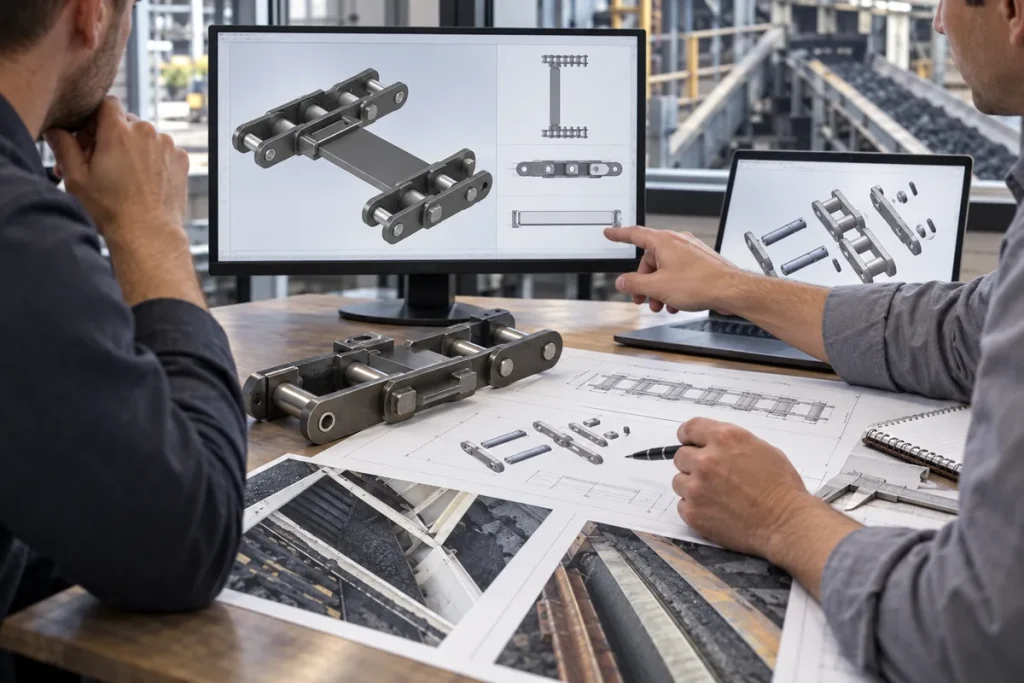
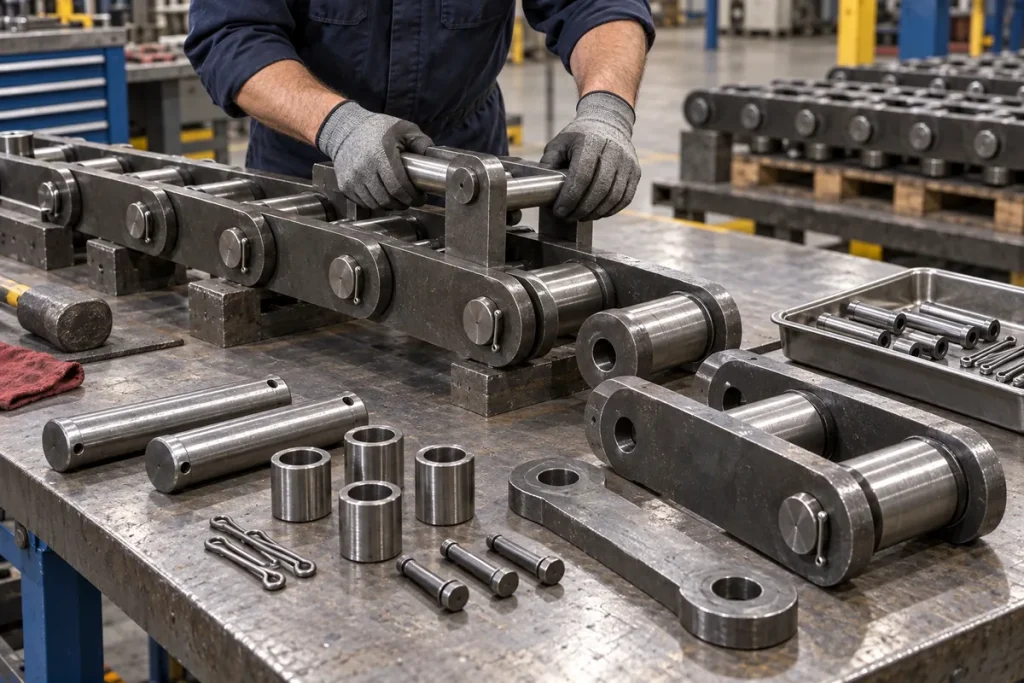
A replacement chain is assembled from parts that control articulation, force transfer, attachment, and retention. Photograph the outer and inner link areas, visible bush and pin geometry, extended pins, T-pins or spring pins, scraper/flight connections, and any special attachment link. Those features can identify a chain when broad dimensions overlap.
Component names should not be treated as a promise that every part is sold separately, and a visually similar pin should not be assumed interchangeable. The component tree is used here as configuration evidence. If the installed chain contains a joint or attachment that the candidate model does not document, preserve that discrepancy and route it for engineering review.
Pitch match
Evidence that the repeating joint spacing is consistent with a candidate chain.
Configuration match
Agreement across pitch, repeating unit, width, flight arrangement, and component structure.
Interface match
Agreement with sprocket engagement, clearances, attachments, take-up, and surrounding machine geometry.
Confirmed identification
A model assignment supported by the controlled evidence rather than by one convenient dimension.
6. Check the Sprocket and Machine Interface
Pitch relates directly to sprocket engagement, but correct engagement also depends on more than pitch. Sprocket tooth form and condition, chain seating, side clearances, shaft and track alignment, take-up arrangement, and attachment clearance can all influence whether a replacement assembly runs correctly. These are machine-level checks, not values that can be safely inferred from a product web page.
During a replacement survey, record the sprocket condition and any unusual wear pattern instead of photographing only the chain. If the old chain has been running with abnormal side contact or repeated adjustment, a new chain should not be expected to solve an unresolved machine issue automatically. The RFQ can identify the chain while the maintenance plan addresses the surrounding system.
7. Build a Hierarchy of Evidence for Unknown Chains
When there is no reliable part number, use a hierarchy rather than a single dimension. Start with application and machine context. Then record pitch, repeating unit length, flight spacing, scraper width, chain-section construction, joint and attachment details, markings, and drawings. Use photographs to link each measured value to its physical reference points. If the chain has been repaired, note which features may be non-original.
A model should be considered confirmed only when the controlled evidence supports it. If two candidates remain plausible, do not select the closer name from a catalogue. State the unresolved variables and request the additional measurement, drawing, or sample that will separate them. This keeps the enquiry moving without turning uncertainty into an unsupported compatibility claim.
8. Know When the Correct Answer Is “Custom or Unconfirmed”
Industrial machines often outlive drawings, change ownership, receive field repairs, or contain replacement parts from several supply cycles. An installed feeder breaker chain may therefore be close to a known configuration without being identical. That situation should not be treated as a failure of the identification process. “Unconfirmed pending drawing review” is a valid engineering status.
For a custom or uncertain chain, the RFQ should focus on the physical and functional interfaces that must be reproduced: pitch, repeating pattern, width, attachment geometry, pin and link details, machine clearances, sprocket relationship, and any customer-controlled material or inspection requirements. Unknown values stay open until they are supported.
Use this handoff checklist to close the field record for Why Pitch Alone Cannot Identify a Replacement Feeder Breaker Chain. The goal is not to create another generic maintenance form. It is to preserve the specific observations, reference points and machine context that the next reviewer needs in order to understand how the result was obtained. Keep machine-specific acceptance limits under the approved drawing, maintenance procedure or engineering instruction rather than inventing a universal web value.
Checkpoint
What to record
How the record is used
Understand What Pitch Describes – and What It Does Not
Record the exact machine location, strand or side, current operating/shutdown state, and the observation that relates to understand what pitch describes – and what it does not. Include a photograph that lets another reviewer find the same area.
Establishes the context so later measurements are not detached from the machine and chain position.
Use K201B and K207B as a Real Identification Example
Capture the physical reference used for use k201b and k207b as a real identification example. Keep the raw dimension, image or marking beside the interpretation, and note any wear, repair, build-up or access limitation that could affect the reading.
Makes the result repeatable and prevents a damaged or poorly defined reference from becoming the replacement requirement.
Add Repeating Unit Length and Flight Spacing
Cross-check add repeating unit length and flight spacing against any controlled drawing, previous purchase reference or retained spare that is available. Keep current field data and historical information in separate fields when they differ.
Preserves traceability when field condition, historical records and nominal product information do not agree perfectly.
Treat Scraper Width as Configuration Evidence, Not a Machine-Width Guess
For treat scraper width as configuration evidence, not a machine-width guess, state what is confirmed, what is only observed, and what still needs engineering confirmation. Attach the image or measurement that supports the statement rather than relying on a product name alone.
Gives maintenance, purchasing and the supplier a clear list of what can be acted on now and what must be resolved before release.
Separate as-found condition from required replacement geometry. A worn, repaired, dirty or partially dismantled component may still be very useful for identification, but its current shape is not automatically the manufacturing requirement. Label field measurements as observed data, retain the original unit and measurement method, and identify any feature that may have been altered by service. For pitch alone feeder breaker chain identification, photographs should show the measurement endpoints or component relationship clearly enough that a remote reviewer can reproduce the logic.
Resolve conflicting information instead of hiding it. If a drawing, old order, marking and current measurement point in different directions, keep each source visible and describe the conflict. Do not average values or silently choose the most convenient one. Use additional photographs, measurements from another intact repeating unit, machine interface information and the controlled document revision to determine which value governs. If know when the correct answer is “custom or unconfirmed” cannot be confirmed during the shutdown, state that limitation explicitly so the open question survives the handoff.
Make the next action obvious for Why Pitch Alone Cannot Identify a Replacement Feeder Breaker Chain. The completed record should tell maintenance what should be rechecked, tell purchasing what information belongs in the RFQ, and tell engineering which dimensions or interfaces still need approval. Before the machine returns to service, confirm that the file set includes an overall machine view, a complete repeating chain/flight view, close-ups of relevant components or markings, and the dimensions used in this guide. For pitch alone feeder breaker chain identification, a traceable set of observations is more useful than a long narrative with no datum, and it reduces the risk that a replacement decision is made from pitch, appearance or an old part number alone.
Questions to Resolve Before the Next Decision
If pitch matches exactly, why can the chain still be wrong?
Because pitch controls only one repeating distance. Width, flight spacing, link construction, joint details, attachment geometry, and machine interface can differ while pitch stays the same.
Are K201B and K207B interchangeable because both are 3.5 inch pitch?
This site does not claim interchangeability. Their documented scraper widths and component structures differ, so a full configuration and machine-interface review is required.
What is the next measurement after pitch?
There is no single universal second measurement, but repeating unit length, scraper width, flight spacing, and component/attachment geometry are normally high-value evidence for this product family.
What if the chain is close to a known model but one feature differs?
Preserve the difference and mark the model unconfirmed. Recheck the measurement and then use drawings, additional photographs, purchase history, or a removed sample to resolve the discrepancy.
Next Step: Close the Technical Record
Pitch belongs at the beginning of feeder breaker chain identification, not at the end. It quickly narrows the possible family, but it does not describe the complete assembly that must fit the machine.
A defensible replacement decision combines pitch with the repeating unit, scraper width, flight arrangement, component structure, sprocket and machine context, and controlled documentation. K201B and K207B make the principle concrete: two documented feeder breaker chains can share nominal pitch and unit length while remaining distinct configurations.