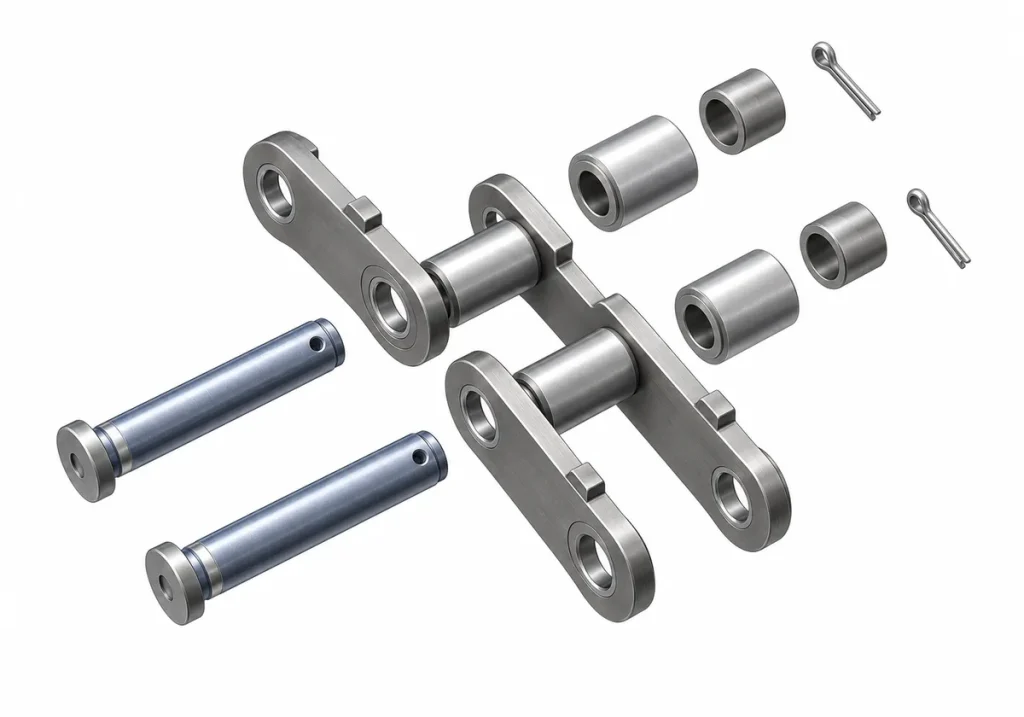
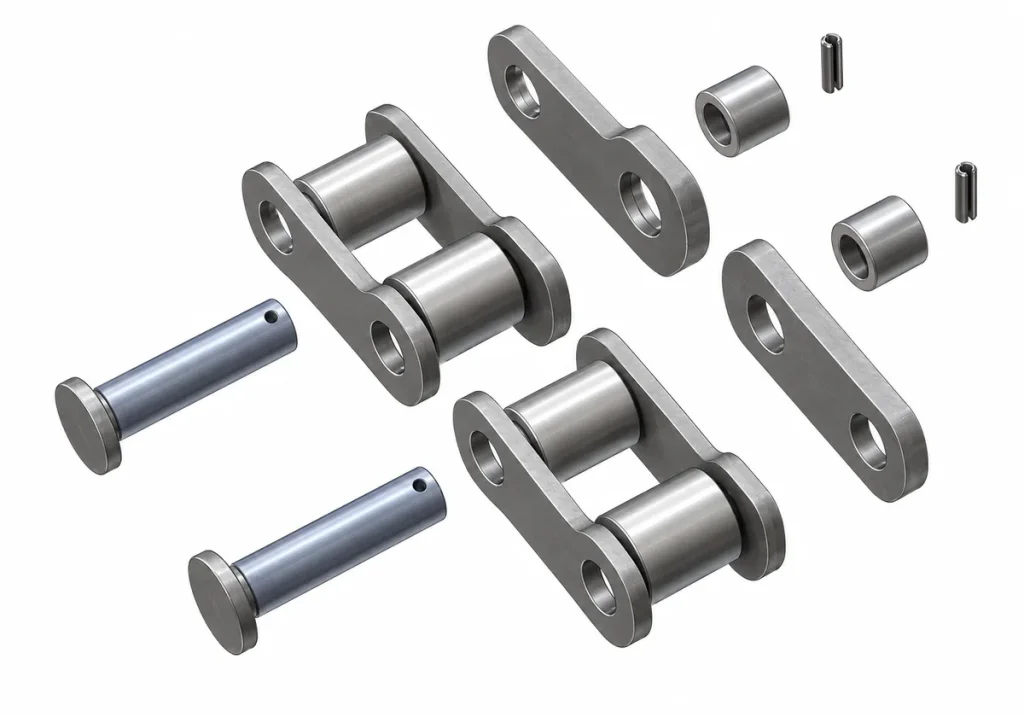
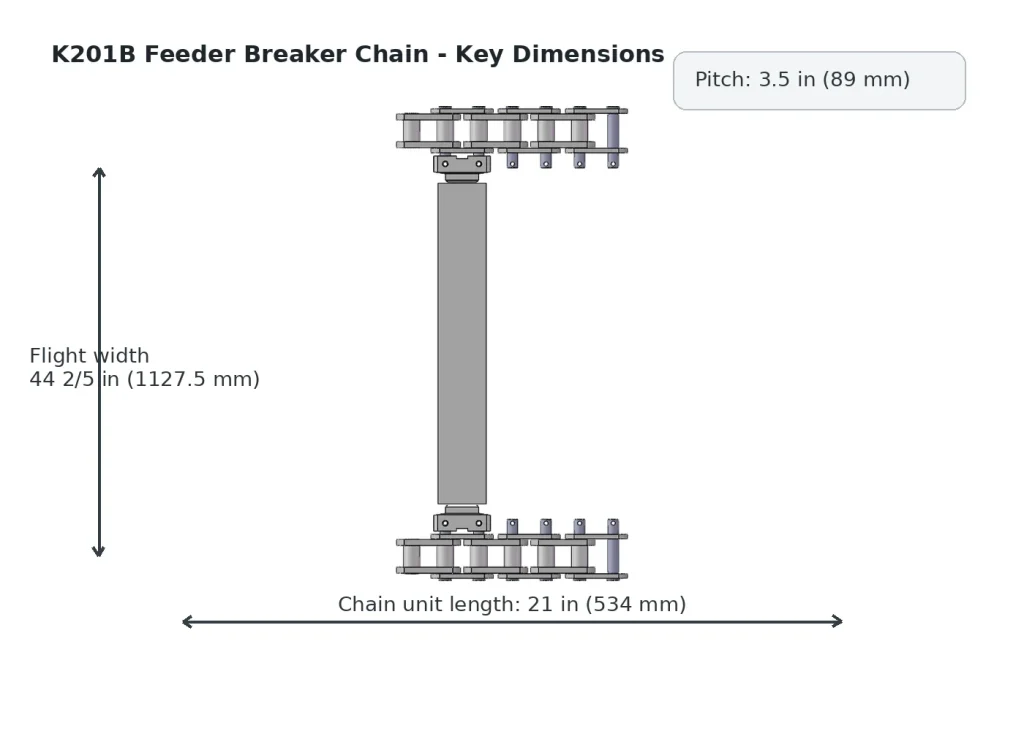
Document feeder breaker chain unit length by defining one repeating assembly, visible endpoints, flight/chain-section pattern, photos, and drawing.
Engineering GuideUpdated செப்டம்பர் 16, 2026
“Unit length” sounds simple until two people measure different parts of the same chain and both report a value with confidence. One technician may measure from flight center to flight center, another may span the outside ends of attachment pins, and a third may use a convenient plate edge. Unless the repeating assembly and endpoints are defined, those values cannot be compared reliably.
For the listed K201B and K207B feeder breaker scraper chains, the technical data describes the chain unit as one Flight Section and two Chain Sections and lists a nominal 21 inch unit length for both models. The metric values are recorded as 534 mm for K201B and 533.4 mm for K207B. Those technically specified values should be preserved rather than silently reconciled. More importantly, the assembly description shows that “unit length” belongs to a repeating configuration, not merely to any 21 inch portion of chain.
This guide explains how to create a field unit-length record for replacement or engineering review. It does not tell a technician how to enter an unsafe machine or move a chain under stored energy. Positioning, isolation, and access must follow the feeder breaker manufacturer’s procedure and the site’s maintenance controls.
Find the repeat
Identify the sequence of chain sections and flight sections that returns to the same structural condition.
Define start and finish
Use equivalent physical features at each end and photograph both within the same evidence set.
Keep pattern with number
Write the measured span together with the assembly description so the dimension cannot be reused out of context.
1. Identify the Repeating Structural Pattern First
Before putting a tape on the chain, trace the assembly until the structural sequence repeats. In a feeder breaker scraper chain, the repeating unit may include ordinary chain sections, attachment links, and a flight or scraper assembly. Mark one reference flight and follow the chain to the next equivalent point in the pattern. If the pattern alternates between two flight styles, the true repeat may be longer than one flight spacing.
For K201B and K207B, the documented unit description is one Flight Section plus two Chain Sections. That description should remain attached to the unit-length value in the RFQ. If the installed chain shows a different number of chain sections between flights, do not force it into the documented pattern simply because the total length appears close.
2. Choose Equivalent Endpoints on the Repeating Units
Unit length requires two equivalent start and end references. Depending on the controlled drawing, that might be corresponding joint centers, corresponding pin features, or another defined datum associated with the repeat. The critical rule is symmetry: the start and finish must represent the same point in successive units. A measurement from one pin center to a scraper edge is not a unit length unless the drawing explicitly defines it that way.
Take a wide photograph that contains both endpoints and a close photograph of each reference feature. If the span is too long for one readable image, use a labelled sequence and include an orientation mark that ties the images together. The written record should use the same endpoint names as the annotated photo or drawing.
3. Measure More Than One Repeating Unit When the Chain Condition Is Uncertain
If access allows, measure the same unit in several locations or span multiple repeating units and record both the total and the count. This reveals whether the assembly spacing is consistent around the chain and reduces the risk that one bent or repaired flight becomes the replacement master. Keep each raw measurement; do not average immediately.
Variation can have several explanations: worn articulation, a local repair, a field-modified flight, mixed chain sections, different tension state, or inconsistent endpoint choice. The measurement log should help engineering distinguish those possibilities. If the pattern itself changes around the loop, that is a configuration finding that deserves separate investigation.
Explains why one field value may not equal nominal design data.
Record rule
Keep unit length attached to the repeating-unit description. A bare number without the pattern can be misapplied to a different chain arrangement.
4. Preserve the technical data Unit and the Converted Unit Separately
Many mining maintenance records mix imperial drawings with metric field tools. That is manageable when the original value is preserved. Record “21.000 in observed” or “533.5 mm observed,” then show the conversion in a separate field if required. Do not repeatedly convert and round the same value through email, spreadsheet, quotation, and drawing revisions.
The K201B/K207B data are a useful reason for discipline. Both models are labelled 21 inches, yet their documented metric values differ: 534 mm for K201B and 533.4 mm for K207B. The correct publication practice is to preserve each model’s documented value. The correct field practice is the same: preserve what was actually read and state the conversion method when one is used.
சங்கிலி அலகு
The repeating structural assembly used as the basis of the recorded unit length.
Equivalent endpoints
Matching physical datums at the start and end of successive repeats.
Raw span
The original measured distance before conversion, division, or rounding.
Configuration conflict
A difference between the installed assembly and the drawing or candidate model that remains open until evidence is reconciled.
5. Record the Flight Relationship at the Same Time
A unit-length number gains identification power when the reviewer can see what occupies the unit. Photograph the flight section, the two neighboring chain sections, the attachment link or extended pin arrangement, and the next repeating flight. Record whether the scraper or flight is centered, offset, or visibly modified. These details show whether the measured repeat corresponds with the candidate chain structure.
For K201B, the documented secondary components include Chain Section K201B01 and Flight Section K201B04. For K207B, the documented structure includes Chain Section K207B01, Scraper Outer Link K207B04, and Flight Section K207B05. Those component identities are not needed to take the measurement, but they are useful during the later evidence comparison.
6. Compare Unit Length with Pitch and Width, Not in Isolation
A 21 inch unit length does not prove K201B or K207B any more than 3.5 inch pitch does. Both models share those broad nominal dimensions. K201B is documented with a 44 2/5 inch scraper width, while K207B is documented at 46 inches, and the component trees contain different details. Identification becomes stronger when all these independent observations agree.
Create a simple comparison matrix for the RFQ: pitch, unit length, unit composition, scraper width, flight spacing, component clues, marking, and drawing reference. Mark each field “matches,” “differs,” or “not yet verified.” This makes uncertainty visible and helps the reviewer request the one missing measurement that will actually resolve the chain identity.
7. Handle a Field Measurement That Conflicts with an Old Drawing
Do not erase the conflict. Record the drawing value with its revision and record the current field value with date, location, endpoint definition, and photos. Then check whether the drawing is the correct machine revision, whether the field chain has been repaired or replaced previously, whether the endpoints are equivalent, and whether wear or chain posture can explain the difference.
If the evidence cannot be reconciled, route the chain as a custom or unconfirmed configuration. A replacement can still be quoted from controlled dimensions and an approved drawing review, but the website should not convert the closest standard model into an automatic substitute. Preserving disagreement is part of good engineering control.
8. Make the Unit-Length Record Reusable for the Next Shutdown
Store the final measurement sheet with the approved drawing or quotation reference, not only in a technician’s phone. Include one overview photo, one annotated unit-length photo, one flight-connection photo, and the raw measurement table. When a repeat order or future inspection begins, the maintenance team can return to the same physical references instead of reinventing the method.
A reusable record also helps diagnose change. If the same endpoints are measured at a later date, the comparison has meaning because the location and method are controlled. That does not create a universal wear criterion, but it creates a site-specific trend that can be reviewed against the machine and chain manufacturer’s requirements.
Use this handoff checklist to close the field record for How to Document Feeder Breaker Chain Unit Length. The goal is not to create another generic maintenance form. It is to preserve the specific observations, reference points and machine context that the next reviewer needs in order to understand how the result was obtained. Keep machine-specific acceptance limits under the approved drawing, maintenance procedure or engineering instruction rather than inventing a universal web value.
Checkpoint
What to record
How the record is used
Identify the Repeating Structural Pattern First
Record the exact machine location, strand or side, current operating/shutdown state, and the observation that relates to identify the repeating structural pattern first. Include a photograph that lets another reviewer find the same area.
Establishes the context so later measurements are not detached from the machine and chain position.
Choose Equivalent Endpoints on the Repeating Units
Capture the physical reference used for choose equivalent endpoints on the repeating units. Keep the raw dimension, image or marking beside the interpretation, and note any wear, repair, build-up or access limitation that could affect the reading.
Makes the result repeatable and prevents a damaged or poorly defined reference from becoming the replacement requirement.
Measure More Than One Repeating Unit When the Chain Condition Is Uncertain
Cross-check measure more than one repeating unit when the chain condition is uncertain against any controlled drawing, previous purchase reference or retained spare that is available. Keep current field data and historical information in separate fields when they differ.
Preserves traceability when field condition, historical records and nominal product information do not agree perfectly.
Preserve the technical data Unit and the Converted Unit Separately
For preserve the technical data unit and the converted unit separately, state what is confirmed, what is only observed, and what still needs engineering confirmation. Attach the image or measurement that supports the statement rather than relying on a product name alone.
Gives maintenance, purchasing and the supplier a clear list of what can be acted on now and what must be resolved before release.
Separate as-found condition from required replacement geometry. A worn, repaired, dirty or partially dismantled component may still be very useful for identification, but its current shape is not automatically the manufacturing requirement. Label field measurements as observed data, retain the original unit and measurement method, and identify any feature that may have been altered by service. For feeder breaker chain unit length measurement, photographs should show the measurement endpoints or component relationship clearly enough that a remote reviewer can reproduce the logic.
Resolve conflicting information instead of hiding it. If a drawing, old order, marking and current measurement point in different directions, keep each source visible and describe the conflict. Do not average values or silently choose the most convenient one. Use additional photographs, measurements from another intact repeating unit, machine interface information and the controlled document revision to determine which value governs. If make the unit-length record reusable for the next shutdown cannot be confirmed during the shutdown, state that limitation explicitly so the open question survives the handoff.
Make the next action obvious for How to Document Feeder Breaker Chain Unit Length. The completed record should tell maintenance what should be rechecked, tell purchasing what information belongs in the RFQ, and tell engineering which dimensions or interfaces still need approval. Before the machine returns to service, confirm that the file set includes an overall machine view, a complete repeating chain/flight view, close-ups of relevant components or markings, and the dimensions used in this guide. For feeder breaker chain unit length measurement, a traceable set of observations is more useful than a long narrative with no datum, and it reduces the risk that a replacement decision is made from pitch, appearance or an old part number alone.
Questions to Resolve Before the Next Decision
Is unit length the same as flight spacing?
Not automatically. It depends on how the chain design defines its repeating assembly. Record both the structural repeat and the physical endpoints instead of assuming the two terms are interchangeable.
Why do K201B and K207B both say 21 inches but show different metric values?
The project preserves the documented values for each model: 534 mm for K201B and 533.4 mm for K207B. Do not silently reconcile technically specified values; compare the field measurement with the controlled model data used for the order.
Can I measure from scraper edge to scraper edge?
Only if those are the defined equivalent datums for the unit in the controlled drawing or identification method. A convenient edge-to-edge span is not automatically a chain unit length.
What if a repaired flight changes the repeating pattern?
Document the repair and measure another intact repeat if possible. If the chain contains mixed or modified units, preserve that fact and route the configuration for engineering review.
Next Step: Close the Measurement Record
A good unit-length record can be repeated by another person months later. It identifies the repeating assembly, defines equivalent endpoints, preserves the raw span and unit, and shows the flight-to-chain relationship in photographs.
Use that record together with pitch, scraper width, component structure, machine context, and drawings. If one dimension agrees with a known model but the repeating configuration does not, the correct next step is more evidence – not a forced model assignment.